
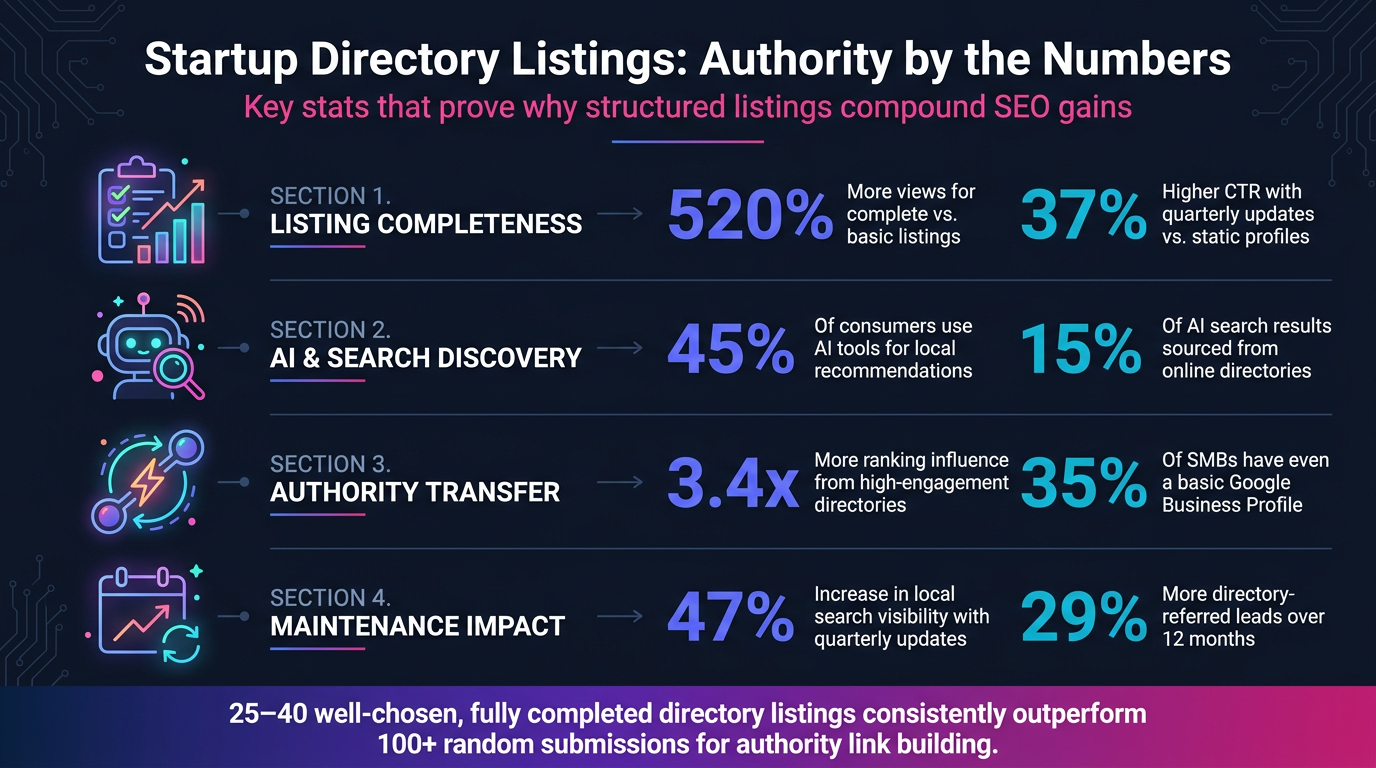
Here’s the bottom line: startup directory listing is one of the fastest, most cost-effective ways to build authority backlinks in 2026. Complete listings receive 520% more views than basic ones.[3] Businesses that update their listings quarterly see 37% higher click-through rates than those with static profiles.[4] And yet, most founders either skip directory submissions entirely or scatter submissions randomly — missing compounding SEO benefits that build over months.
This post teaches you a structured, three-tier framework for startup directory listing that builds authority links, drives referral traffic, and increases investor discoverability faster than almost any other early-stage tactic. Here’s what you’ll learn:
- Why directories still matter in 2026 — including for AI search and voice discovery
- The three-tier framework — authority hubs (DA 80+), high-intent niche directories, and community/launch platforms
- An 8-week submission workflow — so you stop wasting time on random submissions
- Maintenance routines — that compound your results quarter over quarter
- How to measure real authority link gains — with specific metrics and timelines
Whether you’re pre-launch or post-revenue, a structured approach to startup directory listing beats ad hoc submissions every time. Let’s break it down.
1. Why Startup Directory Listings Still Build Authority in 2026
1.1 How Search Engines and AI Discovery Use Directory Signals
Most founders think of directory listings as just “a backlink.” That’s like saying a recommendation letter is just a piece of paper. Directories actually serve three distinct purposes: authority link equity, referral traffic, and credibility signals.[3] Conflating these three into “just SEO” means you’ll underinvest in the ones that matter most for your stage.
Here’s what’s changed: 45% of consumers now use AI tools for local recommendations, and online directories account for 15% of AI search sourcing.[4] That means your directory listing isn’t just feeding Google’s algorithm — it’s feeding ChatGPT, Perplexity, and whatever AI assistant your potential investor or customer uses.
Not all directories carry equal weight. Directories with higher user engagement pass up to 3.4x more ranking influence than low-engagement directories.[3] A listing on a platform where people actually browse, filter, and engage with startup profiles transfers far more value than a forgotten page on a generic business directory.
Startup directories also differ fundamentally from generic business directories. They serve a specific ecosystem — investors, media, partners, fellow founders — which increases relevance signals for search engines. When Google sees your SaaS startup listed on a platform filled with other SaaS startups being browsed by investors, it understands context. That contextual relevance amplifies the link’s authority.
1.2 The Authority Transfer Effect: Why the Host Platform Matters
Think of directory listings like real estate. The neighborhood matters as much as the property itself.
Y Combinator’s directory lists over 5,000 companies on a domain with extreme authority. The combined portfolio valuation exceeds $1 trillion.[1] Being listed alongside vetted companies on a trusted domain transfers reputational value to your startup — both in the eyes of search engines and humans browsing those pages.
This is the authority transfer effect. When a high-DA platform links to you, some of that domain’s trust flows to your site. But it goes beyond raw link juice. Being found on a curated platform signals to investors and journalists that you’ve cleared some bar of legitimacy.
Here’s how the top startup directories compare:
| Platform | Domain Authority | Traffic Level | Primary Value |
|---|---|---|---|
| Hacker News | 92 | Very High | Community + referral traffic |
| Product Hunt | 88 | Very High | Launch visibility + link equity |
| G2 | 82 | High | Buyer intent + reviews |
| Crunchbase | 80 | High | Investor discoverability |
Source: The Startup Project[2]
The strongest directories provide genuine value to users first, with SEO benefit as a byproduct of trust and relevance.[1] Low-value generic directories that exist solely to sell backlinks? Search engines figured those out years ago.
Now that you understand why startup directory listings build authority, let’s look at which directories deserve your time — organized into a prioritized framework.
2. The Three-Tier Startup Directory Listing Framework
2.1 Tier 1: Authority Hubs (DA 80+)
Authority hubs are platforms with Domain Authority 80+ and high referral traffic that confer institutional credibility. These are your first priority because they offer the strongest link equity and widest visibility.
The platforms listed in the table above — Product Hunt, Hacker News, Crunchbase, G2 — all qualify.[2] So do curated lists like the Forbes Fintech 50, which continue to attract significant investor and buyer attention in 2026.[7]
Here’s what surprises most founders: only 35% of SMBs even have a Google Business Profile.[4] If that many businesses skip the most basic listing, imagine how few startups have complete profiles across all Tier 1 hubs. Comprehensive listing on authority hubs is still a real competitive edge — simply because most of your competitors haven’t done it.
Action step: Claim and fully complete your profiles on every DA 80+ platform relevant to your space before doing anything else. One polished Tier 1 listing beats ten sloppy Tier 3 submissions.
2.2 Tier 2: High-Intent Niche Directories
Niche directories are startup-specific platforms where investors, journalists, and partners actively search. Think StartupRanking, AngelList, and SaaSHub (DA 60).[2][6]
These directories matter because the traffic they send is qualified. Someone browsing a startup ranking site by category and country has investor or buyer intent. That’s fundamentally different from random organic traffic.
Platforms that organize startups by useful attributes — category, region, funding stage, metrics — increase discoverability for both humans and search crawlers.[1] The more structured your listing data, the easier it is for algorithms to surface you in relevant queries.
Key selection criteria for Tier 2 directories:
- Relevance to your vertical — a fintech directory matters if you’re in fintech; a general small business directory doesn’t
- Listing completeness options — can you add traction metrics, screenshots, team bios?
- Link policies — do-follow links pass more authority than no-follow, but no-follow links from high-traffic sites still drive referral visitors
- Active user base — a directory with engaged browsing behavior passes more value[3]
2.3 Tier 3: Community and Launch Platforms
Community platforms are places where visibility comes from engagement rather than a static listing. Reddit, Indie Hackers, and Beta List all fit this category.[2]
These platforms blend directory-style discovery with social proof and community endorsement. A well-received Reddit AMA or Indie Hackers milestone post can generate dozens of backlinks from people who share and reference your story.
Startup visibility is increasingly multi-channel: launch platforms, communities, and directories form a single distribution ecosystem.[2] Your Product Hunt launch gains traction when your community already knows you from Indie Hackers. Your Crunchbase profile gets more clicks when journalists have seen you active in relevant subreddits.
A word of caution: community platforms require genuine participation. Dropping links without context gets you downvoted, flagged, or banned. The authority signals come from authentic engagement — comments, helpful responses, shared learnings — not from link-dropping.
With the right directories identified, the next challenge is actually getting listed efficiently — without burning weeks on manual submissions.
3. A Step-by-Step Submission Workflow That Saves Time
3.1 Preparing Your Startup Profile for Maximum Listing Impact
Before submitting anywhere, prepare a master profile document. Every directory asks for slightly different information, but having everything in one place eliminates redundant work.
Your master profile should include:
- Company name (exact, consistent spelling everywhere)
- Primary URL
- Tagline (under 10 words)
- Short description (50-100 words) and long description (200-300 words)
- Category/vertical classification
- Founding date and location
- Team info (founders, key hires)
- Traction metrics (users, revenue, growth rate — whatever you’re comfortable sharing)
- Media assets: logo (multiple sizes), product screenshots, demo video link
Why does completeness matter so much? Complete listings can receive 520% more views than basic listings.[3][4] That’s not a 5% improvement — that’s a 5x multiplier for a few hours of extra work upfront.
NAP consistency (Name, Address, Phone/URL) across all directories matters too. Conflicting information creates confusing signals for search engines. If your company name is “Acme AI” on one directory and “Acme Artificial Intelligence Inc.” on another, you’re splitting your authority instead of compounding it.
Rich media makes a real difference in crowded directories. Startups with screenshots and demo videos stand out when an investor is scrolling through hundreds of listings in a category. Treat your directory profile like a mini landing page — it should communicate value in seconds.
3.2 A Phased Submission Timeline (8 Weeks)
Random, sporadic submissions don’t work. A phased approach gives you momentum while maintaining quality. Here’s the timeline:[2]
| Week | Focus | Activities |
|---|---|---|
| 1-2 | Foundation | Claim profiles on all Tier 1 authority hubs. Complete every field. Verify ownership where possible. |
| 3-4 | Niche Expansion | Submit to 10-15 high-intent startup directories with tailored descriptions per platform. |
| 5-6 | Community Engagement | Join communities, share building-in-public content, schedule soft launches on Beta List. |
| 7-8 | Major Launch Push | Coordinate Product Hunt launch, press outreach, cross-promote across all listings. |
| Ongoing | Maintenance | Quarterly audits, metric updates, review responses. |
Notice the progression. You start with the highest-impact platforms (Tier 1), expand to targeted niche directories, build community presence, then coordinate a visible launch. Each phase builds on the previous one.
The “ongoing” phase isn’t optional. It’s where compounding happens — and we’ll cover that in detail shortly.[3]
3.3 Handling Slow Approvals and Scaling Submissions
One of the biggest frustrations founders face with directory listings: slow approval processes. You submit a profile, wait two weeks, hear nothing. Meanwhile, your launch window passes and your SEO gains are delayed.
Strategies that actually help:
- Batch submissions — submit to 5-10 directories in a single session rather than one per day, so approvals trickle in steadily over the following weeks
- Prioritize predictable timelines — some directories clearly state approval times (24-48 hours). Hit those first for quick wins.
- Use faster-approval services — platforms like StartupRanking’s Faster Approval offer 24-hour listing for founders who can’t afford to wait weeks for SEO gains to begin
- Automate where possible — services that distribute your profile to 30-120+ directories simultaneously save dozens of hours of manual form-filling
One critical principle: prioritize quality and relevance over volume. Mass submission to irrelevant directories can actively harm your site. Search engines are sophisticated enough to recognize when a SaaS startup shows up in plumbing directories and pet care listings. Stick to platforms where your presence makes contextual sense.[3]
Now that your listings are live, the real work begins — keeping them fresh so their value compounds over time.
4. Maintaining Startup Directory Listings So They Keep Compounding Value
4.1 Quarterly Audit and Update Routine
Most founders treat directory listings as a one-time task. Submit, forget, move on. That’s leaving significant value on the table.
Consider this case study: a company that updated 15 key directories quarterly and responded to reviews within 24 hours saw a 47% increase in local search visibility and a 29% increase in directory-referred leads over 12 months.[3]
That’s not a minor improvement. Nearly half more visibility, almost a third more leads — just from regular maintenance.
Your quarterly checklist:
- Verify all URLs still work (products get renamed, pages get restructured)
- Update traction metrics (user count, revenue milestones, funding rounds)
- Refresh descriptions to reflect current positioning
- Add new screenshots showing latest product features
- Respond to any reviews or questions
- Check for duplicate or conflicting listings
Search engines reward freshness and engagement signals. A listing that was last updated two years ago sends a stale signal. A listing updated last month with current metrics signals an active, growing company. The data backs this up: quarterly updates correlate with 37% higher CTR.[4]
4.2 Future-Proofing for AI Search and Voice Discovery
AI search tools already source from directories 15% of the time, and that share is growing.[4] When someone asks an AI assistant “what are the best project management tools for startups,” the AI pulls from structured data sources — including directory listings.
To position yourself for AI discovery:
- Use consistent, schema-friendly information — same company name, same category terms, same founding date everywhere
- Write descriptions in natural language — AI tools prefer clear, factual statements over marketing jargon
- Include specific attributes — pricing tiers, integrations, use cases, team size — that AI can surface in response to specific queries
- Keep information current — AI tools increasingly weight recency when sourcing answers
Appearing in AI local recommendations is actually harder than ranking in traditional Google local results.[4] The startups that get featured are the ones with consistent, detailed, up-to-date information across multiple trusted sources. Your directory listings are part of that information ecosystem.
Treat every listing as content that could be surfaced by an AI assistant or voice search query. Because increasingly, it will be.
All this effort deserves measurement — so let’s look at exactly how to track whether your directory strategy is working.
5. Measuring Results: Tracking Authority Link Gains
You can’t improve what you don’t measure. But tracking directory listing results requires looking at the right metrics on the right timelines.
Key metrics to monitor:
| Metric | What It Tells You | How to Track |
|---|---|---|
| Referring domains | How many unique domains link to you | Ahrefs, Moz, or Semrush backlink reports |
| Domain Rating changes | Your overall site authority trend | Monthly DR/DA tracking |
| Referral traffic from directories | Actual visitors from listings | Google Analytics referral source report + UTM parameters |
| Branded search volume | Whether more people search your company name | Google Search Console queries report |
| Non-branded keyword rankings | Whether directory links improve topical authority | Rank tracking for target keywords |
Practical tracking tips:
- Where directories allow custom URLs, add UTM parameters (e.g.,
?utm_source=crunchbase&utm_medium=directory) to attribute traffic precisely - Monitor your backlink profile monthly — new referring domains from directories should appear within 2-4 weeks of approval
- Screenshot your Domain Rating on day one and compare monthly
Realistic timelines: Authority link gains from directories compound over 3-6 months, not overnight. If you’re expecting a ranking jump within a week of submission, you’ll be disappointed. The value builds gradually as search engines crawl, index, and attribute authority from your directory backlinks.
Here’s how it maps to the framework:
- Tier 1 hubs show the fastest impact — high-DA links get crawled frequently and pass authority quickly
- Tier 2 niche directories build relevance depth — they reinforce topical signals over time
- Tier 3 community platforms generate social signals — they complement direct link equity with engagement metrics
The combination of all three tiers creates a backlink profile that looks natural, diverse, and authoritative. That’s exactly what search engines want to see from a legitimate growing startup.
FAQs
What is a startup directory listing and how does it differ from a regular business listing?
A startup directory listing is a profile on a platform specifically designed for the startup ecosystem — investors, journalists, partners, and fellow founders. Unlike generic business directories (Yellow Pages, Yelp), startup directories organize companies by stage, category, funding status, and growth metrics. They attract people actively looking to discover, evaluate, or invest in emerging companies.[1]
Do startup directory backlinks still help SEO in 2026?
Yes — but quality matters far more than quantity. Directories with high user engagement pass up to 3.4x more ranking influence than low-engagement directories.[3] Additionally, 15% of AI search recommendations now source from directory data, making listings valuable beyond traditional Google rankings.[4] The key is choosing relevant, trusted directories and keeping listings updated.
How many startup directories should I submit to for maximum authority link value?
Focus on 5-7 Tier 1 authority hubs (DA 80+) first, then expand to 10-15 high-intent niche directories relevant to your vertical. Beyond that, add community platforms where you can genuinely participate.[2] Total, 25-40 well-chosen directories with complete profiles outperforms 100+ random submissions. Mass submissions to irrelevant directories can actually harm your SEO.[3]
What information should I include in my startup directory profile for the best results?
Include your consistent company name, primary URL, concise tagline, detailed description, category, founding date, team information, traction metrics, and high-quality media assets (logo, screenshots, demo video). Complete listings receive 520% more views than basic ones.[3] Ensure NAP consistency across all platforms to avoid sending conflicting signals to search engines.
How often should I update my startup directory listings to maintain SEO benefits?
Update your key directory listings quarterly at minimum. Businesses that update listings quarterly see 37% higher click-through rates than those with static profiles.[4] One company that updated 15 directories quarterly and responded to reviews within 24 hours achieved a 47% increase in search visibility over 12 months.[3] Set calendar reminders and treat updates as a recurring growth activity, not a one-time task.
Startup directory listing isn’t a one-time checkbox — it’s a sustained growth strategy that compounds over months. Start today by claiming your profiles on the highest-authority platforms, complete every field, and build outward systematically using the three-tier framework. If you want to accelerate the process, register your startup on StartupRanking for a free global ranking based on your SR Score — and explore tools like Booster and Faster Approval to skip the manual bottlenecks and start building authority links this week.
Leave a Reply