
Here’s the bottom line: dofollow links pass ranking power, but nofollow links are far from worthless. Since Google’s 2019 update, nofollow is treated as a “hint” — meaning it may still pass value, drive real traffic, and contribute to your startup’s authority.[1]
Most startup founders obsess over do follow vs no follow links while ignoring nofollow opportunities that send visitors, build brand awareness, and make their backlink profile look natural to Google. That’s a mistake — especially in 2025, when AI summaries are reducing organic click-through rates and diversifying your traffic sources matters more than ever.[2]
Here’s what you need to know:
-
Dofollow links pass link equity (PageRank) and signal editorial endorsement to Google.
-
Nofollow links are now “hints” — Google may still crawl, index, and credit them.
-
A healthy backlink profile requires both types. An all-dofollow profile can look manipulative.
-
Early-stage startups should build nofollow foundations first (directories, social, communities) before investing heavily in dofollow acquisition.
-
In 2025, referral traffic from nofollow links is strategically more valuable as AI search reduces organic clicks.
Quick Comparison
|
Attribute |
Do-Follow Links |
No-Follow Links |
|---|---|---|
|
SEO equity passed |
Yes |
Possible (treated as a hint) |
|
Risk if purchased |
High (penalty risk) |
Low |
|
Referral traffic value |
Equal |
Equal |
|
Typical startup sources |
Guest posts, editorial mentions |
Directories, social, forums, press |
|
Effort to acquire |
Medium–High |
Low–Medium |
|
Backlink profile naturalness |
Essential but not exclusive |
Essential for balance |
|
Best for |
Ranking authority |
Brand exposure, traffic, trust signals |
This post gives you a practical decision framework for understanding, earning, and managing both do follow and no follow links — whether you’re pre-seed or scaling. It also covers how StartupRanking’s services like Booster and Premium Profile help you build a healthy, diverse backlink profile from day one. Let’s break it down.
1. How Do-Follow and No-Follow Links Actually Work
1.1 What Each Link Type Signals to Google
Every link on the web is dofollow by default. There’s no special “dofollow” attribute you add to HTML. A plain link — <a href="https://example.com"> — tells Google: “I’m vouching for this page.” It passes link equity (also called PageRank), signals an editorial endorsement, and encourages Google to crawl the target URL.
Nofollow works differently. When a site adds rel="nofollow" to a link, it historically told Google: “Don’t pass equity here. Don’t follow this.” But since March 1, 2020, Google treats nofollow as a hint rather than a strict command. That means Google may still crawl the linked page and even credit some value from the link, depending on context.[1]
Here’s what the actual code looks like:
-
<a href="..." rel="nofollow">— general nofollow -
<a href="..." rel="sponsored">— paid or compensated links -
<a href="..." rel="ugc">— user-generated content (comments, forums) -
<a href="..." rel="sponsored nofollow">— combinations are valid too[6]
One thing founders often confuse: there’s a page-level nofollow meta tag (<meta name="robots" content="nofollow">) and a link-level nofollow attribute. The meta tag affects every link on the page. The link attribute affects only the specific link it’s applied to.[6] If you’re checking your own site’s links, make sure you know which one you’re looking at.
1.2 The 2019 Google Update: Sponsored, UGC, and Hint-Based Processing
In September 2019, Google made one of the most significant changes to how do follow vs no follow links work. They introduced two new link attributes — rel="sponsored" and rel="ugc" — and fundamentally shifted how all three nofollow-style attributes are processed.[1]
The breakdown is straightforward:
-
rel=”sponsored” — use this for any link that was paid for, part of an advertising deal, or involved compensation of any kind.
-
rel=”ugc” — use this for links within user-generated content like blog comments, forum replies, or community posts.
-
rel=”nofollow” — still valid as a catch-all when you don’t want to endorse a link and neither sponsored nor ugc applies.
The critical shift? All three attributes became hints, not directives. Google’s algorithms can now choose whether to use them for ranking, crawling, or indexing purposes.
“All the link attributes — sponsored, ugc, and nofollow — are treated as hints about which links to consider or exclude within Search.”
— Google Search Central Blog, Danny Sullivan and Gary Illyes[1]
What does this mean for you as a founder? A nofollow link from a high-authority site like TechCrunch or Product Hunt isn’t worthless. Google may still follow it, index your page through it, and factor it into trust signals. The old binary thinking — “dofollow = good, nofollow = useless” — is outdated.
1.3 How to Check Whether a Link Is Do-Follow or No-Follow
You can check any individual link manually. Right-click the link in your browser, select Inspect Element, and look at the <a> tag in the developer console. If you see rel="nofollow", rel="sponsored", or rel="ugc", the link is nofollowed in some form. No rel attribute (or a rel without those values)? It’s dofollow.
For checking links at scale, use backlink analysis tools. Semrush, Ahrefs, and Mangools all let you filter your entire backlink profile by follow vs. nofollow status.[4][7] Semrush’s Site Audit tool even flags specific issues like “Nofollow attributes in outgoing internal links” and “Nofollow attributes in outgoing external links” — both worth reviewing.[4]
Founder action item: audit your backlink profile at least quarterly. Understand your dofollow-to-nofollow ratio. You’re not trying to hit a magic number — you’re looking for a natural distribution that matches your industry and stage.
2. Why No-Follow Links Still Matter for Startup Growth
2.1 Referral Traffic, Brand Exposure, and Investor Discovery
A nofollow link on a high-traffic site still puts your startup in front of real people. Product Hunt, Reddit, Hacker News, and major press outlets — these platforms typically nofollow outbound links. But they send thousands of direct visitors to the startups they mention.
That traffic matters beyond just page views. Brand mentions from nofollow sources contribute to what SEO professionals call entity recognition — Google’s understanding of your brand as a real, notable thing in the world. When your startup name appears across multiple authoritative contexts, Google builds a stronger association between your brand and your niche, even if the links don’t pass traditional PageRank.
There’s also the investor angle. Many investors discover startups through startup directories and ranking platforms, press mentions, and social media profiles — all of which are predominantly nofollow. An investor browsing top-ranked startups by country isn’t checking whether the link to your site is dofollow. They’re checking your product, your traction, and your story.
This becomes even more important in 2025. Pew Research found that users who see AI-generated summaries in Google search results are less likely to click through to source websites.[2] If organic clicks are declining, diversifying your traffic through nofollow referral links from directories, press, and communities isn’t optional — it’s essential.
2.2 Natural Backlink Profiles Look Like a Mix
Here’s something many founders don’t realize: a backlink profile made up entirely of dofollow links looks suspicious to Google.[4] In the real world, any website that gets mentioned online will naturally accumulate a mix of follow and nofollow links. Social shares are nofollow. Forum mentions are nofollow. Many press outlets nofollow their outbound links. If your profile contains zero nofollow links, it signals that your links were likely built through manipulation rather than earned naturally.
Early-stage startups are especially vulnerable here. When you have a sparse link profile of, say, 20 total backlinks, each one carries outsized weight. If all 20 are dofollow from guest posts you pitched, that’s a red flag. Mix in directory listings, social profiles, and community mentions, and suddenly your profile looks organic.
Ahrefs studied the use of nofollow across the web and found that internal nofollow appeared on 35.3% of sites, but those links made up only 3.6% of all internal links.[7] The takeaway: most sites use nofollow sparingly and intentionally. The presence of nofollow in a profile is normal. The absence of it is not.
So stop dismissing nofollow links from directories, social media, forums, and press. Welcome them. They’re building the foundation of a profile that looks trustworthy to both Google and humans.
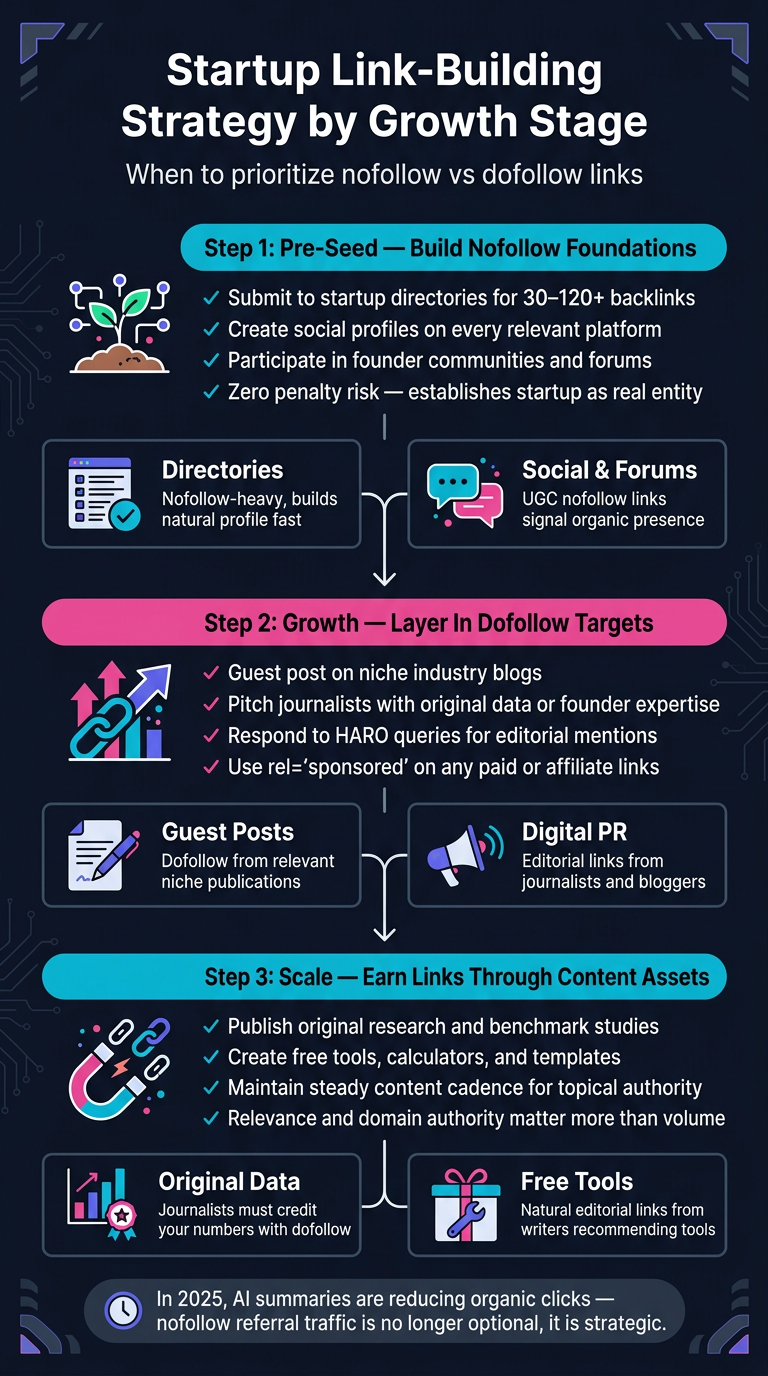
3. A Founder’s Decision Framework: Do Follow vs No Follow Links by Stage
3.1 Prioritizing Link Opportunities by Stage, Budget, and Risk
Your link-building strategy should match your startup’s stage. Chasing high-authority dofollow links when you’re pre-seed with no content and no brand recognition is like trying to run before you can walk.
Pre-seed / Seed stage: Focus on nofollow wins first. Submit your startup to directories like StartupRanking (the Booster plan gets you 30–120+ directory backlinks), create social profiles on every relevant platform, and participate in founder communities. These build foundational visibility with zero penalty risk. You’re establishing your startup as a real entity across the web.
Growth stage: Layer in dofollow targets. Guest post on niche blogs in your industry. Pitch journalists with original data or founder expertise. Respond to HARO queries. Earn editorial links by being genuinely useful to writers covering your space. At this stage, you have enough brand presence and content to make outreach credible.
Scale stage: Invest in content assets that attract dofollow links organically. Original research, free tools, benchmark studies, templates, calculators — these are the assets that journalists, bloggers, and other founders link to without you ever asking. This is the most sustainable and highest-ROI approach, but it requires the resources and authority you’ve built in earlier stages.
Risk calibration at every stage: Buying dofollow links violates Google’s guidelines and carries real penalty risk. Any sponsored, affiliate, or paid-for links must use rel="sponsored".[1][4] The penalty for getting this wrong can tank your rankings overnight — a setback most startups can’t afford.
3.2 Comparison Table: Do-Follow vs No-Follow for Startups
|
Attribute |
Do-Follow Links |
No-Follow Links |
|---|---|---|
|
SEO equity passed |
Yes — full link equity transfer |
Possible — Google treats as “hint” |
|
Risk of penalty if purchased |
High — violates Google guidelines |
Low — no equity expectation |
|
Referral traffic value |
Equal — depends on source traffic |
Equal — depends on source traffic |
|
Typical sources for startups |
Guest posts, editorial mentions, resource pages |
Directories, social media, forums, press releases |
|
Effort to acquire |
Medium–High (outreach, content creation) |
Low–Medium (submissions, participation) |
|
Impact on profile naturalness |
Essential but not exclusive |
Essential for balance |
|
Best for |
Ranking authority and domain strength |
Brand exposure, traffic, trust signals |
3.3 When Internal No-Follow Is a Mistake
Here’s a common founder error: nofollowing internal links to pages like your login screen, pricing page, or blog archive to “sculpt” PageRank toward your most important pages. The idea sounds logical — concentrate your link equity where it matters most.
The problem? Google no longer recommends this approach. When you nofollow an internal link, the link equity that would have flowed through it is simply lost. It doesn’t get redistributed to other links on the page. It evaporates.[1][4]
The Ahrefs benchmark data supports this: while 35.3% of sites they studied had some internal nofollow links, those links accounted for just 3.6% of all internal links.[7] The vast majority of sites keep internal nofollow usage minimal.
Legitimate use cases for internal nofollow do exist: links to private or staging URLs that shouldn’t be indexed, or links to dynamically generated search result pages that could create crawl traps. But your pricing page? Your blog categories? Your team page? Leave those dofollow.
Rule of thumb: if the page exists for users, let internal links to it remain dofollow.
4. Earning Do-Follow Links as a Startup: Practical Tactics
4.1 Content-Led Link Acquisition
The most sustainable dofollow links come from content that other people want to reference. Not content that’s “pretty good.” Content that contains something a journalist or blogger literally cannot get anywhere else.
Publish original data. Run a survey of your users. Share anonymized benchmark statistics from your product. Compile industry data into a report. When you’re the source of a number, people link to you — with dofollow links — because they have to credit the original.
Create free tools and resources. A simple calculator, a template, a checklist, a grading tool — anything that solves a specific problem in your niche. These attract natural editorial links because writers recommend tools their readers will find useful. The link serves the reader, which is exactly why Google values it.
Consistency matters here. A single blog post won’t build topical authority. You need a steady cadence of quality content that establishes your startup as an expert in its space. StartupRanking’s AutoRankr service automates SEO article creation to help founders maintain that rhythm without burning through their limited time — producing the kind of link-worthy content assets that compound over months.
4.2 Digital PR and Founder-Led Outreach
Generic guest post pitches (“I’d love to write for your blog!”) get ignored. What works is leading with something the publication can’t easily replicate: your unique expertise, your startup’s data, or a perspective that challenges conventional thinking.
Pitch niche publications — not just TechCrunch. A dofollow link from a well-respected blog in your specific industry vertical is often more valuable (in both relevance and traffic) than a nofollow mention on a massive generalist site.
Use credibility hooks to strengthen your pitches. If your startup has a strong SR Score on StartupRanking or ranks well in its country category, mention that. Third-party validation makes editors take you more seriously.
Monitor your competitors’ backlinks too. Identify the sites that link editorially in your space, then pitch them with better content or fresher data. If a competitor got a link from a niche blog by providing a quote for an article, you can pitch that same blog with an original data study on the topic.
“There is no such thing as ‘DOfollow.’”
— Nick Eubanks, quoted in Mangools[6]
That quote is a useful reminder: the default state of a link is already follow. You don’t need to “earn” a dofollow attribute — you need to earn the link itself from a site that doesn’t apply nofollow. Focus on being worth linking to.
One reality check: Search Engine Land’s 2025 survey of SEO professionals confirms that link building remains costly and complex.[5] Don’t spray outreach across hundreds of sites. Prioritize high-probability, high-relevance targets where you have a genuine angle.
4.3 Directory and Listing Strategy
Not all directories are equal. A listing on a curated, niche-relevant directory carries real value — both for the backlink and the referral traffic. A mass submission to 500 low-quality directories carries risk.
Prioritize directories that:
-
Are relevant to startups or your specific industry
-
Have editorial review or curation processes
-
Receive real traffic from your target audience (founders, investors, potential customers)
-
Are indexed by Google and have reasonable domain authority
StartupRanking’s Premium Profile provides dofollow links on ad-free, enhanced pages — giving you a quality dofollow backlink from a trusted startup platform while also improving how your startup appears to the investors and founders browsing the site. The Faster Approval option gets your listing live within 24 hours, which means you start building link age sooner — and link age is a factor in Google’s trust calculations.
For broader directory coverage, the Booster plan submits your startup to 30–120+ directories, building the kind of diverse, nofollow-heavy foundation that makes your backlink profile look natural and established. This is especially valuable for early-stage startups that need to go from zero web presence to credible entity fast.
5. Adapting Your Do Follow vs No Follow Links Strategy for 2025
5.1 Links in the Age of AI Search and Reduced Click-Through
The search landscape is shifting underneath every startup’s feet. Pew Research reported in March 2025 that Google users who encounter AI-generated summaries are significantly less likely to click through to the source websites those summaries draw from.[2] That means even if your page ranks well, you might see fewer organic visitors than you would have a year ago.
At the same time, Search Engine Journal reported in July 2025 that Google may increasingly rely less on links and more on content quality and user-behavior signals going forward.[3] Does that mean links don’t matter? No. But it means the exclusive focus on links as a ranking lever is outdated.
The practical implication for founders: treat nofollow links that drive referral traffic and brand awareness as strategically equal to low-authority dofollow links. A nofollow link from a Reddit thread that sends 500 visitors to your landing page is more valuable than a dofollow link from a DA-20 blog that nobody reads.
Despite all the changes, SEO professionals surveyed by Search Engine Land in 2025 still confirm that links matter for discovery and authority.[5] The consensus isn’t that links are dead — it’s that they’re one piece of a broader strategy that now includes entity recognition, content quality, and direct traffic sources.
5.2 Maintaining a Healthy Link Profile as You Scale
As your startup grows and accumulates more backlinks, you need a system to keep things clean. Here’s a quarterly audit cadence that works:
-
Check your dofollow/nofollow ratio. There’s no perfect ratio, but look for a natural distribution. If you’re 95% dofollow, something’s off.
-
Identify toxic links. Spammy sites linking to you can drag down your profile. Use Semrush or Ahrefs to spot them and disavow if necessary.
-
Verify rel attributes on your own outbound links. Make sure any sponsored, affiliate, or paid links on your site use
rel="sponsored". This protects you from penalties.[1] -
Compare against competitors. Use backlink tools to see where your competitors are earning dofollow links that you’re missing. Look for gaps in high-quality, relevant sources.
Stop obsessing over raw dofollow count. A startup with 50 highly relevant dofollow links from respected industry sites will outperform one with 500 dofollow links from random, low-quality blogs. Relevance and authority of the linking domain matter far more than sheer volume.
The same principle applies to nofollow links. A nofollow mention in a Forbes article or a popular subreddit carries real weight — in traffic, in brand recognition, and potentially in Google’s hint-based processing. Forbes, for example, uses nofollow for all external links as a policy — but a mention there still drives massive brand exposure.[4]
Build your link profile like you’d build your startup: with intention, patience, and a focus on quality over vanity metrics.
Conclusion and Key Takeaways
Let’s bring it all together. If you remember nothing else from this article, remember these five things:
-
Dofollow links pass ranking equity, but nofollow links aren’t worthless. Google treats nofollow as a hint and may still crawl, index, and credit value from these links.[1]
-
Use the correct rel attribute for paid links. The 2019 Google update introduced
rel="sponsored"andrel="ugc". Getting this wrong with paid or affiliate links can trigger penalties.[1] -
A natural backlink profile requires both link types. Early-stage startups should build nofollow foundations through directories, social media, and communities before investing heavily in dofollow acquisition.
-
Internal nofollow is almost never the right choice. Ahrefs data shows it makes up only 3.6% of all internal links across studied sites — and the equity you block simply disappears.[7]
-
As AI search reduces organic clicks, nofollow referral traffic becomes more valuable. Diversifying your traffic sources is no longer optional.[2]
The founders who win at SEO in 2025 aren’t the ones chasing dofollow links at all costs. They’re the ones building a diverse, natural web presence that drives traffic from multiple sources while establishing their startup as a credible entity in Google’s eyes.
Ready to start building that foundation? Register your startup on StartupRanking to establish your backlink base, earn dofollow links through Premium Profile, get listed across 30–120+ directories with Booster, and keep your content engine running with AutoRankr. Your future backlink profile will thank you.
FAQs
Are nofollow links worthless for startups, or do they still help SEO?
Nofollow links are far from worthless. Since Google’s 2019 update, nofollow is treated as a “hint,” meaning Google may still crawl, index, and even pass some value through these links.[1] Beyond potential ranking signals, nofollow links from high-traffic sites drive direct referral traffic, build brand awareness, and contribute to a natural-looking backlink profile. An all-dofollow profile can actually look suspicious to Google.[4]
How can I tell if a backlink to my startup is do-follow or no-follow?
For individual links, right-click the link in your browser, select “Inspect Element,” and look for a rel="nofollow", rel="sponsored", or rel="ugc" attribute in the <a> tag. If none of these appear, the link is dofollow by default. For bulk analysis, use tools like Semrush, Ahrefs, or Mangools, which let you filter your entire backlink profile by follow vs. nofollow status.[4][7]
Should I use rel=”sponsored” or rel=”nofollow” for paid partnerships on my startup blog?
Use rel="sponsored" for any link that involves payment, compensation, or advertising agreements. Google introduced this attribute specifically for paid links and recommends it over the generic nofollow for these situations.[1] You can also combine them (rel="sponsored nofollow") if you want to be extra explicit. The key is to never leave paid links as plain dofollow — that violates Google’s guidelines and risks a manual penalty.
Do backlinks still matter for startup SEO in 2025 with AI search?
Yes, backlinks still matter — but the landscape is evolving. While AI summaries are reducing organic click-through rates[2], SEO professionals surveyed in 2025 confirm that links remain important for discovery and authority.[5] The shift is toward a more balanced strategy where links work alongside content quality, brand signals, and diversified traffic sources rather than being the sole focus.
Is it bad to have more no-follow links than do-follow links in my backlink profile?
Not necessarily. Many legitimate startups have more nofollow links than dofollow, especially early on — social media profiles, directory listings, forum mentions, and press coverage are all predominantly nofollow. What matters is that your profile looks natural for your stage and industry. A healthy mix of both is the goal. An all-dofollow profile is actually more concerning to Google than one that skews nofollow, because it suggests link manipulation.[4][6]
Leave a Reply