
**Not all backlinks are created equal.** One relevant link from a respected site in your niche can do more for your rankings than 100 random links from low-quality directories. The key to startup SEO isn’t chasing every link you can get — it’s *measuring backlink quality* so you invest your limited time into opportunities that actually move the needle.Here’s what matters most when evaluating backlinks: **relevance first**, then authority and traffic, then placement and link attributes. Platforms like [StartupRanking](https://www.startupranking.com) help you start building that quality backlink profile from day one — but first, you need a framework for knowing what makes a link worth pursuing. Below, you’ll find a practical framework — built specifically for bootstrapped founders — that covers the 7 metrics that matter, stage-based benchmarks, a conflict resolution rubric for when metrics disagree, and a free tool stack that lets you evaluate any link opportunity without spending a dime on enterprise software.- **96.6%** of all content gets zero backlinks from external websites [7] — earning any link already puts you ahead- Pages with at least one backlink perform **10x better** in organic search than pages without [7]– The #1 result in Google averages **3.8x more backlinks** than positions 2–10 [7]– **93.8%** of link builders now prioritize quality over quantity [6]Google’s shift from quantity to quality — driven by the Penguin algorithm and reinforced by the March 2024 spam updates that target scaled content abuse and site reputation abuse [9] — means that low-quality link schemes don’t just fail to help; they can actively penalize your site. This article gives you a practical, metric-driven framework for measuring backlink quality, benchmarks tailored to your startup stage, and tools that don’t require enterprise budgets.## 1. The 7 Key Metrics for Measuring Backlink Quality### 1.1 Referring Domain Relevance (The #1 Priority)Relevance is the single most important factor in backlink quality. **84.6% of SEO professionals cite relevance as the most critical factor** when evaluating a link [6]. That’s not a coincidence — it’s how Google’s algorithms are built.What does “relevance” actually mean? It’s the *topical alignment* between the linking page’s content and your startup’s niche. A link from a SaaS blog to a SaaS startup carries significantly more weight than a link from an unrelated high-DR fitness site. The logic is straightforward: if a respected voice in your industry points to you, that endorsement is trustworthy. If a random site with no topical connection links to you, the signal is weak.A link from a *mildly* relevant page won’t hurt you — it just won’t help much. But a link with zero topical connection provides minimal value, regardless of how authoritative the linking domain is [2]. For startups trying to build authority from scratch, this distinction is everything: chasing irrelevant high-DR links wastes time you can’t afford to lose.### 1.2 Domain Authority (DR) and Page Authority (UR)Domain Rating (DR) and URL Rating (UR) serve as shorthand for domain-level and page-level authority [2]. DR tells you how strong the *entire website* is, while UR tells you how strong the *specific page* linking to you is. Both matter, but they should never be evaluated in isolation.The data is clear: **a 10-point increase in DR corresponds to an average of 27% more organic traffic** [7]. Websites with DR 50+ rank on average 2.7x faster for new content than those with DR below 30 [7]. That compounding effect means early link investments pay dividends across all future content.But authority without relevance is a trap. A DR 90 fitness site linking to your fintech startup is *less valuable* than a DR 40 finance site doing the same. The authority number looks impressive, but Google’s algorithms evaluate the topical context of the link. Always pair DR with the relevance check from Section 1.1.### 1.3 Referring Domain Organic TrafficOrganic traffic is a practical quality proxy that many competitors overlook. A site with strong organic traffic is actively validated by Google — it’s a *living signal*, unlike a static authority score that can be manipulated or outdated [4].Here’s a concrete threshold: **85.3% of guest posting sites are low quality**, defined as DR < 40 and < 10K monthly organic traffic [6]. If you’re evaluating a guest post opportunity and it falls below both of those benchmarks, you’re likely looking at a site that provides little to no SEO value. Use these numbers as your minimum bar.Why does traffic matter so much? A site that Google sends thousands of visitors to is trusted. A site with high DR but almost no organic traffic may have inherited that DR from a previous owner, bought links, or experienced a penalty. Checking traffic protects you from these edge cases [4].### 1.4 Anchor Text Distribution and NaturalnessAnchor text — the clickable words that form the link — signals topical context to Google. **Relevant anchor text helps Google understand what your page is about**, but over-optimization triggers penalties [1].The ideal anchor text profile includes a natural mix:- **Brand name anchors** (e.g., “StartupRanking” or “startupranking.com”) — these should make up the largest share- **Keyword-rich anchors** (e.g., “measuring backlink quality”) — useful in moderation, but dangerous when overused- **Generic phrases** (e.g., “click here”, “this guide”) — add naturalness to your profileA backlink profile heavy on exact-match keywords looks manipulative to Google. If 50%+ of your anchors are exact-match keywords, that’s a red flag. Aim for a distribution that looks like it was built naturally over time, not engineered overnight.### 1.5 Link Placement and Context**Editorially placed links within content (in-body) pass more value** than footer, sidebar, or author bio links [2]. Google’s algorithms can detect where a link sits on a page, and links that are woven naturally into the content signal genuine editorial endorsement.Links surrounded by relevant content also send stronger signals than links in isolated sections [1]. A link embedded in a paragraph discussing startup SEO — where your content provides a logical next step for the reader — is worth far more than a link crammed into a sidebar widget alongside dozens of other outbound links.When evaluating a link opportunity, look at where your link will actually appear on the page. If it’s buried in the footer or squeezed into an author bio with 15 other links, the value is significantly diluted.### 1.6 Link Attributes (Dofollow vs. Nofollow, Sponsored, UGC)Not all links pass authority equally. Here’s the breakdown [3]😐 Attribute | Authority Transfer | Primary Value ||—|—|—|| **Dofollow** | Full — passes link juice | Primary SEO value driver || **Nofollow** | Indirect — no direct authority transfer | Traffic, diversification, natural profile || **Sponsored** | Indirect — signals paid relationship | Compliance, some indirect SEO value || **UGC** | Indirect — signals user-generated content | Compliance, some indirect SEO value |Here’s the nuance most guides miss: **a nofollow link from a highly relevant, high-traffic site is still worth having**. It provides referral traffic, contributes to a natural-looking link profile, and may even be treated as a ranking hint by Google. Don’t automatically reject a nofollow link from a quality source — just don’t count it toward your dofollow authority targets.### 1.7 Link Juice Dilution: Number of Outgoing LinksA link from a page linking to hundreds of other URLs shares less authority per link than a page with few outgoing links [2]. This concept is called *link juice dilution*, and it’s one of the easiest metrics to check before pursuing a placement.Imagine a page with a DR 70 authority that links to 200 external websites. Your link gets 1/200th of that authority. Now imagine a DR 50 page that links to only 3 external sites — including yours. You get 1/3rd of that authority. The math makes the lower-DR, lower-dilution option far more valuable.The practical check: before pursuing or accepting a link placement, scroll through the linking page and count how many external links it contains. If you see a wall of outbound links, the authority passed by each one is minimal.With these seven metrics in hand, you can evaluate any link opportunity. But knowing the metrics in isolation isn’t enough — you need context for what “good” looks like at your specific stage of growth.
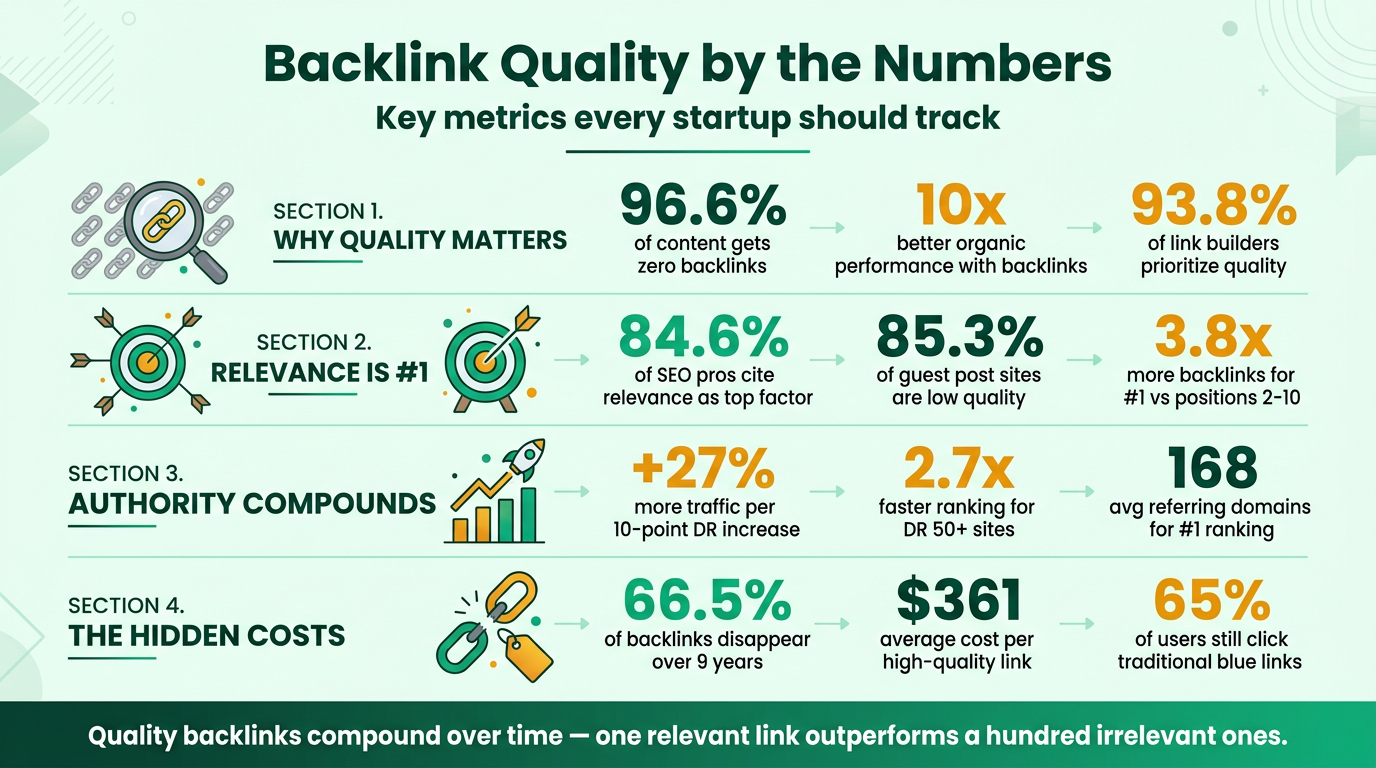
Backlink Quality Statistics for Startup Founders
## 2. The Startup Backlink Quality Scorecard### 2.1 Tiered Benchmarks by Startup StageWhat counts as a “good” backlink depends heavily on where your startup is in its journey. A bootstrapped founder doesn’t need the same link profile as a Series A company any more than a seedling needs the same water as a mature tree. Here are directional targets based on startup maturity:| Stage | Target DR | Additional Criteria | Target Referring Domains ||—|—|—|—|| **Pre-seed / Bootstrapped** | 20–40 | Topically relevant | 10–20 quality referring domains || **Seed / Early Growth** | 40–60 | Relevant + >5K monthly organic traffic | 35–50 referring domains || **Series A / Scaling** | 50+ | High traffic + editorial placement | 50–100+ referring domains |**Pre-seed / Bootstrapped**: This stage is about building foundational authority. Target DR 20–40 links that are topically relevant to your niche. 10–20 quality referring domains give you a base to grow from. Don’t waste time chasing DR 80 links — they’re unlikely to link to a brand-new startup anyway.**Seed / Early Growth**: Now you’re competing for visibility. Target DR 40–60 with relevance *and* traffic (at least 5K monthly organic visitors). Aim for 35–50 referring domains — that’s roughly the benchmark for position 10 in Google, which averages 35 referring domains [7].**Series A / Scaling**: You need authoritative, editorially placed links from high-traffic sites. Target DR 50+ and aim for 50–100+ referring domains. The #1 ranking position averages 168 referring domains [7], so this is your long-term target as you scale.These numbers are directional targets, not hard rules — niche competitiveness shifts them significantly. A fintech startup may need more links to compete than a niche SaaS tool in a less crowded vertical.### 2.2 The Conflict Resolution RubricReal link opportunities are messy. A site might have high DR but low traffic, or great relevance but a nofollow attribute. When metrics conflict, use this priority hierarchy:1. **Relevance always wins** — a relevant DR 30 link beats an irrelevant DR 70 link, hands down.2. **Traffic beats authority when they disagree** — a DR 35 site with 20K monthly visitors is worth more than a DR 60 site with 500 visitors. Traffic proves the site is real and trusted by Google.3. **Placement quality beats quantity** — one in-content editorial link outweighs three footer links from the same domain.4. **Dofollow is preferred, but a nofollow link from a high-traffic relevant source is always better than no link**.This rubric saves you from analysis paralysis. When you’re evaluating multiple opportunities and your head is spinning from conflicting DR scores and traffic numbers, simply run down this list and the decision becomes clear.### 2.3 Monthly Monitoring CadenceHere’s a sobering statistic: **66.5% of all backlinks from the past 9 years have disappeared** [7]. Links break, pages get deleted, sites go offline. If you’re not monitoring your backlink profile, you’re flying blind.For founders who don’t have time for daily monitoring, here’s a simple monthly checklist:- **Week 1**: Check for new referring domains in Google Search Console. Note any unexpected spikes or drops.- **Week 2**: Verify that your top 10 existing links are still live. Click through to confirm the linking page hasn’t been removed or the link hasn’t been changed to nofollow.- **Week 3**: Review your anchor text distribution. If you see exact-match keyword anchors climbing above 30–40% of your profile, that’s an over-optimization warning.- **Week 4**: Track your DR trend and organic traffic correlation on [StartupRanking](https://www.startupranking.com). Are your link-building efforts translating into traffic growth?This cadence takes roughly 30–60 minutes per week and catches problems before they compound. Now, let’s talk about the tools that make this monitoring possible without paying enterprise-level subscriptions.## 3. Measuring Backlink Quality Without Enterprise Tools### 3.1 The Free Tool Stack Every Startup Can UseYou don’t need an Ahrefs full subscription or a Semrush account to evaluate backlinks effectively. Here’s a practical stack for founders with a $0 budget:| Tool | Cost | Best For ||—|—|—|| **Google Search Console** | Free | Monitoring new links, referring domains, anchor text — the most reliable starting point for any founder || **Ahrefs Free Webmaster Tools** | Free tier | DR and UR data on referring domains, plus basic backlink reports || **Ubersuggest** | Free tier (with limits) | Competitive backlink analysis — see which domains link to competitors || **Manual checks** | Free | Reviewing linking pages for content quality, ad density, relevance, and link placement |Why bother learning to evaluate links manually? Because the financial stakes are real. **The average cost per high-quality link is $361** [7], and a quality guest post costs $692–$957 [6]. If you’re spending that kind of money, you need to know whether the opportunity is actually worth it. And if you’re doing outreach yourself, time is your most limited resource — knowing how to evaluate opportunities manually saves hours that you’d otherwise waste on low-value targets.### 3.2 Step-by-Step: Evaluating a Single Backlink Opportunity for FreeHere’s a concrete evaluation process you can follow the next time someone offers you a link, you find an outreach target, or you’re assessing whether a directory listing is worth your time:**Step 1: Open the linking page in your browser.** Assess content quality and relevance. Ask yourself: does the topic of this page match my startup’s niche? This is the Woorank checklist approach — if the topic doesn’t align with what you do, the link provides minimal SEO value [1].**Step 2: Check the site’s organic traffic estimates.** Use Ahrefs free site explorer or Ubersuggest. If the traffic is below 10K monthly visitors and the DR is under 40, you’re likely looking at a low-quality opportunity [6].**Step 3: Look at the site’s DR.** Use the Ahrefs free toolbar. Compare it against your stage-based benchmarks (see Section 2.1). A DR 20 link is perfectly fine for a pre-seed startup — it’s not worth pursuing if you’re already at Series A scale.**Step 4: Inspect link juice dilution.** Count how many external links the page contains. A page with 50+ outbound links is sharing authority thin — your link gets a tiny fraction of the page’s value.**Step 5: Verify the link attribute.** Right-click the link and use “Inspect Element” to check if it’s dofollow or nofollow. Dofollow is the goal, but don’t dismiss a relevant nofollow link from a high-traffic site.**Step 6: Check that the anchor text is natural and relevant.** If you have control over the anchor, aim for brand name or a variation of your target keyword — not an exact-match keyword every time.This six-step process takes about 5 minutes per opportunity. It’s not as fast as running an automated report, but it’s far more accurate for making smart decisions with limited resources. And if you’re doing outreach, remember that **personalized outreach achieves 15–25% response rates** compared to the 8.5% average [7]. Investing quality evaluation time into fewer, better-targeted opportunities pays off over spam-style volume outreach.Understanding how to measure quality is one thing — connecting it to your business goals is what turns SEO from a cost center into a growth driver.## 4. Connecting Backlink Quality to Startup Growth Metrics### 4.1 From DR to Revenue: The Business Impact ChainThe ultimate purpose of building quality backlinks isn’t to impress other SEOs — it’s to drive revenue. Here’s how the chain works:**Quality backlinks → Higher DR → 27% more organic traffic per 10 DR points** [7] → More qualified visitors → More demo requests and signups.And there’s a compounding effect: **websites with DR 50+ rank 2.7x faster for new content** than those with DR below 30 [7]. This means every quality link you build today doesn’t just help your current content — it accelerates the performance of every piece of content you publish in the future. Authority compounds.For founders, track this simple KPI dashboard month over month:- **Referring domains** (growth trend) — are you adding quality domains consistently?- **Organic traffic** (month-over-month) — is your authority translating into visibility?- **Organic signups/demo requests** — is that visibility turning into pipeline?If referring domains are growing but traffic isn’t, you may be building irrelevant or low-quality links. If traffic is growing but signups aren’t, your content or onboarding needs work. This dashboard connects SEO activity directly to business outcomes.### 4.2 How StartupRanking Helps You Build and Track Quality BacklinksThe strategies covered in this article — evaluating relevance, targeting the right DR, monitoring your link profile — take time. [StartupRanking](https://www.startupranking.com) gives founders structured, efficient ways to execute on these strategies without spending months on manual outreach:**Free Startup Profile**: Listing your startup on StartupRanking creates a page that can earn a backlink and starts building your SR Score at zero cost. It’s the baseline every founder should set up — it addresses the fundamentals of establishing authority without any budget.**Booster**: For founders struggling to gain initial traction and backlinks, Booster provides 30–120+ directory backlinks. This gives you a structured way to acquire diverse referring domains without individual outreach — directly addressing the time-consuming manual submission process that keeps founders from building links consistently.**Premium Profile**: Upgrades your listing to an enhanced, ad-free page with do-follow links. This directly addresses the link attribute and placement quality metrics covered in Section 1.6 — you’re getting dofollow authority from a relevant, startup-focused domain rather than a generic directory buried in nofollow links.**AutoRankr**: Generates automated SEO articles to create linkable assets on your profile. This is aligned with the strategy of building content that naturally attracts quality backlinks [2] — instead of chasing links, you’re creating content worth linking to, and StartupRanking automates the process.These aren’t shortcuts around quality evaluation — they’re efficiency layers for founders who want to execute the scorecard framework without spending months on manual outreach. Google is actively targeting spammy link practices [8], so building links through legitimate, relevant platforms matters more than ever.## Conclusion: Measure What Matters, Build What LastsThe framework is straightforward: **relevance first, then authority + traffic, then placement and attributes**. Use the scorecard to evaluate opportunities, the free tool stack to measure them, and the monthly cadence to maintain your progress.The data backs this up: **93.8% of link builders prioritize quality over quantity** [6]. A single quality link outperforms dozens of irrelevant ones. The average page ranking #1 has 168 referring domains [7], but those domains earned quality first, quantity second.And backlinks still matter — now and into the future. **65% of users still click traditional blue links** [6], and AI search still cites the top 10 results 75% of the time [6]. Building quality backlinks is investing in both traditional and AI-driven search visibility — the work you do today compounds regardless of how search evolves [10][11].Ready to start building? [Register your startup on StartupRanking](https://www.startupranking.com) to begin building your backlink profile, earn your SR Score, and track your authority growth over time.## FAQs
How do I measure backlink quality without paid SEO tools?
Use Google Search Console (free) to monitor new links and referring domains, Ahrefs Free Webmaster Tools for DR and UR data, and Ubersuggest’s free tier for competitive analysis. Manually check linking pages for relevance, content quality, and link placement. Follow the six-step evaluation process in Section 3.2 — it takes about 5 minutes per opportunity and requires zero budget.
What Domain Rating should my startup target for backlinks?
It depends on your stage. Pre-seed/bootstrapped startups should target DR 20–40 links that are topically relevant. Seed-stage startups should target DR 40–60 with relevance and traffic (>5K monthly organic visitors). Series A+ startups should target DR 50+ with editorial placement. Always prioritize relevance over raw DR — a relevant DR 30 link beats an irrelevant DR 70 link.
Is one high-quality backlink better than 100 low-quality ones?
Yes. 93.8% of link builders prioritize quality over quantity for a reason. Low-quality links from irrelevant, low-traffic, or spammy sites can trigger Google penalties and dilute your authority. A single relevant, high-traffic, editorially placed link passes more ranking value and compounds over time — especially when pages with backlinks perform 10x better in organic search than pages without.
How often should I audit my startup’s backlink profile?
Follow a monthly cadence: Week 1, check for new referring domains in Google Search Console. Week 2, verify that your top existing links are still live. Week 3, review anchor text distribution for over-optimization warnings. Week 4, track DR trend and organic traffic correlation. This takes 30–60 minutes per week and catches the fact that 66.5% of backlinks eventually disappear.
Are backlinks still important for SEO in 2025 and 2026?
Yes. Pages with at least one backlink perform 10x better in organic search, and the #1 result in Google averages 3.8x more backlinks than positions 2–10. Google’s March 2024 spam updates penalize low-quality link schemes, making quality backlinks even more important. Additionally, 65% of users still click traditional blue links, and AI search cites the top 10 results 75% of the time — so quality backlinks power both traditional and AI-driven visibility.
Leave a Reply