
Most founders calculate content marketing ROI wrong. They look at their $29/month WordPress hosting bill and think, “This is cheap.” They forget the 14 hours they spent writing two blog posts last month—time that could have gone into product development, sales calls, or investor meetings. That time has a price tag, and ignoring it makes content marketing look far cheaper than it actually is.
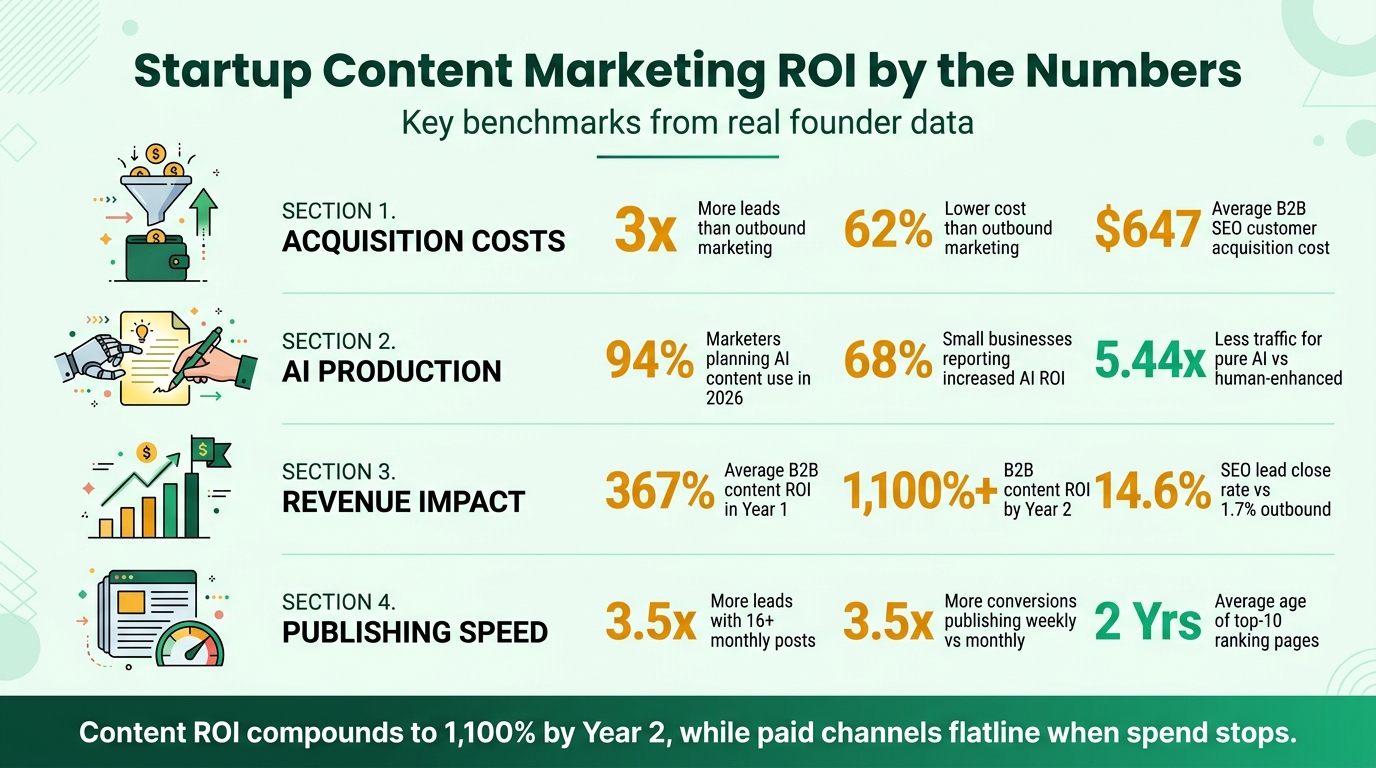
Here’s the reality: content marketing costs 62% less than outbound marketing while generating 3x as many leads—but only if you measure it correctly over a 12–18 month horizon, not the typical 90-day window where startups abandon their efforts[1]. And 56% of marketers say attributing ROI to content is a top challenge, which gets even harder for startups with limited traffic[9].
This post gives you a realistic, stage-aware framework for measuring content marketing ROI for your startup. You’ll learn:
-
The true cost of content across four execution models (DIY isn’t free)
-
A startup-adapted ROI formula that accounts for founder time and pre-revenue metrics
-
Realistic timeline expectations so you don’t kill campaigns too early
-
How to present content ROI to investors in language they understand
-
Why GEO tracking belongs in your measurement framework starting now
The True Cost of Startup Content Marketing: Four Execution Models
Before you can measure ROI, you need to know what you’re actually spending. Most founders track only direct costs—freelancer invoices, tool subscriptions, ad spend. They miss the biggest expense: time.
DIY, Freelancer, In-House, and AI-Assisted Cost Comparison
Startups typically produce content through one of four models. Each carries different direct costs, hidden costs, and timelines to reliable ROI signals. Here’s how they compare for a Seed to Series A company[1]:
|
Model |
Direct Cost/Month |
Hidden Cost/Month |
Output (Posts/Month) |
Time to ROI Signal |
|---|---|---|---|---|
|
DIY |
$0–500 |
$2,100+ (founder time) |
2–4 |
6–12 months |
|
Freelancer |
$1,000–3,000 |
$750–1,500 (coordination) |
4–8 |
4–8 months |
|
In-House |
$8,000–15,000 |
$0 (built-in) |
8–16 |
3–6 months (after ramp) |
|
AI-Assisted |
$45–500 |
$300–750 (review time) |
4–12 |
4–8 months |
The takeaway: the “cheapest” option on paper often costs the most when you factor in opportunity cost. And the most expensive option (in-house) reaches ROI signals fastest because of higher output volume and dedicated focus.
Why the “Free” DIY Option Often Costs the Most
Let’s do the math on DIY. If a founder’s time is worth $150/hour—conservative for someone capable of raising venture capital—and they spend 14 hours per month writing and editing four blog posts, that’s $2,100/month in opportunity cost[1]. Over a year, that’s $25,200 worth of founder time that could have gone to product, sales, or fundraising.
Compare that to hiring a quality B2B SaaS writer at $200–500 per post. Yes, it’s real cash out the door. But the founder gets those 14 hours back, and professional writers typically produce better content that ranks faster. The catch: traditional freelance platforms have a 70% project failure rate for meeting original objectives, so vetting is essential[1].
Then there’s the AI-assisted model. Platforms now cost $45–500/month for 4–12 posts, slashing per-piece production time from 2–3 hours to under 1 hour[1]. But here’s the critical nuance: pure AI content receives 5.44x less traffic than human-enhanced content[1]. AI is a starting point, not a finish line.
With 94% of marketers planning to use AI in content creation in 2026, AI-assisted production is becoming the practical baseline for lean teams[5]. The winning formula: AI for research and drafts, humans for expertise and polish.
Choosing your production model is step one. Step two is figuring out whether that investment actually pays off—which brings us to the math. For many startups, getting listed on a startup discovery platform is a low-effort first step to building the backlink profile that makes content ROI compound faster.
How to Calculate and Measure Content Marketing ROI
The ROI Formula Adapted for Startups
The standard formula is straightforward:
Content Marketing ROI = ((Revenue Attributed to Content – Total Content Costs) / Total Content Costs) × 100[3]
If you spend $5,000 on content and it generates $15,000 in attributed revenue, your ROI is 200%. Simple enough. But startups need two important adaptations:
First, include all internal costs in the denominator. Founder time at market rate, tool subscriptions ($29–$500/month), freelance coordination hours, and the opportunity cost of what else that time could have produced. If your denominator only includes freelancer invoices, you’re lying to yourself about efficiency[1].
Second, for pre-revenue startups, substitute pipeline value or qualified leads for revenue. If you’re not yet generating ARR, track the estimated value of leads that content brings in. A qualified lead that matches your ICP profile has real worth—assign a conservative dollar figure based on your expected conversion rate and average deal size. This lets you calculate ROI even before the first dollar hits your bank account.
Timeline Expectations and Milestone Metrics
Content marketing is a compounding asset, not a light switch. SEO typically takes 3–6 months to show initial results, with significant growth between 6–12 months. The average page ranking in Google’s top 10 is roughly 2 years old[1]. If you’re judging success at month three, you’re killing campaigns before they have a chance.
Here’s what realistic milestones look like:
-
Months 1–2: Pages get indexed, organic traffic is minimal or zero, and you’re questioning every life choice that led you here
-
Months 3–4: Long-tail rankings start improving, you might see the first attributed lead from search
-
Months 5–6: Consistent traffic arrives, initial ROI signals appear
-
Months 7–12+: Compound growth kicks in—150%+ increases are common as older posts accumulate backlinks and authority[1]
Volume matters too. Publishing 16+ posts per month drives 3.5x more leads than publishing 4 or fewer. Weekly publishing drives 3.5x more conversions than monthly publishing[1]. The compounding effect accelerates with consistent output.
And the cost comparison to paid channels is stark: organic CAC via content runs $500–$1,500, while paid CAC ranges from $802–$2,000. Better yet, organic CAC improves with scale as your content library grows, while paid CAC typically increases as you exhaust cheap audiences[1]. For B2B specifically, SEO delivers a CAC of $647 versus higher-cost channels, making it the highest-ROI digital marketing channel available[4].
Attribution for Low-Traffic Startup Websites
If your site gets fewer than 1,000 monthly visitors, forget multi-touch attribution. You don’t have enough data points for statistical reliability. Instead, use simple first-touch and last-touch tracking in a spreadsheet[1].
Tag every piece of content with UTM parameters. When a lead comes in, trace them back to the first content asset that brought them to your site. This gives you a direct, if imperfect, line between content investment and pipeline generation.
Here’s why this matters even with small numbers: SEO leads have a 14.6% close rate versus 1.7% for outbound leads[1]. Even three or four content-attributed leads per month carry disproportionate revenue potential compared to dozens of cold outreach responses.
Getting the math right is only half the equation. The other half is the content itself—quality determines whether your investment compounds or evaporates.
Content Quality Tiers and the AI+Human Hybrid Model
The Three Quality Tiers and Their ROI Impact
Not all content is created equal, and the quality gap shows up directly in ROI. Drawing from First Page Sage’s Content Quality Tier Framework, content falls into three buckets[2]:
|
Quality Tier |
Characteristics |
ROI Impact |
|---|---|---|
|
Low Quality |
Amateurish, unedited, no industry expertise, thin information |
Negative ROI; can harm brand perception and trust |
|
Standard Quality |
Grammatically correct but reads like a sales pitch; lacks depth |
Modest returns initially; fails to compound over time |
|
High Quality (Thought Leadership) |
Carefully edited, authoritative, includes custom graphics, data, case studies, and original insights |
Highest returns, averaging $984,000/year in new revenue |
Quality is the single variable that separates campaigns with no ROI from those that justify building an in-house team[2]. The good news for startups: small businesses are 23% more likely than average to see ROI from blog posts, meaning lean teams can reach high-quality tier by leveraging founder expertise and AI assistance[5].
“The variable of quality explains why some companies have had no success with content marketing and others have had so much that they’ve invested in building a complete content marketing team in-house.”
— Evan Bailyn, Founder of First Page Sage and Generative Engine Optimization Expert
Startup Content Marketing ROI Statistics for Founders
The AI-Assisted Human Content Framework
The path to thought-leadership quality on a startup budget runs through AI-assisted production. Here’s the framework: AI handles research, outlining, and draft generation; humans add expertise, original insights, and final polish[1].
The numbers back this up. 67% of small businesses now use AI for content marketing, and 68% report increased ROI from AI implementation[5]. But the critical guardrail remains: pure AI content gets 5.44x less traffic than human-enhanced content, so skipping the human review step destroys the ROI you’re trying to create[1].
AI-assisted platforms cost $45–500/month for 4–12 posts. This makes it the most cost-efficient model for resource-constrained startups aiming for thought-leadership quality—provided the founder or a subject-matter expert spends 30–60 minutes per piece adding original data, anecdotes, and strategic framing[1].
Once you’re producing high-quality content and measuring ROI with real numbers, the next step is communicating those results to the people who fund your company.
Presenting Content ROI to Investors and the GEO Opportunity
Investor-Ready Content ROI Metrics
Investors don’t care about pageviews. They care about unit economics, scalable acquisition, and capital efficiency. Translate your content metrics into their language:
-
Organic traffic growth → CAC efficiency. Show that your blended CAC is declining as content volume increases. Benchmark your organic CAC ($500–$1,500) against industry averages: B2B SaaS CAC sits at $273 and B2B fintech at $923[4]. If your content-driven CAC beats your industry average, that’s a fundraising narrative.
-
Content-attributed pipeline → scalable acquisition proof. Track what percentage of your pipeline comes from content. A growing share signals that acquisition can scale without proportionally growing spend.
-
Conversion rate → product-market-fit signal. If visitors from organic search convert at higher rates than other channels, it suggests your messaging resonates with people actively seeking solutions—a strong PMF indicator.
Frame content as a compounding asset. Year 1 ROI averages 367% across B2B verticals, scaling to 1,100%+ by Year 2[2]. That’s the opposite of paid channels, where spend stops producing results the moment you stop paying. Content from two years ago keeps generating leads at near-zero marginal cost.
“B2B content marketing generates an average 3:1 ROI, or $3 for every dollar invested; when executed with proper SEO strategies, returns can reach 748%.”
— Genesys Growth, Content Marketing ROI Statistics for Marketing Leaders[6]
Generative Engine Optimization: Measuring Content ROI Beyond Traditional Search
Google isn’t the only search engine that matters anymore. ChatGPT, Perplexity, Gemini, and Claude are becoming answer engines, and your content either shows up in their citations or it doesn’t. 24% of marketers are already updating their SEO strategy for generative AI search, and 92% plan to optimize for both traditional and AI-powered engines[5].
For startups, this is a measurement opportunity hiding in plain sight. Add GEO metrics to your ROI framework:
-
Track whether your content appears in ChatGPT and Perplexity responses using manual queries or emerging monitoring tools
-
Attribute downstream traffic and leads to AI citations when users click through from an AI-generated answer
-
Monitor brand mentions in LLM outputs—being cited as a source even without a click builds authority that converts later
-
Log referral traffic from AI-powered search results as a separate channel in your analytics
McKinsey notes that generative AI and agentic AI are already accelerating classic marketing approaches, meaning early GEO investment offers a first-mover compounding advantage[7]. No competitor is yet tracking this systematically—which means you can build a measurement advantage before the space gets crowded.
Getting listed on startup directories and ranking platforms feeds directly into this strategy. When your startup profile appears in curated lists and rankings, AI engines treat those citations as authority signals, increasing your chances of appearing in generated answers.
Key Takeaways
Measuring content marketing ROI for a startup isn’t complicated, but it requires honesty about costs and patience with timelines. Here’s what to remember:
-
DIY content is not free. Factor founder opportunity cost ($2,100+/month) into all ROI calculations. The “cheap” option is often the most expensive per unit of output[1].
-
Measure over 12–18 months, not 90 days. The average top-10 ranking page is roughly 2 years old. Killing campaigns at month three guarantees negative ROI[1].
-
Content quality is the deciding variable. Thought-leadership content generates $984,000/year in new revenue on average; low-quality content generates negative ROI[2]. Use the AI+human hybrid model to reach that tier on a startup budget.
-
Organic CAC ($500–$1,500) beats paid CAC ($802–$2,000) and improves with scale. Content + SEO is the highest-ROI channel available to startups[1][4].
-
Speak investor language. Present content metrics using CAC, LTV, and payback period—not vanity metrics like pageviews[4][1].
-
Add GEO tracking now. AI search citations are a new compounding traffic source that competitors aren’t measuring yet. Early measurement infrastructure creates a data advantage.
Building the backlink profile and organic signals that make content ROI compound starts with visibility. Register your startup on StartupRanking to get discovered, build authoritative backlinks, and generate the kind of organic momentum that makes every piece of content you publish work harder over time.
FAQs
How do you calculate content marketing ROI for a pre-revenue startup?
For pre-revenue startups, substitute pipeline value or qualified leads for revenue in the standard formula. Assign a conservative dollar figure to each qualified lead based on your expected conversion rate and average deal size. Use the formula: ((Pipeline Value Attributed to Content – Total Content Costs) / Total Content Costs) × 100. Include all internal costs—founder time, tool subscriptions, and coordination hours—not just freelancer invoices[3][1].
How long does it take for content marketing to show ROI?
Content marketing typically takes 3–6 months to show initial results, with significant growth between 6–12 months. The average page ranking in Google’s top 10 is roughly 2 years old. Realistic milestones: months 1–2 for indexing, months 3–4 for long-tail rankings and first attributed leads, months 5–6 for consistent traffic and initial ROI signals, and months 7–12+ for compound growth of 150%+[1]. Publishing 16+ posts per month accelerates this timeline significantly.
What is the true cost of DIY content marketing for founders?
DIY content marketing costs far more than the $0–500/month in direct expenses. At a conservative founder rate of $150/hour, spending 14 hours per month on content production equals $2,100/month in opportunity cost—or $25,200/year[1]. Additionally, founder-written content often underperforms professionally written content, extending the time to ROI. The AI-assisted model ($45–500/month plus 30–60 minutes of review per piece) offers a more cost-efficient alternative.
How should startups present content marketing ROI to investors?
Translate content metrics into investor language: frame organic traffic growth as CAC efficiency, content-attributed pipeline as proof of scalable acquisition, and conversion rates as product-market-fit signals. Benchmark your organic CAC ($500–$1,500) against industry averages like B2B SaaS CAC ($273) or B2B fintech CAC ($923)[4]. Highlight that content ROI compounds over time—Year 1 averages 367% across B2B verticals, scaling to 1,100%+ by Year 2[2]—unlike paid channels where returns stop when spending stops.
How does AI-assisted content production affect content marketing ROI?
AI-assisted production reduces per-piece creation time from 2–3 hours to under 1 hour and costs $45–500/month for 4–12 posts, making it the most cost-efficient model for startups[1]. 68% of small businesses using AI report increased ROI[5]. However, pure AI content receives 5.44x less traffic than human-enhanced content, so maintaining a human review step for expertise and original insights is essential for reaching thought-leadership quality that compounds over time[1].
Leave a Reply