
Organic search drives 33% of overall website traffic across key industries[1] — yet most startups quietly sabotage this channel with mistakes that are completely avoidable. Worse, AI Overviews now correlate with a 58% lower average clickthrough rate for top-ranking pages[4], which means the old assumptions about ranking don’t hold anymore. Every SEO mistake startups leave unfixed now costs more traffic than it did two years ago.
The good news: 91% of SEO practitioners report that SEO positively impacted their website performance and marketing goals in 2024.[1] Getting it right still pays off — significantly.
This post covers the 10 most common SEO mistakes startups make, grouped into five priority layers so you know exactly what to fix first:
-
Foundation — mistakes that block everything else (fix in Week 1)
-
Measurement — gaps that let bad decisions compound silently (fix in Month 1)
-
Content — strategy errors that burn time and budget (fix in Month 1)
-
Authority — why your domain rating stays stubbornly low (fix in Quarter 1)
-
AI-Search Readiness — the shift most startups are ignoring right now (fix in Quarter 1)
At the end, you’ll find a concrete fix-first framework — Week 1, Month 1, and Quarter 1 — so this doesn’t just become another article you bookmark and forget.
—
Section 1: Foundation SEO Mistakes That Block Every Other Effort
No content strategy or backlink campaign can save a broken foundation. These are your Week 1 fixes — the ones that make everything else actually work.
Mistake #1 — Publishing on Hosted Platforms Instead of Your Own Domain
Here’s the trap: you write a solid article, post it on Medium or LinkedIn Articles, it gets traction — and every single backlink pointing to that piece builds Medium’s domain authority, not yours.[2]
Every month you publish primarily on a hosted platform is a month of domain equity you’re giving away for free. The long-term compounding loss here is brutal, especially for startups trying to build authority from zero.
The right model: your owned domain is the source of record. Syndicate to Medium or Substack for distribution reach if you want, but always canonicalize back to your original URL so search engines credit your site.
Practical fix:
-
Migrate existing content to
yourstartup.com/blog -
Set canonical tags pointing back to your domain on any syndicated copies
-
Use Medium’s import tool for reach — never as your primary publishing home
Mistake #2 — Building a One-Page or Near-One-Page Website
A single-page site can only rank for a handful of keywords — full stop. No matter how good your copy is, you’ve hard-capped your organic traffic potential.[2]
One-page sites are acceptable when organic search isn’t central to your business model — think invite-only products or purely referral-driven tools. But if you want SEO to drive growth, you need pages.
High-maturity SEO organizations measure 3x more metrics than low-maturity ones[1] — and that level of measurement only becomes possible when there are multiple pages to evaluate and optimize.
Practical fix: build dedicated pages for each product feature, use case, target industry, and location (if relevant). Each page becomes an independent ranking asset, and they all compound over time.
Mistake #3 — Ignoring Core Technical SEO from Day One
Technical SEO isn’t glamorous, but skipping it is expensive. The most common omissions for early-stage startups: missing XML sitemaps, broken internal links, unoptimized page titles and meta descriptions, and poor mobile performance.
Here’s the compounding problem: technical errors suppress every other SEO investment. Backlinks underperform. Content underranks. Keyword targeting falls flat. You can pour money into content and links and still lose.
> One SaaS startup spent $30,000 on link building — then lost 60% of their traffic after a Google update because the technical foundation was never properly addressed.[3]
Practical fix: run a free crawl with Screaming Frog or Google Search Console’s Coverage report in your first week. Treat P1 technical errors — crawl blocks, broken redirects, missing sitemaps — as launch-blockers, not post-launch to-dos.
Once your foundation is solid, the next biggest silent killer is measurement — specifically, measuring the wrong things.
Section 2: Measurement SEO Mistakes Startups Commonly Overlook
You can’t fix what you can’t see. Measurement gaps let bad decisions compound for months before anyone notices the SEO strategy isn’t actually driving growth.
Mistake #4 — Tracking Traffic Volume Instead of Qualified Conversions
Raw session counts can look healthy while your actual signups, demo requests, and qualified leads from organic search sit near zero. This is the vanity metric trap — and it’s surprisingly common.
Traffic is an input. Conversions are the output. If you’re only watching one, you’re flying blind on the other.
Practical fix: configure conversion events in GA4 for the actions that actually matter to your business:[2]
-
Free trial starts or signups
-
Demo requests
-
Contact form submissions
-
Pricing page visits
Then segment organic traffic by landing page and map each page to a conversion goal. Pages with high traffic but zero conversions almost always reveal a keyword-intent mismatch — you’re ranking for queries your buyers aren’t actually searching.
This measurement discipline is a genuine competitive moat. High-SEO-maturity organizations report on 3x as many metrics as low-maturity teams.[1]
Mistake #5 — Targeting Keywords by Volume Alone, Ignoring Commercial Intent
Ranking #1 for a high-volume informational keyword sounds impressive. But if none of those visitors are buyers, you’ve wasted link equity and content budget on traffic that doesn’t convert.
Commercial-intent keywords — think “best project management tool for startups” or “Notion vs. Asana for remote teams” — convert at a far higher rate than generic informational queries, even at lower search volumes.[2]
The urgency here has grown sharply. Position-one CTR for informational keywords in AI Overview results dropped from 0.073 in December 2023 to 0.016 in December 2025.[4] Intent-light content is becoming an even weaker organic channel.
Practical fix: build your content roadmap around buyer-intent keyword modifiers:
| Modifier Type | Example | Intent Level ||—|—|—|| “best” | best CRM for startups | High || “vs” / “alternative” | HubSpot vs Pipedrive | High || “pricing” | Notion pricing 2026 | High || “for [use case]” | project management for remote teams | Medium-High || “how to” | how to set up a CRM | Low-Medium |
Once measurement is working and you’re targeting the right keywords, the next mistake is in how you produce the actual content.
Section 3: Content Mistakes That Waste Time and Budget
Content is the most time-intensive SEO investment for lean startup teams. Getting the strategy wrong doesn’t just hurt rankings — it burns runway you can’t afford to lose.
Mistake #6 — Producing Isolated Blog Posts Instead of Topical Clusters
Here’s something counterintuitive: a startup with 8 tightly connected posts on a defined topic will typically outrank a competitor with 20 loosely related articles. Google rewards topical authority, and scattered content signals shallow expertise.
The cluster model works like this:
-
Pillar page: covers a broad topic comprehensively (e.g., “The Complete Guide to Startup SEO”)
-
Cluster posts: target related long-tail queries and link back to the pillar
-
Internal links: connect the cluster, signaling depth and structure to search engines
Startups using content clusters have seen organic traffic surge by as much as 173% compared to isolated post strategies[3] — though it’s worth noting this is directional data from a vendor, not independently verified. The structural logic, however, is well-established.
Practical fix: audit your existing content. Group related posts together, add internal links between them, and use tools like Ahrefs or Semrush to identify gaps where you need new supporting pages. If you’re looking to build content authority faster, StartupRanking’s AutoRankr tool can help generate SEO-optimized articles at scale without draining your team’s time.
Mistake #7 — Writing for Search Engines Instead of the Reader Who Will Convert
Keyword stuffing is a 2010 problem, but its modern equivalent is alive and well: over-optimized headers, thin how-to posts answering generic queries no real buyer searches, and AI-generated content published without any editorial voice or unique perspective.
Google’s E-E-A-T signals — Experience, Expertise, Authoritativeness, and Trustworthiness — increasingly reward content that demonstrates firsthand knowledge. This is actually an area where startup founders have a real advantage, if they lean into it.
Over-reliance on AI writing tools without editorial oversight is one of the most commonly flagged SEO mistakes heading into 2025 and 2026.[6] The issue isn’t AI itself — it’s publishing AI output that reads like everyone else’s AI output.
Practical fix: every piece of content should answer one specific question for one specific reader persona. Add something that generic content can’t replicate — a unique data point, a founder perspective, a counterintuitive insight from your own experience building the product.
Strong content without strong backlinks still leaves you competing with one hand tied — which is where the next set of mistakes lives.
Section 4: Authority Mistakes That Keep Domain Ratings Low
Backlinks remain one of Google’s most important ranking factors.[2] Startups without a deliberate link-building strategy are effectively in a race where their competitors started months ahead.
Mistake #8 — Relying on Passive Backlink Acquisition with No Active Strategy
For established brands, waiting for backlinks to appear organically is a viable (if slow) strategy. For a new startup domain, it’s not. You need deliberate acquisition to build authority faster than competitors who are also starting from zero.
Three of the most accessible link-building tactics for startups:
-
Guest posting on industry publications — earns editorially placed do-follow links that directly pass ranking authority
-
Startup directories and ranking platforms — consistent citation presence builds brand trust signals and referral traffic
-
Data-driven content — original research, surveys, or data studies attract press coverage and organic links
One important distinction: do-follow links pass ranking authority; no-follow links (common in user-generated content and paid placements) don’t directly improve your domain rating.[2] When evaluating link opportunities, always check the link type.
Practical fix: identify 10 high-authority industry publications that accept contributor posts, pitch one per week, and track domain rating growth in Ahrefs monthly. It’s slower than you’d like, but it compounds.
Mistake #9 — Underinvesting in Startup Listing Profiles and Directory Citations
Startup directories aren’t just traffic sources — they’re citation signals. Consistent NAP data (name, URL, contact information) across reputable directories reinforces brand trust and generates referral backlinks that quietly strengthen your domain over time.
The problem most founders run into: manual directory submissions are genuinely time-consuming. Delayed listings mean delayed link equity — and for early-stage startups, that lag matters. This is one of the core pain points that StartupRanking’s Faster Approval and Booster services are built to solve — giving startups access to 30–120+ directory backlinks without the manual overhead of submitting to each one individually.
Practical fix: prioritize directories with high domain authority and startup-specific context. Make sure every profile includes:
-
A complete, keyword-relevant startup description
-
Accurate category tags
-
A clean link to your primary domain
Batch-submission tools or managed services reduce the time cost significantly — and get your link equity accruing weeks earlier.
Even a technically solid, well-linked site with great content can lose traffic to a shift that most startups haven’t fully addressed yet: the rise of AI-assisted search.
Section 5: AI-Search Readiness — The SEO Mistakes Startups Are Making Right Now
Zero-click search is no longer a future concern. 27.2% of U.S. Google searches ended without a click in March 2025, up from 24.4% the year before.[5] Startups optimizing only for blue-link rankings are optimizing for a traffic environment that is actively shrinking.
Mistake #10 — Optimizing Only for Blue-Link Rankings, Not AI-Assisted Search Visibility
AI Overviews resolve many queries directly on the results page — before users ever click. Even pages that rank #1 are seeing dramatically lower click-through rates. Position-one CTR for AI Overview keywords fell from 0.073 to 0.016 over just two years.[4]
This has given rise to a new discipline: Generative Engine Optimization (GEO) — optimizing not just to rank in blue links, but to be cited within AI-generated answers.[7] Brands that appear consistently across authoritative third-party sources — publications, directories, social platforms — are more likely to be surfaced by AI models when users ask relevant questions.
Practical fix:
-
Structure content with clear definitions, lists, and Q&A formats that AI systems can easily extract
-
Build brand presence across third-party publications and directories so AI models associate your brand with your topic
-
Optimize meta titles and snippet copy for click appeal — for the users who do choose to click through
This isn’t a reason to panic. 63% of respondents in Conductor’s 2025 survey said AI Overviews positively impacted their organic traffic, visibility, or rankings.[1] Adaptation works. Avoidance doesn’t.
> “As I wrote in our previous study: Assuming AI Overviews stay in this current form, this is also likely the highest the CTR will be. As the novelty wears off and the law of shitty clickthroughs kicks in, I would expect to see clicks reduce further.”> — Ryan Law, Director of Content Marketing, Ahrefs[4]
Now that you know the 10 mistakes, here’s exactly how to sequence the fixes so nothing gets skipped.
Section 6: The Fix-First Framework — Week 1, Month 1, and Quarter 1
Most SEO advice tells you what’s wrong. This framework tells you what order to fix it in — specifically for founders who are time-constrained and need results, not theory.
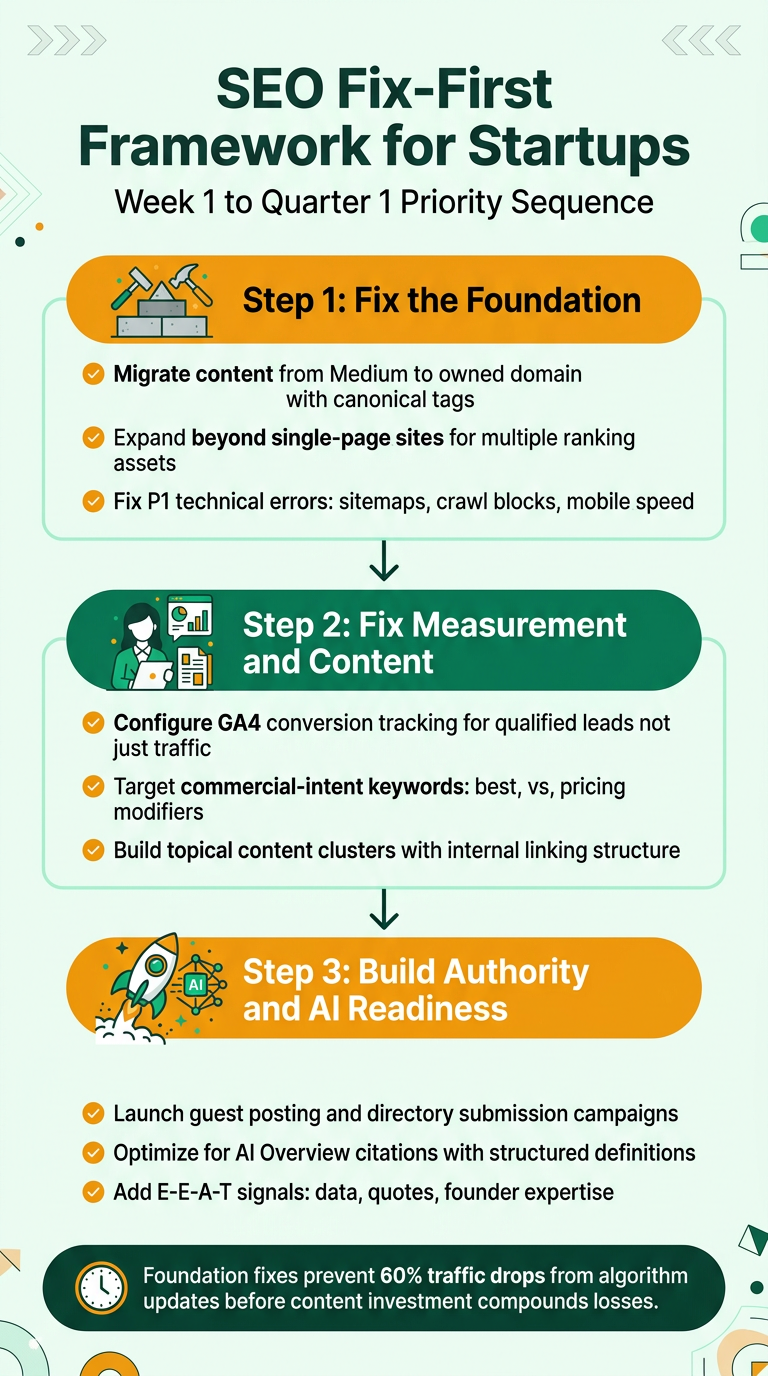
Week 1 — Fix the Foundation
-
Confirm all primary content lives on your owned domain, not a hosted platform
-
Run Google Search Console’s Coverage report and Screaming Frog; fix all P1 technical errors before anything else
-
Audit your site architecture — do you have enough pages to target your core keyword clusters? If not, plan them now
Month 1 — Fix Measurement and Content Strategy
-
Configure GA4 conversion goals for qualified events: signups, demo requests, pricing page visits
-
Audit existing content for keyword intent — flag pages with high traffic but zero conversions
-
Build or restructure one topical cluster around your highest-value use case; add internal links between related posts
Quarter 1 — Build Authority and AI Readiness
-
Launch a systematic link-building routine: guest posting outreach plus directory submissions running in parallel
-
Optimize your top pages for snippet appeal — clear definitions, bulleted answers, Q&A formatting
-
Add data, expert quotes, or firsthand founder perspective to your most important pages to strengthen E-E-A-T signals
Teams that systemize SEO across tools, metrics, and cross-functional processes consistently outperform ad-hoc approaches.[1] The framework above isn’t just prioritization — it’s the foundation of that systematic approach.
It’s also worth considering what Meta’s VP of Marketing Alex Schultz has said about early-stage growth priorities:
> “At the early stage, the CEO needs to take charge of growth before handing it off to a dedicated team. Founders who delegate growth too early often lose the feedback loop that informs what’s actually working.”> — Alex Schultz, VP of Marketing, Meta[8]
You don’t need to be an SEO expert to own the Week 1 fixes. But you do need to own them before handing them off. Register your startup on StartupRanking to start building directory authority while your content and technical foundation come together.
Conclusion: Fix the Mistakes That Compound Fastest First
The five-layer priority structure exists for a reason: Foundation → Measurement → Content → Authority → AI-Search Readiness. Each layer depends on the one before it. Backlinks underperform on technically broken sites. Content clusters fail without the right keyword intent. Authority building is wasted if you never convert the traffic.
The stakes are higher than they were two years ago. With AI Overviews reducing top-ranked CTR by 58%[4] and zero-click searches continuing to rise[5], every unaddressed SEO mistake now carries a larger traffic penalty than it used to. But the upside of fixing them is equally large — and it’s incremental. A two-person startup team can implement the Week 1 fixes this week.
Here’s the short version of everything this post covered:
-
Own your domain and your content equity — never build on rented platforms
-
Track conversions, not just traffic — qualified leads are the only metric that maps to actual startup growth
-
Build topical authority with clusters — not isolated posts that signal shallow expertise
-
Earn do-follow backlinks deliberately — passive acquisition is too slow for early-stage startups
-
Adapt to AI search now — ranking alone no longer guarantees traffic
If you want to accelerate the authority-building step without burning weeks on manual submissions, register your startup on StartupRanking to access ranking-based global visibility, Booster backlink packages covering 30–120+ curated directories, and AutoRankr for automated SEO content — all without waiting months for manual approvals to process.
—
FAQs
What is the biggest SEO mistake startups make in 2026?
The single most costly mistake is ignoring the technical foundation while investing in content and backlinks. A SaaS startup that spends $30K on link building and then loses 60% of traffic after a Google update — because of weak technical SEO — illustrates the problem perfectly. Fix crawl errors, sitemaps, and mobile performance first; everything else compounds on top of that base.
How long does it take for startup SEO to show results?
Most startups see initial organic traction within 3–6 months when the foundation is clean and content is targeting commercial-intent keywords. Domain authority growth — which drives consistent ranking improvements — typically takes 6–12 months of deliberate link building. The Week 1 and Month 1 fixes outlined in this post can accelerate early results significantly.
How do startups build backlinks with a small budget?
Three approaches work well at low cost: guest posting on industry publications (time-intensive but earns editorial do-follow links), submitting to curated startup directories and ranking platforms (especially services that batch submissions to save time), and creating original data-driven content that earns press coverage organically. Prioritize do-follow links from high-authority domains — a few quality links outperform dozens of low-authority ones.
Is SEO still worth investing in now that AI Overviews reduce organic clicks?
Yes — but the strategy needs to evolve. While position-one CTR for AI Overview keywords dropped from 0.073 to 0.016 between 2023 and 2025, 63% of SEO practitioners still report that AI Overviews positively impacted their traffic and visibility.[1] The shift is from ranking in blue links to being cited within AI-generated answers, which rewards brand authority, consistent third-party mentions, and well-structured content — all areas where good SEO practice still applies.
Should a startup hire an SEO agency or handle SEO in-house?
At the earliest stage, founders should own the core SEO priorities before delegating — as Meta’s Alex Schultz has noted about growth functions generally.[8] The Week 1 foundation fixes and basic measurement setup don’t require an agency. Where agencies or tools add value is in scaling link acquisition, technical audits for more complex sites, and content production at scale. Many early-stage startups use a hybrid model: in-house strategy, with tools and targeted services handling execution.
Leave a Reply