Blog

  • Link Building for Startups: Co-Marketing Guide

    Link Building for Startups: Co-Marketing Guide

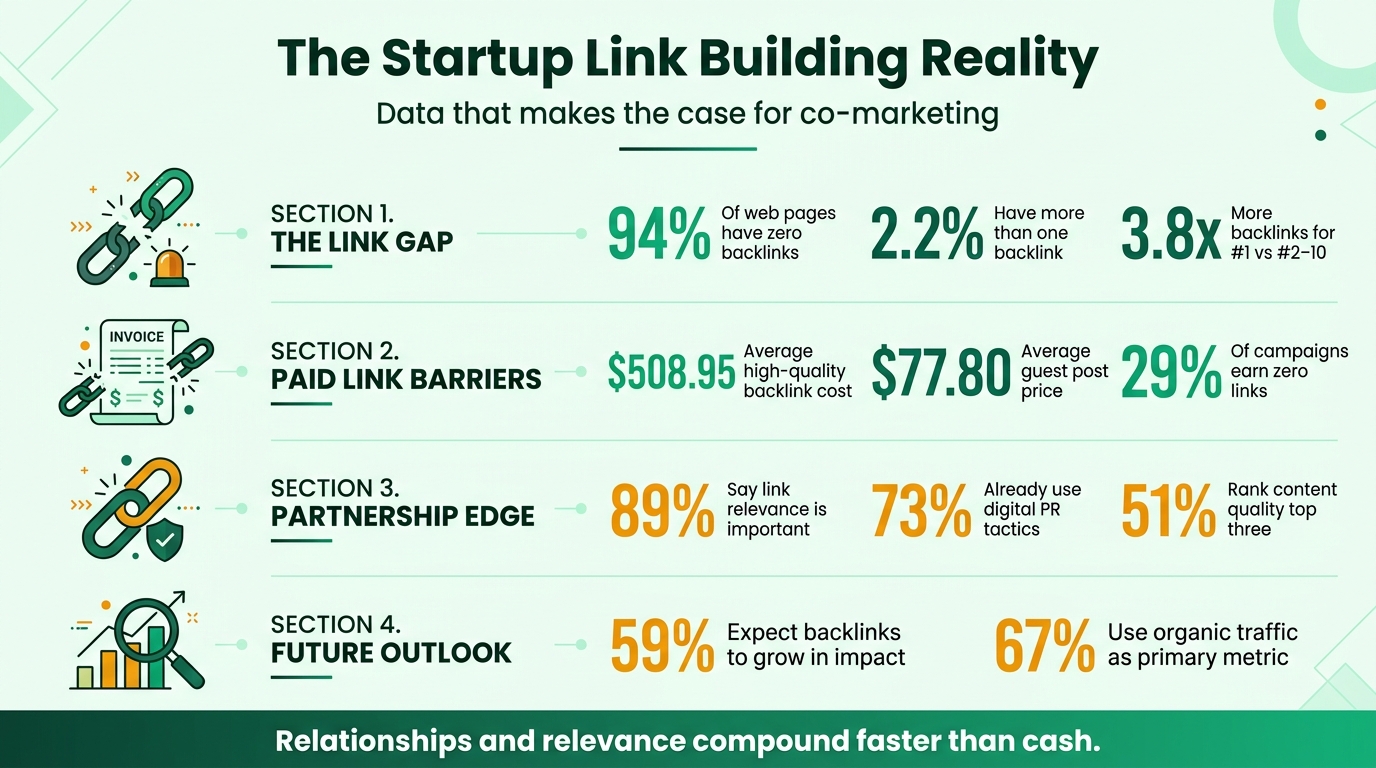
    You don’t need a $2,000 monthly retainer to build backlinks that move the needle. The average high-quality backlink costs $508.95[1], and 47% of professional link builders spend over $750 per month on link acquisition[2]. For a startup with limited runway, competing on cash is a losing game.

    But here’s what the data also tells us: 94% of all published web pages have zero backlinks[1]. Most startups never escape that statistic because they rely on tactics designed for established brands with deep pockets. The alternative? Co-marketing partnerships—a relationship-driven approach that trades mutual value for links, audiences, and credibility.

    Key takeaways in 30 seconds:

    • Partnership links cost $0–$200 in team time versus $508.95+ for paid alternatives[1]
    • 89% of link builders say link relevance matters—and partnership links are inherently relevant by design[2]
    • The “Partnership Link Stack” (Identify → Propose → Execute → Measure) gives lean teams a repeatable system
    • Co-marketing generates secondary benefits that paid links never will: shared audiences, brand credibility, and co-branded assets

    1. Why Partnership Link Building Works for Startups

    Before diving into tactics, you need to understand the structural reasons why partnerships outperform paid alternatives for early-stage companies. The data paints a clear picture—and it’s not kind to the traditional playbook.

    1.1 The Link Landscape Is Rigged Against New Domains

    Google’s #1 ranking result has 3.8x more backlinks than positions #2 through #10[1]. That gap isn’t static—top-ranking pages passively accumulate 5% to 14.5% more backlinks every single month simply because they’re already visible[1]. This compounding advantage means established domains pull further ahead while new domains stay stuck.

    Only 2.2% of web pages have more than one backlink[1]. That means your blog posts, landing pages, and product pages will almost certainly earn zero links unless you proactively build them. The math is unforgiving: if you publish content and wait for organic discovery, you’re betting on a 2.2% success rate.

    Partnerships change the equation. Instead of competing against entrenched domains for attention, you borrow credibility from complementary startups that already have an audience—and a domain with existing authority. For startups that have already registered on global ranking platforms, partnership links amplify the visibility you’re already building through directory listings and profile pages.

    1.2 Partnership Links Are More Relevant Than Paid Alternatives

    89% of link builders believe link relevance is important[2]. This isn’t surprising—Google’s algorithm evaluates not just how many links point to your site, but whether those links come from topically related sources. A link from a SaaS blog to your SaaS startup carries more weight than a link from a random directory.

    Partnership links are inherently relevant because you collaborate with companies in adjacent or complementary niches. A project management tool linking to a time-tracking integration partner makes contextual sense. A fintech startup co-authoring a guide with an accounting platform produces links that sit naturally within both ecosystems.

    Compare this to the paid alternative. The average guest post costs $77.80, and a single high-quality backlink averages $508.95[1]. These paid links often come from generic sites with broad, unfocused audiences. Worse, 29% of link-building campaigns fail to earn a single link[1]—meaning you can spend thousands and get nothing.

    1.3 Why Relationships Beat Transactions for Sustainable SEO

    Laura Jawad, a link-building strategist, describes a framework she calls the Professional Ecosystem: building a small circle of trusted professionals who share values and serve similar audiences creates a foundation for ongoing, natural link acquisition rather than one-off transactions[3].

    “The best links start with people who already believe in what you do.”
    — Laura Jawad, Relationship-Driven Link Building[3]

    This approach aligns with Google’s E-E-A-T framework (Experience, Expertise, Authoritativeness, Trustworthiness). Google’s algorithm recognizes patterns of relevant topics, consistent mentions, and natural placement that signal genuine credibility[3]. A link from a partner who has collaborated with you on a webinar, co-authored research, and regularly mentions your brand looks far more natural than a random guest post on an unrelated blog.

    John Mueller, Google’s Search Advocate, reinforced this point:

    “Because you could go off and create millions of links across millions of websites if you wanted to, and we could just ignore them all…Or there could be one really good link from one website out there that is, for us, a really important sign that we should treat this website as something that is relevant because it has that one link.”
    — John Mueller, Google Search Advocate[1]

    Partnerships, by their nature, produce the kind of “really good links” that Mueller referenced—links embedded in genuine collaborations, not link schemes.

    Think of partnership link building as planting a garden rather than buying cut flowers. Paid links wilt quickly—they deliver one link, no relationship, and constant cost. Partnerships grow over time, producing links, referrals, shared audiences, and co-branded assets that compound.

    2. The Partnership Link Stack: A 4-Stage Framework for Startup Co-Marketing

    This framework turns the partnership concept into a repeatable system. Each stage builds on the previous one, creating a pipeline that generates links consistently without requiring a dedicated link-building budget.

    2.1 Stage 1: Identify Complementary Startup Partners

    Finding the right partners matters more than any other step in this framework. Partner with the wrong company—a direct competitor, a startup with a spammy backlink profile, or one at a completely different growth stage—and you’ll waste time with no SEO return.

    Where to find partnership-ready startups:

    • Accelerator and incubator cohorts. Startups in the same Y Combinator, Techstars, or 500 Global batch already share trust and audience overlap. If you’re in an accelerator, your cohort is your highest-probability partnership pool.
    • Founder communities. Indie Hackers, MicroConf, and industry-specific Slack groups are filled with founders actively seeking collaboration opportunities. These spaces normalize co-marketing discussions.
    • Tool integration marketplaces. If you’re a SaaS startup, browse integration directories for complementary products. A CRM tool listing integrations with email marketing platforms is signaling partnership openness.
    • LinkedIn and Twitter/X founder networks. Follow startup founders in adjacent niches. Engage with their content before pitching. Co-marketing opportunities often emerge from public conversations.

    Vetting criteria for potential partners:

    Not every startup with an audience is a good partner. Apply three filters before moving to the proposal stage:

    1. Complementary audience, not competitor. The partner should serve the same buyer persona but solve a different problem. A project management tool and a time-tracking tool serve the same team leads but don’t compete.
    2. Similar growth stage. A seed-stage startup partnering with a Series C company creates an imbalance—the larger company has less incentive to follow through on link commitments.
    3. Shared values and quality standards. Check the potential partner’s existing content, backlink profile, and social presence. A partner with spam signals can hurt your domain by association.

    A real-world model: legal technology company Clio formed a “Preferred Partnership” with digital marketing platform Scorpion, where both B2B companies collaborated for mutual growth while serving overlapping professional services audiences[4]. The partnership worked because both companies sold to law firms but offered complementary—not competing—solutions.

    Laura Jawad recommends building your professional ecosystem intentionally: identify 5–10 professionals whose work you genuinely respect and whose audiences would benefit from your product, then nurture those relationships before proposing any collaboration[3].
    Startup Link Building Landscape Statistics for Founders

    Startup Link Building Landscape Statistics for Founders

    2.2 Stage 2: Propose Zero-Cash Co-Marketing Campaigns with Link Placement Agreements

    Once you’ve identified potential partners, you need a concrete proposal that makes the link exchange a natural byproduct of genuine collaboration—not the primary ask. The most effective proposals spell out exactly what both parties get, including link placement.

    Five zero-cash co-marketing campaign types:

    1. Joint Guides and Original Research. Two startups co-author a data-backed guide relevant to both audiences. Each company links to the other’s domain in author bios, resource sections, and promotion pages. Example: a hiring platform and a payroll startup co-publish “The 2026 State of Remote Team Operations” with each linking to the other’s tools in relevant sections.

    2. Webinar and Newsletter Swaps. One startup hosts a webinar featuring the other’s founder. Both promote to their email lists and link to each other’s landing pages in follow-up content. The host gets valuable content for their audience; the guest gets exposure and a backlink from the webinar recap post.

    3. Tool Integration and API Partnerships. Two SaaS products build a lightweight integration. Each creates a documentation page, integration listing, or blog post linking to the partner. These links sit on high-intent pages—users actively looking for connected tools.

    4. Bundle Giveaways and Digital Summits. Multiple startups contribute products or resources to a shared bundle. Each participant page and promotion includes backlinks to all contributors. This creates a natural backlink cluster across multiple domains simultaneously.

    5. Founder Podcast and Guest Post Swaps. Founders interview each other on their respective podcasts or write guest posts for each other’s blogs, with natural do-follow links in show notes and author bios.

    Outreach template structure:

    Your initial message should follow a four-part structure: (1) a genuine compliment referencing specific work the potential partner has done, (2) a clear mutual-value proposition explaining why collaboration benefits both sides, (3) a specific campaign idea with link placement spelled out, and (4) a low-pressure call to action.

    51% of SEOs place content quality and relevance in their top three link-building factors[2]. Your co-marketing content must meet the quality bar both audiences expect. A sloppy joint webinar won’t earn links or trust.

    Shopify’s guidance on high-impact marketing reinforces this: focus on one high-impact strategy rather than spreading efforts thin across multiple channels[5]. For link building, targeted partnerships represent that single high-impact strategy.

    If you’re looking for a credibility signal when approaching potential partners, a strong startup ranking and visibility score can demonstrate your existing traction and make collaboration proposals more compelling.

    2.3 Stage 3: Execute with Lean Team Templates and Timelines

    Execution is where most partnership link-building efforts collapse. A 1–3 person marketing team can’t manage a dozen simultaneous collaborations. Structure prevents chaos.

    The quarterly collaboration focus method:

    Laura Jawad recommends choosing one or two partnership opportunities per quarter to keep efforts manageable and intentional[3]. This constraint forces prioritization—you’ll naturally select the highest-potential partnerships rather than chasing every opportunity.

    Simple partnership agreement template (bullet-point format):

    • Scope: What campaign type are you running? (webinar, joint guide, integration, etc.)
    • Link placement expectations: Where will each party place links? (author bio, resource section, documentation page, show notes—be specific about URLs and anchor text)
    • Promotion commitments: Who promotes where? (email newsletter, social channels, blog—specify dates)
    • Timeline: Content creation deadline, review period, and publish date
    • Follow-up cadence: When will you check link status and referral traffic?

    Tracking spreadsheet structure:

    Partner Name Campaign Type Status Expected Link URL Link Live? Referral Traffic (30 days)
    Partner A Joint Guide In Progress partner.com/guide No
    Partner B Webinar Swap Live partner.com/webinar-recap Yes 47 visits
    Partner C Integration Launch Proposed partner.com/integrations No

    73% of link builders use digital PR as a tactic[2]. Co-marketing partnerships are digital PR in its most natural form—when two brands collaborate on content or events, they generate mutual media mentions and backlinks without a formal PR outreach campaign.

    Many startups find that submitting their startup to global directories creates a baseline of visibility while partnership link building compounds over time. The two strategies complement each other: directories provide initial domain authority, while partnerships build relevant, high-quality links.

    2.4 Stage 4: Measure Partnership Link ROI with Startup-Appropriate KPIs

    43% of link builders say quality control and measuring ROI are their two biggest challenges[2]. For startups, the measurement problem compounds because early-stage domains see delayed ranking impacts—you might not see keyword movement for 6–12 months after earning a link.

    Simplified KPI stack for startup partnership links:

    • Domain Rating (DR) or Domain Authority (DA) growth over 6–12 months. Look at trends, not week-over-week changes. A single partnership link won’t move DR, but 10–15 partnership links over a year will.
    • Referral traffic from partner domains. In Google Analytics, segment traffic by source. Are partner links sending qualified visitors who engage with your content?
    • Cost-per-link calculated as team time. If a founder spends 5 hours on a partnership that yields 2 links, and their effective hourly rate is $100, that’s $250 per link—still less than half the $508.95 average[1].
    • New backlinks earned per partnership campaign. Track this as a straightforward output metric.
    KPI Paid Link Building Partnership Link Building
    Average cost per link $77.80 (guest post) to $508.95 (high-quality)[1] Team time only (est. $0–$200 in labor per link)
    Link relevance Variable; often generic High; naturally complementary niches[2]
    Scalability Limited by budget Limited by relationship-building capacity
    Risk of penalties Moderate to high (paid links violate Google guidelines) Low (natural, earned links from real collaborations)
    Secondary benefits None beyond the link Audience sharing, brand credibility, co-branded assets
    Success rate 29% of campaigns earn zero links[1] Higher; mutual incentives drive follow-through

    67% of SEOs use organic traffic as the primary metric for evaluating backlink quality[2]. For startups, this is the right long-term lens. A partnership link that drives zero referral traffic but contributes to a domain authority increase that eventually boosts organic rankings is still valuable—but the traffic data provides a more immediate signal of link quality.

    3. Partnership Types Competitors Overlook

    Most link-building guides recommend the same tired tactics: guest posts, HARO responses, and broken link outreach. These partnership models are specifically designed for startups operating with constrained resources and existing relationships.

    3.1 Accelerator Cohort Collaborations

    If you’re in an accelerator like Y Combinator, Techstars, or 500 Global—or even a local startup program—your cohort is your highest-ROI partnership pool. The trust already exists. The growth stage is similar. The audiences often overlap.

    How to structure cohort-based link building:

    • Shared demo day promotion pages. Multiple cohort startups link to a central “Meet the Batch” page that links back to each startup’s domain.
    • Co-authored “lessons learned” posts. Two or three founders from the same cohort write about their accelerator experience, each linking to the others’ startups.
    • Reciprocal testimonials with backlinks. If you genuinely use another cohort company’s product, offer a testimonial for their website (with a link to your startup) and ask for the same in return.

    These collaborations require almost no cold outreach because the relationship infrastructure is already in place. The accelerator itself often promotes cohort-generated content, amplifying the link value.

    3.2 Indie Hacker and Founder Community Cross-Promotions

    Platforms like Indie Hackers, Product Hunt, and niche founder Slack communities are filled with startups seeking exposure. These communities normalize mutual promotion in ways that traditional B2B spaces don’t.

    “Deal Days” and cross-promotional bundles:

    Propose a time-limited event where 5–10 indie hackers promote each other’s products simultaneously. Each participant creates a landing page listing all participating products with backlinks to every other participant’s domain. The bundle gets promoted across all participants’ email lists, social channels, and communities.

    This creates a natural backlink cluster: 10 domains all linking to each other through a shared promotion page. Google sees these as relevant, contextually appropriate links—not a link scheme, because the collaboration produces genuine value (the bundle deal) for end users.

    3.3 API and Integration Partnership Co-Marketing

    For SaaS startups, building an integration with a complementary tool creates a legitimate, defensible reason for mutual linking. These aren’t manufactured links—they’re documentation of a real product relationship.

    Link placement opportunities in integration partnerships:

    • Integration documentation pages. “How to connect [Your Product] with [Partner Product]”—both sides publish these and link to each other.
    • “Powered by” badges. One product displays the other’s badge in their UI, linked to the partner’s site.
    • Partner directories. Many SaaS products maintain public integration directories with do-follow links to partner domains.
    • Co-branded case studies. A customer success story featuring both products, published on both domains with cross-links.

    Example: a project management SaaS integrates with a time-tracking SaaS. Both publish integration announcement posts. The project management tool links to the time-tracker in its “Integrations” page. The time-tracker links back in its “Works With” directory. These links sit on high-authority pages that accumulate value over time.

    For startups tracking their SEO progress, monitoring your startup’s ranking across countries and categories helps you see how partnership links translate into visibility gains in specific markets.

    4. Avoiding Common Partnership Link Building Pitfalls

    Partnership link building isn’t risk-free. The same relationship dynamics that make it powerful can also create problems if you’re not selective about partners and disciplined about quality control.

    4.1 Spotting Low-Quality Partners and Link Schemes

    Not every startup waving a “let’s partner!” flag is a good link partner. Some operate with spammy backlink profiles that can harm your domain by association. Others propose reciprocal link schemes that violate Google’s guidelines—and search engines are expected to penalize automated link-building schemes, with manual, natural link placements and human-written content being essential for sustainable results[2].

    Quick vetting checklist before agreeing to any partnership:

    1. Check DR/DA. Use Ahrefs, Moz, or a free alternative. Is the domain in the same ballpark as yours? A DR 80 domain linking to a DR 5 startup is unusual—and possibly a red flag.
    2. Review backlink profile. Look for spam signals: high volumes of low-quality directory links, irrelevant foreign-language backlinks, or sudden spikes suggesting purchased links.
    3. Audit content quality. Does the potential partner publish genuine, useful content? Or thin, keyword-stuffed blog posts?
    4. Verify audience overlap. Use SimilarWeb or builtwith to check whether their audience demographics align with your target users.

    If a potential partner suggests exchanging links across all blog posts or building a private blog network (PBN), decline immediately. These schemes violate Google’s guidelines and risk manual penalties.

    4.2 Maintaining Link Quality at Scale

    43% of link builders cite quality control as a top challenge[2]. As your partnership volume grows, it becomes tempting to lower standards—accepting links from less relevant partners, skipping backlink profile audits, or letting link placement agreements get vague.

    Partnership quality scorecard (score each partnership quarterly):

    Criterion Score (1–5) Notes
    Domain relevance to your niche 4 Adjacent but not identical industry
    Partner domain authority 3 DR 30–50 range
    Content quality of link page 5 Well-written, genuinely useful
    Referral traffic driven 2 12 visits in 90 days—low

    Sunset partnerships that score below a cumulative threshold (say, 10 out of 20) for two consecutive quarters. The opportunity cost of maintaining a low-quality partnership is higher than the value of the link it provides.

    4.3 Avoiding the “Partnership Trap”—When Co-Marketing Distracts from Core SEO

    Partnership link building works best as part of a broader SEO strategy, not as a replacement for fundamentals. A startup with broken technical SEO, thin content, and no keyword strategy won’t rank just because it earned 20 partnership links.

    Shopify’s guidance on high-impact marketing strategies emphasizes focus: choose one high-impact approach and execute it well rather than spreading efforts across multiple channels[5]. Partnership link building can be that high-impact strategy for your off-page SEO—but it must sit alongside:

    • Technical SEO (site speed, mobile usability, crawlability)
    • On-page optimization (title tags, headers, internal linking)
    • Content quality (publishing pages worth linking to)

    If you’re spending 80% of your marketing time on partnership outreach and neglecting your own blog or product pages, you’re in the partnership trap. The links you earn will point to suboptimal pages, reducing their impact.

    Conclusion: Building a Partnership-Driven Link Engine That Compounds

    Partnership link building is the most budget-efficient, sustainable path for startups to build domain authority. The data makes this clear: 47% of professional link builders spend $750 or more per month on link acquisition[2], while the average paid backlink costs $508.95[1]. Cash-based competition is unsustainable for early-stage companies—but relationship-based competition is open to anyone willing to invest time and genuine collaboration.

    The Partnership Link Stack—Identify, Propose, Execute, Measure—turns this approach into a repeatable system rather than a one-off tactic. By limiting yourself to one or two partnership collaborations per quarter[3], you keep the workload manageable for lean teams while building a portfolio of relevant, high-quality backlinks.

    89% of link builders value relevance[2], and partnership links are naturally the most relevant links a startup can earn—from companies in adjacent niches serving overlapping audiences. No paid guest post on a generic blog can match the contextual relevance of a link from an integration partner’s documentation page or a co-authored industry guide.

    Looking ahead, the case for partnership link building only strengthens. 59% of SEO experts believe backlinks will have a larger impact on rankings in coming years[1]. As AI commoditizes information and makes it easier to generate generic content at scale, genuine brand mentions from real partnerships will become even more valuable as trust signals[2]. Google’s algorithms are increasingly sophisticated at distinguishing manufactured links from authentic collaborations—and partnerships produce the latter.

    This week, identify one complementary startup in your network or community. Craft a co-marketing proposal using the campaign types and outreach structure from Stage 2. That single partnership could produce more relevant, sustainable backlinks than a month of cold outreach—and it costs nothing but time and genuine collaboration. If your startup is listed on StartupRanking, your SR Score can serve as a credibility signal when approaching potential partners, demonstrating your existing traction and visibility in the startup ecosystem.

    FAQs

    How can a startup with zero budget start building backlinks through partnerships?

    Start by identifying 5–10 complementary startups in your existing network—accelerator cohorts, founder communities, or integration partners. Propose a zero-cost co-marketing campaign like a joint guide, webinar swap, or integration announcement where both parties agree to link to each other’s domains in the resulting content. The only investment is team time, and because both parties benefit from shared audiences, there’s no need for cash incentives.

    What types of co-marketing campaigns generate the best backlinks for early-stage startups?

    Joint original research and data studies generate the highest-quality backlinks because they attract links from third parties who cite the data—not just from your partner. Tool integration partnerships create links on high-intent documentation and directory pages that accumulate authority over time. Webinar swaps and founder podcast exchanges produce natural do-follow links in show notes, recap posts, and author bios.

    How do I measure the ROI of partnership link building compared to paid link building?

    Calculate cost-per-link by dividing team time investment by links earned—most partnership links cost $0–$200 in labor versus $508.95 for a paid high-quality link. Track Domain Rating growth over 6–12 months rather than weekly, monitor referral traffic from partner domains in Google Analytics, and measure secondary benefits like shared audience growth and co-branded assets that paid links never provide.

    How do I find complementary startups to partner with for co-marketing and link building?

    The highest-probability channels are accelerator and incubator cohorts where trust already exists, founder communities like Indie Hackers and industry Slack groups where collaboration is normalized, tool integration marketplaces for SaaS startups, and LinkedIn/Twitter founder networks where co-marketing discussions happen publicly. Prioritize startups serving the same buyer persona but solving different, non-competing problems.

    Is link building still relevant for SEO in 2026, and do partnerships actually work?

    Yes—59% of SEO experts believe backlinks will have a larger impact on rankings in coming years. As AI-generated content floods the web, genuine backlinks from real collaborations become stronger trust signals for Google’s algorithms. Partnerships work because they produce the kind of relevant, contextually appropriate links that 89% of link builders say matter most, with the added benefit of shared audiences and brand credibility.

  • Backlink Quality Metrics Startups Should Track

    Backlink Quality Metrics Startups Should Track

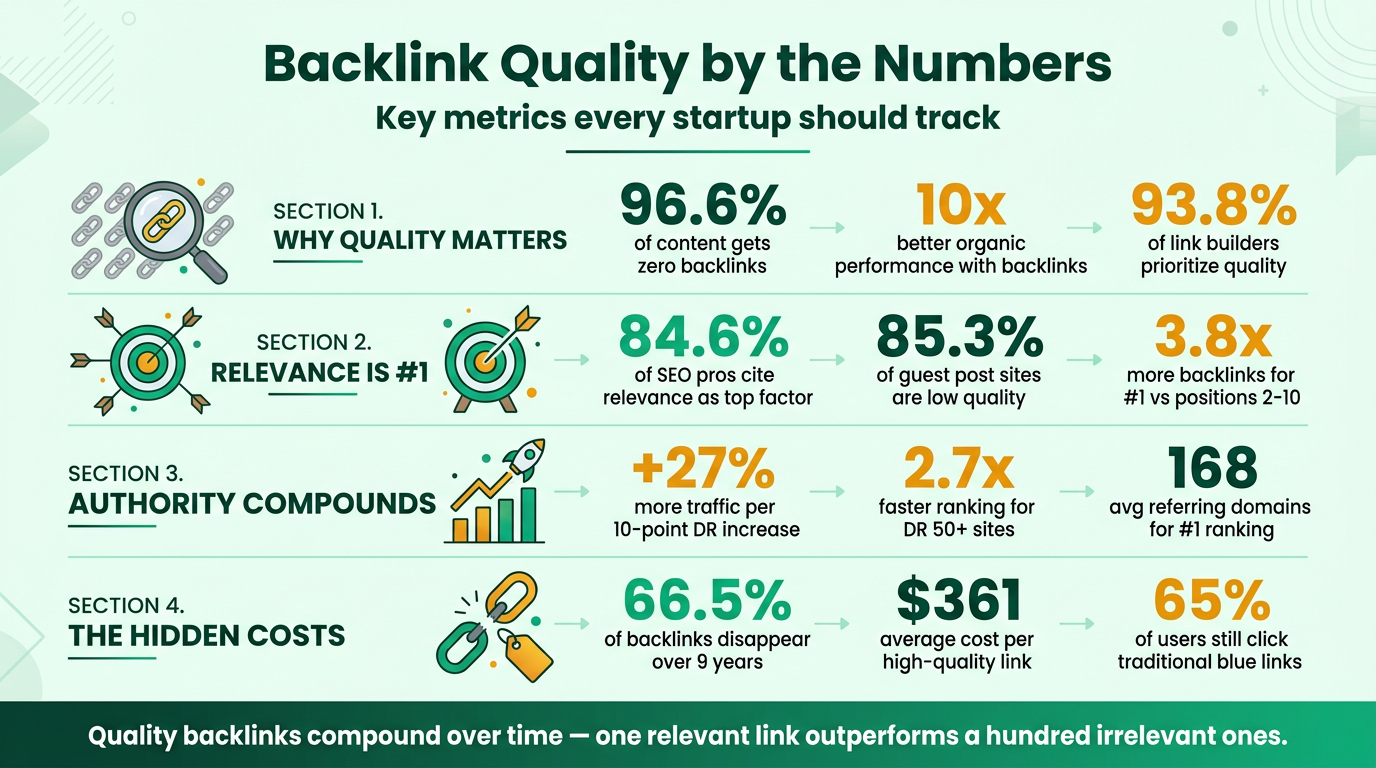
    **Not all backlinks are created equal.** One relevant link from a respected site in your niche can do more for your rankings than 100 random links from low-quality directories. The key to startup SEO isn’t chasing every link you can get — it’s *measuring backlink quality* so you invest your limited time into opportunities that actually move the needle.Here’s what matters most when evaluating backlinks: **relevance first**, then authority and traffic, then placement and link attributes. Platforms like [StartupRanking](https://www.startupranking.com) help you start building that quality backlink profile from day one — but first, you need a framework for knowing what makes a link worth pursuing. Below, you’ll find a practical framework — built specifically for bootstrapped founders — that covers the 7 metrics that matter, stage-based benchmarks, a conflict resolution rubric for when metrics disagree, and a free tool stack that lets you evaluate any link opportunity without spending a dime on enterprise software.- **96.6%** of all content gets zero backlinks from external websites [7] — earning any link already puts you ahead- Pages with at least one backlink perform **10x better** in organic search than pages without [7]– The #1 result in Google averages **3.8x more backlinks** than positions 2–10 [7]– **93.8%** of link builders now prioritize quality over quantity [6]Google’s shift from quantity to quality — driven by the Penguin algorithm and reinforced by the March 2024 spam updates that target scaled content abuse and site reputation abuse [9] — means that low-quality link schemes don’t just fail to help; they can actively penalize your site. This article gives you a practical, metric-driven framework for measuring backlink quality, benchmarks tailored to your startup stage, and tools that don’t require enterprise budgets.## 1. The 7 Key Metrics for Measuring Backlink Quality### 1.1 Referring Domain Relevance (The #1 Priority)Relevance is the single most important factor in backlink quality. **84.6% of SEO professionals cite relevance as the most critical factor** when evaluating a link [6]. That’s not a coincidence — it’s how Google’s algorithms are built.What does “relevance” actually mean? It’s the *topical alignment* between the linking page’s content and your startup’s niche. A link from a SaaS blog to a SaaS startup carries significantly more weight than a link from an unrelated high-DR fitness site. The logic is straightforward: if a respected voice in your industry points to you, that endorsement is trustworthy. If a random site with no topical connection links to you, the signal is weak.A link from a *mildly* relevant page won’t hurt you — it just won’t help much. But a link with zero topical connection provides minimal value, regardless of how authoritative the linking domain is [2]. For startups trying to build authority from scratch, this distinction is everything: chasing irrelevant high-DR links wastes time you can’t afford to lose.### 1.2 Domain Authority (DR) and Page Authority (UR)Domain Rating (DR) and URL Rating (UR) serve as shorthand for domain-level and page-level authority [2]. DR tells you how strong the *entire website* is, while UR tells you how strong the *specific page* linking to you is. Both matter, but they should never be evaluated in isolation.The data is clear: **a 10-point increase in DR corresponds to an average of 27% more organic traffic** [7]. Websites with DR 50+ rank on average 2.7x faster for new content than those with DR below 30 [7]. That compounding effect means early link investments pay dividends across all future content.But authority without relevance is a trap. A DR 90 fitness site linking to your fintech startup is *less valuable* than a DR 40 finance site doing the same. The authority number looks impressive, but Google’s algorithms evaluate the topical context of the link. Always pair DR with the relevance check from Section 1.1.### 1.3 Referring Domain Organic TrafficOrganic traffic is a practical quality proxy that many competitors overlook. A site with strong organic traffic is actively validated by Google — it’s a *living signal*, unlike a static authority score that can be manipulated or outdated [4].Here’s a concrete threshold: **85.3% of guest posting sites are low quality**, defined as DR < 40 and < 10K monthly organic traffic [6]. If you’re evaluating a guest post opportunity and it falls below both of those benchmarks, you’re likely looking at a site that provides little to no SEO value. Use these numbers as your minimum bar.Why does traffic matter so much? A site that Google sends thousands of visitors to is trusted. A site with high DR but almost no organic traffic may have inherited that DR from a previous owner, bought links, or experienced a penalty. Checking traffic protects you from these edge cases [4].### 1.4 Anchor Text Distribution and NaturalnessAnchor text — the clickable words that form the link — signals topical context to Google. **Relevant anchor text helps Google understand what your page is about**, but over-optimization triggers penalties [1].The ideal anchor text profile includes a natural mix:- **Brand name anchors** (e.g., “StartupRanking” or “startupranking.com”) — these should make up the largest share- **Keyword-rich anchors** (e.g., “measuring backlink quality”) — useful in moderation, but dangerous when overused- **Generic phrases** (e.g., “click here”, “this guide”) — add naturalness to your profileA backlink profile heavy on exact-match keywords looks manipulative to Google. If 50%+ of your anchors are exact-match keywords, that’s a red flag. Aim for a distribution that looks like it was built naturally over time, not engineered overnight.### 1.5 Link Placement and Context**Editorially placed links within content (in-body) pass more value** than footer, sidebar, or author bio links [2]. Google’s algorithms can detect where a link sits on a page, and links that are woven naturally into the content signal genuine editorial endorsement.Links surrounded by relevant content also send stronger signals than links in isolated sections [1]. A link embedded in a paragraph discussing startup SEO — where your content provides a logical next step for the reader — is worth far more than a link crammed into a sidebar widget alongside dozens of other outbound links.When evaluating a link opportunity, look at where your link will actually appear on the page. If it’s buried in the footer or squeezed into an author bio with 15 other links, the value is significantly diluted.### 1.6 Link Attributes (Dofollow vs. Nofollow, Sponsored, UGC)Not all links pass authority equally. Here’s the breakdown [3]😐 Attribute | Authority Transfer | Primary Value ||—|—|—|| **Dofollow** | Full — passes link juice | Primary SEO value driver || **Nofollow** | Indirect — no direct authority transfer | Traffic, diversification, natural profile || **Sponsored** | Indirect — signals paid relationship | Compliance, some indirect SEO value || **UGC** | Indirect — signals user-generated content | Compliance, some indirect SEO value |Here’s the nuance most guides miss: **a nofollow link from a highly relevant, high-traffic site is still worth having**. It provides referral traffic, contributes to a natural-looking link profile, and may even be treated as a ranking hint by Google. Don’t automatically reject a nofollow link from a quality source — just don’t count it toward your dofollow authority targets.### 1.7 Link Juice Dilution: Number of Outgoing LinksA link from a page linking to hundreds of other URLs shares less authority per link than a page with few outgoing links [2]. This concept is called *link juice dilution*, and it’s one of the easiest metrics to check before pursuing a placement.Imagine a page with a DR 70 authority that links to 200 external websites. Your link gets 1/200th of that authority. Now imagine a DR 50 page that links to only 3 external sites — including yours. You get 1/3rd of that authority. The math makes the lower-DR, lower-dilution option far more valuable.The practical check: before pursuing or accepting a link placement, scroll through the linking page and count how many external links it contains. If you see a wall of outbound links, the authority passed by each one is minimal.With these seven metrics in hand, you can evaluate any link opportunity. But knowing the metrics in isolation isn’t enough — you need context for what “good” looks like at your specific stage of growth.

    Backlink Quality Statistics for Startup Founders

    Backlink Quality Statistics for Startup Founders

    ## 2. The Startup Backlink Quality Scorecard### 2.1 Tiered Benchmarks by Startup StageWhat counts as a “good” backlink depends heavily on where your startup is in its journey. A bootstrapped founder doesn’t need the same link profile as a Series A company any more than a seedling needs the same water as a mature tree. Here are directional targets based on startup maturity:| Stage | Target DR | Additional Criteria | Target Referring Domains ||—|—|—|—|| **Pre-seed / Bootstrapped** | 20–40 | Topically relevant | 10–20 quality referring domains || **Seed / Early Growth** | 40–60 | Relevant + >5K monthly organic traffic | 35–50 referring domains || **Series A / Scaling** | 50+ | High traffic + editorial placement | 50–100+ referring domains |**Pre-seed / Bootstrapped**: This stage is about building foundational authority. Target DR 20–40 links that are topically relevant to your niche. 10–20 quality referring domains give you a base to grow from. Don’t waste time chasing DR 80 links — they’re unlikely to link to a brand-new startup anyway.**Seed / Early Growth**: Now you’re competing for visibility. Target DR 40–60 with relevance *and* traffic (at least 5K monthly organic visitors). Aim for 35–50 referring domains — that’s roughly the benchmark for position 10 in Google, which averages 35 referring domains [7].**Series A / Scaling**: You need authoritative, editorially placed links from high-traffic sites. Target DR 50+ and aim for 50–100+ referring domains. The #1 ranking position averages 168 referring domains [7], so this is your long-term target as you scale.These numbers are directional targets, not hard rules — niche competitiveness shifts them significantly. A fintech startup may need more links to compete than a niche SaaS tool in a less crowded vertical.### 2.2 The Conflict Resolution RubricReal link opportunities are messy. A site might have high DR but low traffic, or great relevance but a nofollow attribute. When metrics conflict, use this priority hierarchy:1. **Relevance always wins** — a relevant DR 30 link beats an irrelevant DR 70 link, hands down.2. **Traffic beats authority when they disagree** — a DR 35 site with 20K monthly visitors is worth more than a DR 60 site with 500 visitors. Traffic proves the site is real and trusted by Google.3. **Placement quality beats quantity** — one in-content editorial link outweighs three footer links from the same domain.4. **Dofollow is preferred, but a nofollow link from a high-traffic relevant source is always better than no link**.This rubric saves you from analysis paralysis. When you’re evaluating multiple opportunities and your head is spinning from conflicting DR scores and traffic numbers, simply run down this list and the decision becomes clear.### 2.3 Monthly Monitoring CadenceHere’s a sobering statistic: **66.5% of all backlinks from the past 9 years have disappeared** [7]. Links break, pages get deleted, sites go offline. If you’re not monitoring your backlink profile, you’re flying blind.For founders who don’t have time for daily monitoring, here’s a simple monthly checklist:- **Week 1**: Check for new referring domains in Google Search Console. Note any unexpected spikes or drops.- **Week 2**: Verify that your top 10 existing links are still live. Click through to confirm the linking page hasn’t been removed or the link hasn’t been changed to nofollow.- **Week 3**: Review your anchor text distribution. If you see exact-match keyword anchors climbing above 30–40% of your profile, that’s an over-optimization warning.- **Week 4**: Track your DR trend and organic traffic correlation on [StartupRanking](https://www.startupranking.com). Are your link-building efforts translating into traffic growth?This cadence takes roughly 30–60 minutes per week and catches problems before they compound. Now, let’s talk about the tools that make this monitoring possible without paying enterprise-level subscriptions.## 3. Measuring Backlink Quality Without Enterprise Tools### 3.1 The Free Tool Stack Every Startup Can UseYou don’t need an Ahrefs full subscription or a Semrush account to evaluate backlinks effectively. Here’s a practical stack for founders with a $0 budget:| Tool | Cost | Best For ||—|—|—|| **Google Search Console** | Free | Monitoring new links, referring domains, anchor text — the most reliable starting point for any founder || **Ahrefs Free Webmaster Tools** | Free tier | DR and UR data on referring domains, plus basic backlink reports || **Ubersuggest** | Free tier (with limits) | Competitive backlink analysis — see which domains link to competitors || **Manual checks** | Free | Reviewing linking pages for content quality, ad density, relevance, and link placement |Why bother learning to evaluate links manually? Because the financial stakes are real. **The average cost per high-quality link is $361** [7], and a quality guest post costs $692–$957 [6]. If you’re spending that kind of money, you need to know whether the opportunity is actually worth it. And if you’re doing outreach yourself, time is your most limited resource — knowing how to evaluate opportunities manually saves hours that you’d otherwise waste on low-value targets.### 3.2 Step-by-Step: Evaluating a Single Backlink Opportunity for FreeHere’s a concrete evaluation process you can follow the next time someone offers you a link, you find an outreach target, or you’re assessing whether a directory listing is worth your time:**Step 1: Open the linking page in your browser.** Assess content quality and relevance. Ask yourself: does the topic of this page match my startup’s niche? This is the Woorank checklist approach — if the topic doesn’t align with what you do, the link provides minimal SEO value [1].**Step 2: Check the site’s organic traffic estimates.** Use Ahrefs free site explorer or Ubersuggest. If the traffic is below 10K monthly visitors and the DR is under 40, you’re likely looking at a low-quality opportunity [6].**Step 3: Look at the site’s DR.** Use the Ahrefs free toolbar. Compare it against your stage-based benchmarks (see Section 2.1). A DR 20 link is perfectly fine for a pre-seed startup — it’s not worth pursuing if you’re already at Series A scale.**Step 4: Inspect link juice dilution.** Count how many external links the page contains. A page with 50+ outbound links is sharing authority thin — your link gets a tiny fraction of the page’s value.**Step 5: Verify the link attribute.** Right-click the link and use “Inspect Element” to check if it’s dofollow or nofollow. Dofollow is the goal, but don’t dismiss a relevant nofollow link from a high-traffic site.**Step 6: Check that the anchor text is natural and relevant.** If you have control over the anchor, aim for brand name or a variation of your target keyword — not an exact-match keyword every time.This six-step process takes about 5 minutes per opportunity. It’s not as fast as running an automated report, but it’s far more accurate for making smart decisions with limited resources. And if you’re doing outreach, remember that **personalized outreach achieves 15–25% response rates** compared to the 8.5% average [7]. Investing quality evaluation time into fewer, better-targeted opportunities pays off over spam-style volume outreach.Understanding how to measure quality is one thing — connecting it to your business goals is what turns SEO from a cost center into a growth driver.## 4. Connecting Backlink Quality to Startup Growth Metrics### 4.1 From DR to Revenue: The Business Impact ChainThe ultimate purpose of building quality backlinks isn’t to impress other SEOs — it’s to drive revenue. Here’s how the chain works:**Quality backlinks → Higher DR → 27% more organic traffic per 10 DR points** [7] → More qualified visitors → More demo requests and signups.And there’s a compounding effect: **websites with DR 50+ rank 2.7x faster for new content** than those with DR below 30 [7]. This means every quality link you build today doesn’t just help your current content — it accelerates the performance of every piece of content you publish in the future. Authority compounds.For founders, track this simple KPI dashboard month over month:- **Referring domains** (growth trend) — are you adding quality domains consistently?- **Organic traffic** (month-over-month) — is your authority translating into visibility?- **Organic signups/demo requests** — is that visibility turning into pipeline?If referring domains are growing but traffic isn’t, you may be building irrelevant or low-quality links. If traffic is growing but signups aren’t, your content or onboarding needs work. This dashboard connects SEO activity directly to business outcomes.### 4.2 How StartupRanking Helps You Build and Track Quality BacklinksThe strategies covered in this article — evaluating relevance, targeting the right DR, monitoring your link profile — take time. [StartupRanking](https://www.startupranking.com) gives founders structured, efficient ways to execute on these strategies without spending months on manual outreach:**Free Startup Profile**: Listing your startup on StartupRanking creates a page that can earn a backlink and starts building your SR Score at zero cost. It’s the baseline every founder should set up — it addresses the fundamentals of establishing authority without any budget.**Booster**: For founders struggling to gain initial traction and backlinks, Booster provides 30–120+ directory backlinks. This gives you a structured way to acquire diverse referring domains without individual outreach — directly addressing the time-consuming manual submission process that keeps founders from building links consistently.**Premium Profile**: Upgrades your listing to an enhanced, ad-free page with do-follow links. This directly addresses the link attribute and placement quality metrics covered in Section 1.6 — you’re getting dofollow authority from a relevant, startup-focused domain rather than a generic directory buried in nofollow links.**AutoRankr**: Generates automated SEO articles to create linkable assets on your profile. This is aligned with the strategy of building content that naturally attracts quality backlinks [2] — instead of chasing links, you’re creating content worth linking to, and StartupRanking automates the process.These aren’t shortcuts around quality evaluation — they’re efficiency layers for founders who want to execute the scorecard framework without spending months on manual outreach. Google is actively targeting spammy link practices [8], so building links through legitimate, relevant platforms matters more than ever.## Conclusion: Measure What Matters, Build What LastsThe framework is straightforward: **relevance first, then authority + traffic, then placement and attributes**. Use the scorecard to evaluate opportunities, the free tool stack to measure them, and the monthly cadence to maintain your progress.The data backs this up: **93.8% of link builders prioritize quality over quantity** [6]. A single quality link outperforms dozens of irrelevant ones. The average page ranking #1 has 168 referring domains [7], but those domains earned quality first, quantity second.And backlinks still matter — now and into the future. **65% of users still click traditional blue links** [6], and AI search still cites the top 10 results 75% of the time [6]. Building quality backlinks is investing in both traditional and AI-driven search visibility — the work you do today compounds regardless of how search evolves [10][11].Ready to start building? [Register your startup on StartupRanking](https://www.startupranking.com) to begin building your backlink profile, earn your SR Score, and track your authority growth over time.## FAQs

    How do I measure backlink quality without paid SEO tools?

    Use Google Search Console (free) to monitor new links and referring domains, Ahrefs Free Webmaster Tools for DR and UR data, and Ubersuggest’s free tier for competitive analysis. Manually check linking pages for relevance, content quality, and link placement. Follow the six-step evaluation process in Section 3.2 — it takes about 5 minutes per opportunity and requires zero budget.

    What Domain Rating should my startup target for backlinks?

    It depends on your stage. Pre-seed/bootstrapped startups should target DR 20–40 links that are topically relevant. Seed-stage startups should target DR 40–60 with relevance and traffic (>5K monthly organic visitors). Series A+ startups should target DR 50+ with editorial placement. Always prioritize relevance over raw DR — a relevant DR 30 link beats an irrelevant DR 70 link.

    Is one high-quality backlink better than 100 low-quality ones?

    Yes. 93.8% of link builders prioritize quality over quantity for a reason. Low-quality links from irrelevant, low-traffic, or spammy sites can trigger Google penalties and dilute your authority. A single relevant, high-traffic, editorially placed link passes more ranking value and compounds over time — especially when pages with backlinks perform 10x better in organic search than pages without.

    How often should I audit my startup’s backlink profile?

    Follow a monthly cadence: Week 1, check for new referring domains in Google Search Console. Week 2, verify that your top existing links are still live. Week 3, review anchor text distribution for over-optimization warnings. Week 4, track DR trend and organic traffic correlation. This takes 30–60 minutes per week and catches the fact that 66.5% of backlinks eventually disappear.

    Are backlinks still important for SEO in 2025 and 2026?

    Yes. Pages with at least one backlink perform 10x better in organic search, and the #1 result in Google averages 3.8x more backlinks than positions 2–10. Google’s March 2024 spam updates penalize low-quality link schemes, making quality backlinks even more important. Additionally, 65% of users still click traditional blue links, and AI search cites the top 10 results 75% of the time — so quality backlinks power both traditional and AI-driven visibility.

  • Top SEO Mistakes Startups Make & How to Fix Themss

    Top SEO Mistakes Startups Make & How to Fix Themss

    Organic search drives 33% of overall website traffic across key industries[1] — yet most startups quietly sabotage this channel with mistakes that are completely avoidable. Worse, AI Overviews now correlate with a 58% lower average clickthrough rate for top-ranking pages[4], which means the old assumptions about ranking don’t hold anymore. Every SEO mistake startups leave unfixed now costs more traffic than it did two years ago.

    The good news: 91% of SEO practitioners report that SEO positively impacted their website performance and marketing goals in 2024.[1] Getting it right still pays off — significantly.

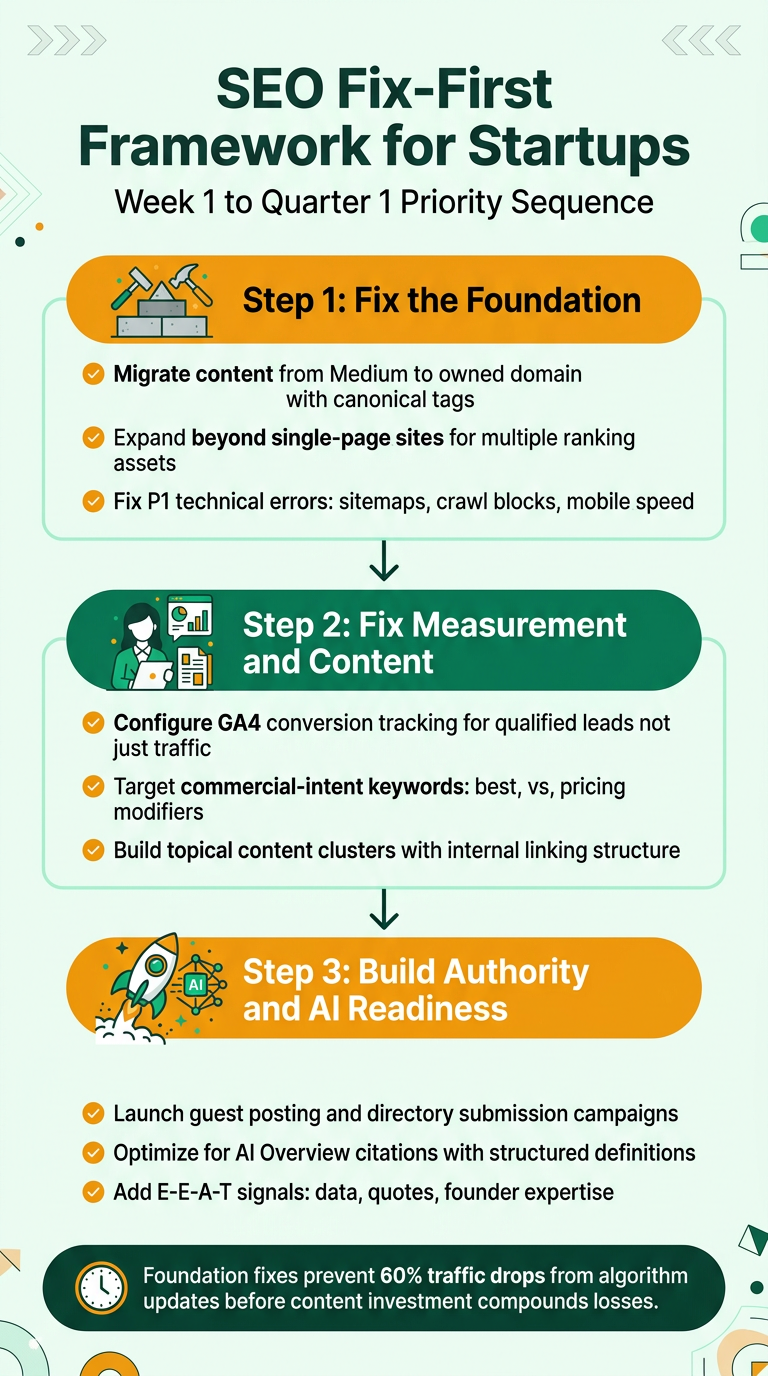
    This post covers the 10 most common SEO mistakes startups make, grouped into five priority layers so you know exactly what to fix first:

    • Foundation — mistakes that block everything else (fix in Week 1)

    • Measurement — gaps that let bad decisions compound silently (fix in Month 1)

    • Content — strategy errors that burn time and budget (fix in Month 1)

    • Authority — why your domain rating stays stubbornly low (fix in Quarter 1)

    • AI-Search Readiness — the shift most startups are ignoring right now (fix in Quarter 1)

    At the end, you’ll find a concrete fix-first framework — Week 1, Month 1, and Quarter 1 — so this doesn’t just become another article you bookmark and forget.

    Section 1: Foundation SEO Mistakes That Block Every Other Effort

    No content strategy or backlink campaign can save a broken foundation. These are your Week 1 fixes — the ones that make everything else actually work.

    Mistake #1 — Publishing on Hosted Platforms Instead of Your Own Domain

    Here’s the trap: you write a solid article, post it on Medium or LinkedIn Articles, it gets traction — and every single backlink pointing to that piece builds Medium’s domain authority, not yours.[2]

    Every month you publish primarily on a hosted platform is a month of domain equity you’re giving away for free. The long-term compounding loss here is brutal, especially for startups trying to build authority from zero.

    The right model: your owned domain is the source of record. Syndicate to Medium or Substack for distribution reach if you want, but always canonicalize back to your original URL so search engines credit your site.

    Practical fix:

    • Migrate existing content to yourstartup.com/blog

    • Set canonical tags pointing back to your domain on any syndicated copies

    • Use Medium’s import tool for reach — never as your primary publishing home

    Mistake #2 — Building a One-Page or Near-One-Page Website

    A single-page site can only rank for a handful of keywords — full stop. No matter how good your copy is, you’ve hard-capped your organic traffic potential.[2]

    One-page sites are acceptable when organic search isn’t central to your business model — think invite-only products or purely referral-driven tools. But if you want SEO to drive growth, you need pages.

    High-maturity SEO organizations measure 3x more metrics than low-maturity ones[1] — and that level of measurement only becomes possible when there are multiple pages to evaluate and optimize.

    Practical fix: build dedicated pages for each product feature, use case, target industry, and location (if relevant). Each page becomes an independent ranking asset, and they all compound over time.

    Mistake #3 — Ignoring Core Technical SEO from Day One

    Technical SEO isn’t glamorous, but skipping it is expensive. The most common omissions for early-stage startups: missing XML sitemaps, broken internal links, unoptimized page titles and meta descriptions, and poor mobile performance.

    Here’s the compounding problem: technical errors suppress every other SEO investment. Backlinks underperform. Content underranks. Keyword targeting falls flat. You can pour money into content and links and still lose.

    > One SaaS startup spent $30,000 on link building — then lost 60% of their traffic after a Google update because the technical foundation was never properly addressed.[3]

    Practical fix: run a free crawl with Screaming Frog or Google Search Console’s Coverage report in your first week. Treat P1 technical errors — crawl blocks, broken redirects, missing sitemaps — as launch-blockers, not post-launch to-dos.

    Once your foundation is solid, the next biggest silent killer is measurement — specifically, measuring the wrong things.

    Infographic summary
    Key insights at a glance

    Section 2: Measurement SEO Mistakes Startups Commonly Overlook

    You can’t fix what you can’t see. Measurement gaps let bad decisions compound for months before anyone notices the SEO strategy isn’t actually driving growth.

    Mistake #4 — Tracking Traffic Volume Instead of Qualified Conversions

    Raw session counts can look healthy while your actual signups, demo requests, and qualified leads from organic search sit near zero. This is the vanity metric trap — and it’s surprisingly common.

    Traffic is an input. Conversions are the output. If you’re only watching one, you’re flying blind on the other.

    Practical fix: configure conversion events in GA4 for the actions that actually matter to your business:[2]

    • Free trial starts or signups

    • Demo requests

    • Contact form submissions

    • Pricing page visits

    Then segment organic traffic by landing page and map each page to a conversion goal. Pages with high traffic but zero conversions almost always reveal a keyword-intent mismatch — you’re ranking for queries your buyers aren’t actually searching.

    This measurement discipline is a genuine competitive moat. High-SEO-maturity organizations report on 3x as many metrics as low-maturity teams.[1]

    Mistake #5 — Targeting Keywords by Volume Alone, Ignoring Commercial Intent

    Ranking #1 for a high-volume informational keyword sounds impressive. But if none of those visitors are buyers, you’ve wasted link equity and content budget on traffic that doesn’t convert.

    Commercial-intent keywords — think “best project management tool for startups” or “Notion vs. Asana for remote teams” — convert at a far higher rate than generic informational queries, even at lower search volumes.[2]

    The urgency here has grown sharply. Position-one CTR for informational keywords in AI Overview results dropped from 0.073 in December 2023 to 0.016 in December 2025.[4] Intent-light content is becoming an even weaker organic channel.

    Practical fix: build your content roadmap around buyer-intent keyword modifiers:

    | Modifier Type | Example | Intent Level ||—|—|—|| “best” | best CRM for startups | High || “vs” / “alternative” | HubSpot vs Pipedrive | High || “pricing” | Notion pricing 2026 | High || “for [use case]” | project management for remote teams | Medium-High || “how to” | how to set up a CRM | Low-Medium |

    Once measurement is working and you’re targeting the right keywords, the next mistake is in how you produce the actual content.

    Section 3: Content Mistakes That Waste Time and Budget

    Content is the most time-intensive SEO investment for lean startup teams. Getting the strategy wrong doesn’t just hurt rankings — it burns runway you can’t afford to lose.

    Mistake #6 — Producing Isolated Blog Posts Instead of Topical Clusters

    Here’s something counterintuitive: a startup with 8 tightly connected posts on a defined topic will typically outrank a competitor with 20 loosely related articles. Google rewards topical authority, and scattered content signals shallow expertise.

    The cluster model works like this:

    • Pillar page: covers a broad topic comprehensively (e.g., “The Complete Guide to Startup SEO”)

    • Cluster posts: target related long-tail queries and link back to the pillar

    • Internal links: connect the cluster, signaling depth and structure to search engines

    Startups using content clusters have seen organic traffic surge by as much as 173% compared to isolated post strategies[3] — though it’s worth noting this is directional data from a vendor, not independently verified. The structural logic, however, is well-established.

    Practical fix: audit your existing content. Group related posts together, add internal links between them, and use tools like Ahrefs or Semrush to identify gaps where you need new supporting pages. If you’re looking to build content authority faster, StartupRanking’s AutoRankr tool can help generate SEO-optimized articles at scale without draining your team’s time.

    Mistake #7 — Writing for Search Engines Instead of the Reader Who Will Convert

    Keyword stuffing is a 2010 problem, but its modern equivalent is alive and well: over-optimized headers, thin how-to posts answering generic queries no real buyer searches, and AI-generated content published without any editorial voice or unique perspective.

    Google’s E-E-A-T signals — Experience, Expertise, Authoritativeness, and Trustworthiness — increasingly reward content that demonstrates firsthand knowledge. This is actually an area where startup founders have a real advantage, if they lean into it.

    Over-reliance on AI writing tools without editorial oversight is one of the most commonly flagged SEO mistakes heading into 2025 and 2026.[6] The issue isn’t AI itself — it’s publishing AI output that reads like everyone else’s AI output.

    Practical fix: every piece of content should answer one specific question for one specific reader persona. Add something that generic content can’t replicate — a unique data point, a founder perspective, a counterintuitive insight from your own experience building the product.

    Strong content without strong backlinks still leaves you competing with one hand tied — which is where the next set of mistakes lives.

    Section 4: Authority Mistakes That Keep Domain Ratings Low

    Backlinks remain one of Google’s most important ranking factors.[2] Startups without a deliberate link-building strategy are effectively in a race where their competitors started months ahead.

    Mistake #8 — Relying on Passive Backlink Acquisition with No Active Strategy

    For established brands, waiting for backlinks to appear organically is a viable (if slow) strategy. For a new startup domain, it’s not. You need deliberate acquisition to build authority faster than competitors who are also starting from zero.

    Three of the most accessible link-building tactics for startups:

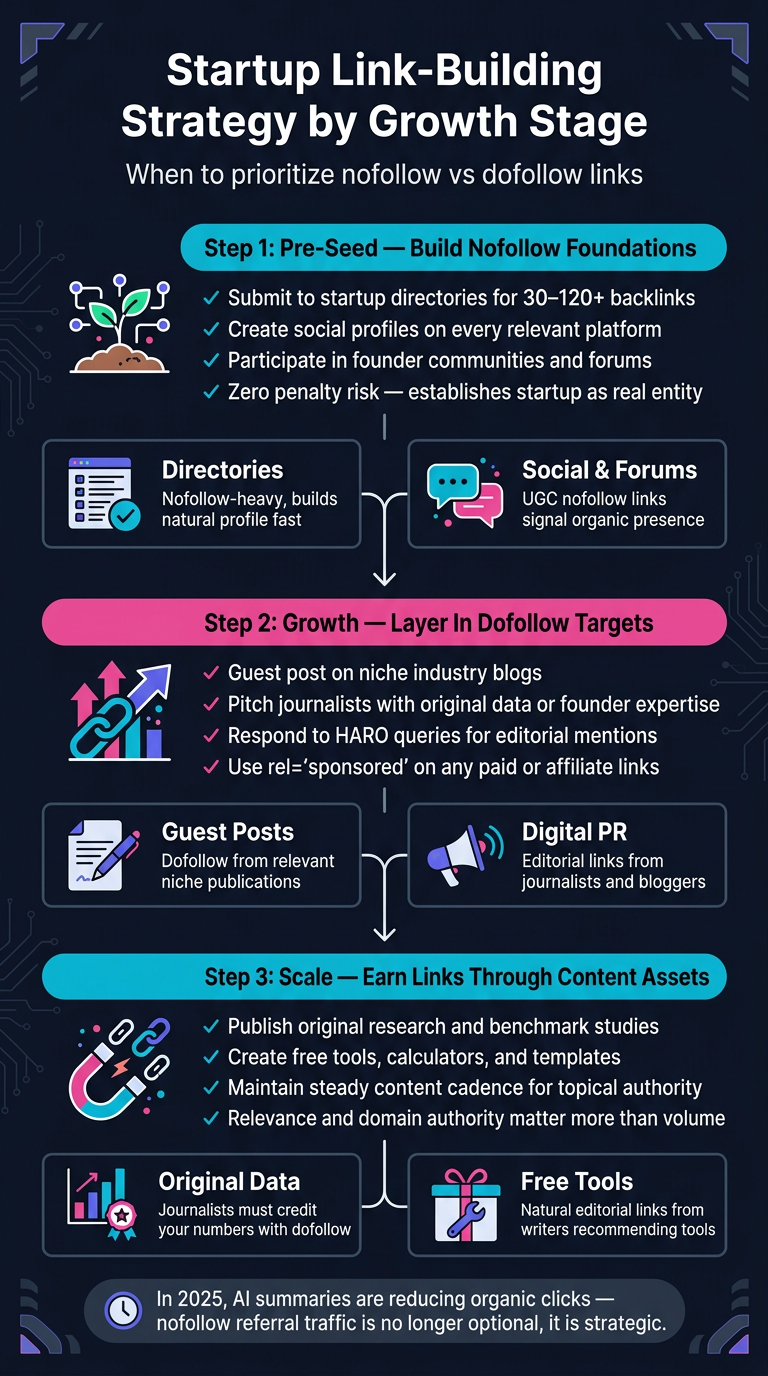
    1. Guest posting on industry publications — earns editorially placed do-follow links that directly pass ranking authority

    2. Startup directories and ranking platforms — consistent citation presence builds brand trust signals and referral traffic

    3. Data-driven content — original research, surveys, or data studies attract press coverage and organic links

    One important distinction: do-follow links pass ranking authority; no-follow links (common in user-generated content and paid placements) don’t directly improve your domain rating.[2] When evaluating link opportunities, always check the link type.

    Practical fix: identify 10 high-authority industry publications that accept contributor posts, pitch one per week, and track domain rating growth in Ahrefs monthly. It’s slower than you’d like, but it compounds.

    Mistake #9 — Underinvesting in Startup Listing Profiles and Directory Citations

    Startup directories aren’t just traffic sources — they’re citation signals. Consistent NAP data (name, URL, contact information) across reputable directories reinforces brand trust and generates referral backlinks that quietly strengthen your domain over time.

    The problem most founders run into: manual directory submissions are genuinely time-consuming. Delayed listings mean delayed link equity — and for early-stage startups, that lag matters. This is one of the core pain points that StartupRanking’s Faster Approval and Booster services are built to solve — giving startups access to 30–120+ directory backlinks without the manual overhead of submitting to each one individually.

    Practical fix: prioritize directories with high domain authority and startup-specific context. Make sure every profile includes:

    • A complete, keyword-relevant startup description

    • Accurate category tags

    • A clean link to your primary domain

    Batch-submission tools or managed services reduce the time cost significantly — and get your link equity accruing weeks earlier.

    Even a technically solid, well-linked site with great content can lose traffic to a shift that most startups haven’t fully addressed yet: the rise of AI-assisted search.

    Section 5: AI-Search Readiness — The SEO Mistakes Startups Are Making Right Now

    Zero-click search is no longer a future concern. 27.2% of U.S. Google searches ended without a click in March 2025, up from 24.4% the year before.[5] Startups optimizing only for blue-link rankings are optimizing for a traffic environment that is actively shrinking.

    Mistake #10 — Optimizing Only for Blue-Link Rankings, Not AI-Assisted Search Visibility

    AI Overviews resolve many queries directly on the results page — before users ever click. Even pages that rank #1 are seeing dramatically lower click-through rates. Position-one CTR for AI Overview keywords fell from 0.073 to 0.016 over just two years.[4]

    This has given rise to a new discipline: Generative Engine Optimization (GEO) — optimizing not just to rank in blue links, but to be cited within AI-generated answers.[7] Brands that appear consistently across authoritative third-party sources — publications, directories, social platforms — are more likely to be surfaced by AI models when users ask relevant questions.

    Practical fix:

    • Structure content with clear definitions, lists, and Q&A formats that AI systems can easily extract

    • Build brand presence across third-party publications and directories so AI models associate your brand with your topic

    • Optimize meta titles and snippet copy for click appeal — for the users who do choose to click through

    This isn’t a reason to panic. 63% of respondents in Conductor’s 2025 survey said AI Overviews positively impacted their organic traffic, visibility, or rankings.[1] Adaptation works. Avoidance doesn’t.

    > “As I wrote in our previous study: Assuming AI Overviews stay in this current form, this is also likely the highest the CTR will be. As the novelty wears off and the law of shitty clickthroughs kicks in, I would expect to see clicks reduce further.”> — Ryan Law, Director of Content Marketing, Ahrefs[4]

    Now that you know the 10 mistakes, here’s exactly how to sequence the fixes so nothing gets skipped.

    Section 6: The Fix-First Framework — Week 1, Month 1, and Quarter 1

    Most SEO advice tells you what’s wrong. This framework tells you what order to fix it in — specifically for founders who are time-constrained and need results, not theory.

    Week 1 — Fix the Foundation

    • Confirm all primary content lives on your owned domain, not a hosted platform

    • Run Google Search Console’s Coverage report and Screaming Frog; fix all P1 technical errors before anything else

    • Audit your site architecture — do you have enough pages to target your core keyword clusters? If not, plan them now

    Month 1 — Fix Measurement and Content Strategy

    • Configure GA4 conversion goals for qualified events: signups, demo requests, pricing page visits

    • Audit existing content for keyword intent — flag pages with high traffic but zero conversions

    • Build or restructure one topical cluster around your highest-value use case; add internal links between related posts

    Quarter 1 — Build Authority and AI Readiness

    • Launch a systematic link-building routine: guest posting outreach plus directory submissions running in parallel

    • Optimize your top pages for snippet appeal — clear definitions, bulleted answers, Q&A formatting

    • Add data, expert quotes, or firsthand founder perspective to your most important pages to strengthen E-E-A-T signals

    Teams that systemize SEO across tools, metrics, and cross-functional processes consistently outperform ad-hoc approaches.[1] The framework above isn’t just prioritization — it’s the foundation of that systematic approach.

    It’s also worth considering what Meta’s VP of Marketing Alex Schultz has said about early-stage growth priorities:

    > “At the early stage, the CEO needs to take charge of growth before handing it off to a dedicated team. Founders who delegate growth too early often lose the feedback loop that informs what’s actually working.”> — Alex Schultz, VP of Marketing, Meta[8]

    You don’t need to be an SEO expert to own the Week 1 fixes. But you do need to own them before handing them off. Register your startup on StartupRanking to start building directory authority while your content and technical foundation come together.

    Conclusion: Fix the Mistakes That Compound Fastest First

    The five-layer priority structure exists for a reason: Foundation → Measurement → Content → Authority → AI-Search Readiness. Each layer depends on the one before it. Backlinks underperform on technically broken sites. Content clusters fail without the right keyword intent. Authority building is wasted if you never convert the traffic.

    The stakes are higher than they were two years ago. With AI Overviews reducing top-ranked CTR by 58%[4] and zero-click searches continuing to rise[5], every unaddressed SEO mistake now carries a larger traffic penalty than it used to. But the upside of fixing them is equally large — and it’s incremental. A two-person startup team can implement the Week 1 fixes this week.

    Here’s the short version of everything this post covered:

    1. Own your domain and your content equity — never build on rented platforms

    2. Track conversions, not just traffic — qualified leads are the only metric that maps to actual startup growth

    3. Build topical authority with clusters — not isolated posts that signal shallow expertise

    4. Earn do-follow backlinks deliberately — passive acquisition is too slow for early-stage startups

    5. Adapt to AI search now — ranking alone no longer guarantees traffic

    If you want to accelerate the authority-building step without burning weeks on manual submissions, register your startup on StartupRanking to access ranking-based global visibility, Booster backlink packages covering 30–120+ curated directories, and AutoRankr for automated SEO content — all without waiting months for manual approvals to process.

    FAQs

    What is the biggest SEO mistake startups make in 2026?

    The single most costly mistake is ignoring the technical foundation while investing in content and backlinks. A SaaS startup that spends $30K on link building and then loses 60% of traffic after a Google update — because of weak technical SEO — illustrates the problem perfectly. Fix crawl errors, sitemaps, and mobile performance first; everything else compounds on top of that base.

    How long does it take for startup SEO to show results?

    Most startups see initial organic traction within 3–6 months when the foundation is clean and content is targeting commercial-intent keywords. Domain authority growth — which drives consistent ranking improvements — typically takes 6–12 months of deliberate link building. The Week 1 and Month 1 fixes outlined in this post can accelerate early results significantly.

    How do startups build backlinks with a small budget?

    Three approaches work well at low cost: guest posting on industry publications (time-intensive but earns editorial do-follow links), submitting to curated startup directories and ranking platforms (especially services that batch submissions to save time), and creating original data-driven content that earns press coverage organically. Prioritize do-follow links from high-authority domains — a few quality links outperform dozens of low-authority ones.

    Is SEO still worth investing in now that AI Overviews reduce organic clicks?

    Yes — but the strategy needs to evolve. While position-one CTR for AI Overview keywords dropped from 0.073 to 0.016 between 2023 and 2025, 63% of SEO practitioners still report that AI Overviews positively impacted their traffic and visibility.[1] The shift is from ranking in blue links to being cited within AI-generated answers, which rewards brand authority, consistent third-party mentions, and well-structured content — all areas where good SEO practice still applies.

    Should a startup hire an SEO agency or handle SEO in-house?

    At the earliest stage, founders should own the core SEO priorities before delegating — as Meta’s Alex Schultz has noted about growth functions generally.[8] The Week 1 foundation fixes and basic measurement setup don’t require an agency. Where agencies or tools add value is in scaling link acquisition, technical audits for more complex sites, and content production at scale. Many early-stage startups use a hybrid model: in-house strategy, with tools and targeted services handling execution.

  • Content Marketing ROI for Startups: How to Track

    Content Marketing ROI for Startups: How to Track

    Most founders calculate content marketing ROI wrong. They look at their $29/month WordPress hosting bill and think, “This is cheap.” They forget the 14 hours they spent writing two blog posts last month—time that could have gone into product development, sales calls, or investor meetings. That time has a price tag, and ignoring it makes content marketing look far cheaper than it actually is.

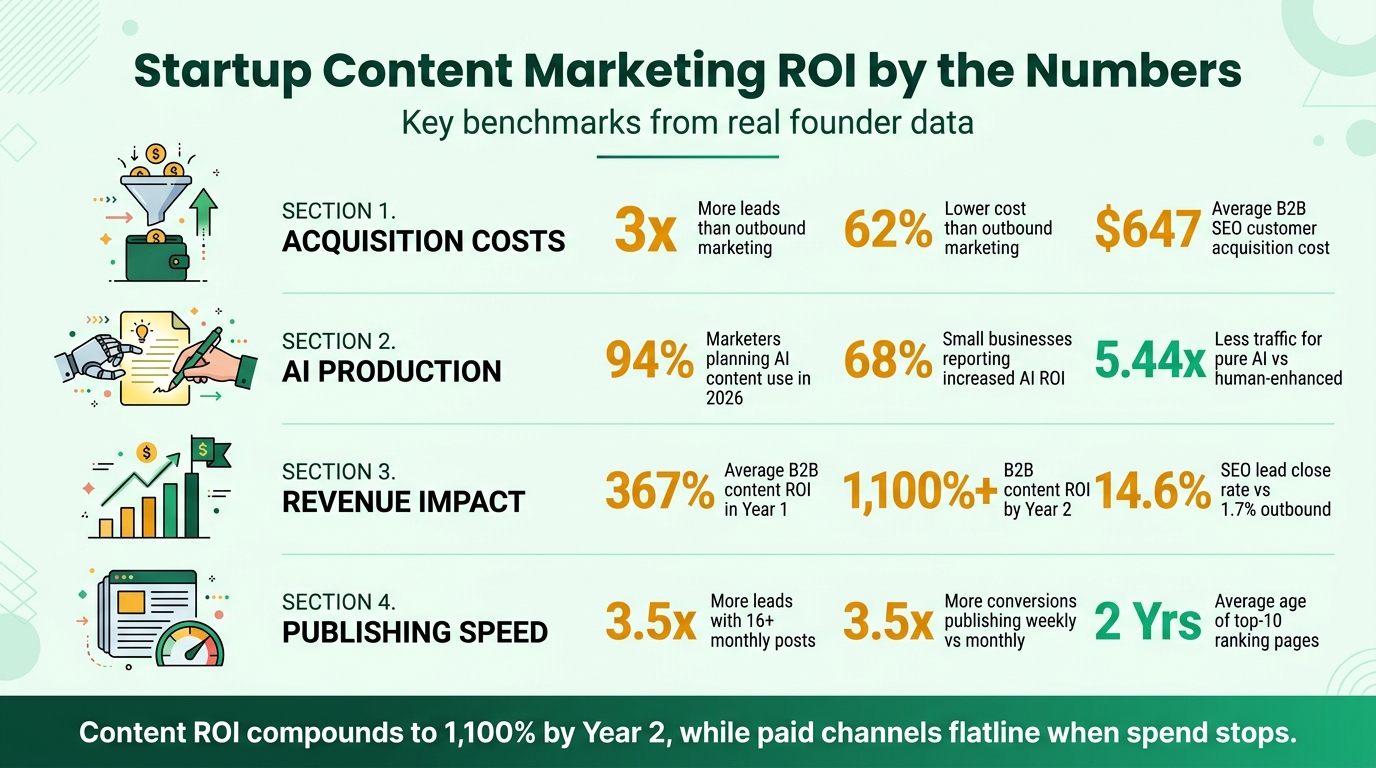
    Here’s the reality: content marketing costs 62% less than outbound marketing while generating 3x as many leads—but only if you measure it correctly over a 12–18 month horizon, not the typical 90-day window where startups abandon their efforts[1]. And 56% of marketers say attributing ROI to content is a top challenge, which gets even harder for startups with limited traffic[9].

    This post gives you a realistic, stage-aware framework for measuring content marketing ROI for your startup. You’ll learn:

    • The true cost of content across four execution models (DIY isn’t free)

    • A startup-adapted ROI formula that accounts for founder time and pre-revenue metrics

    • Realistic timeline expectations so you don’t kill campaigns too early

    • How to present content ROI to investors in language they understand

    • Why GEO tracking belongs in your measurement framework starting now

    The True Cost of Startup Content Marketing: Four Execution Models

    Before you can measure ROI, you need to know what you’re actually spending. Most founders track only direct costs—freelancer invoices, tool subscriptions, ad spend. They miss the biggest expense: time.

    DIY, Freelancer, In-House, and AI-Assisted Cost Comparison

    Startups typically produce content through one of four models. Each carries different direct costs, hidden costs, and timelines to reliable ROI signals. Here’s how they compare for a Seed to Series A company[1]:

    Model

    Direct Cost/Month

    Hidden Cost/Month

    Output (Posts/Month)

    Time to ROI Signal

    DIY

    $0–500

    $2,100+ (founder time)

    2–4

    6–12 months

    Freelancer

    $1,000–3,000

    $750–1,500 (coordination)

    4–8

    4–8 months

    In-House

    $8,000–15,000

    $0 (built-in)

    8–16

    3–6 months (after ramp)

    AI-Assisted

    $45–500

    $300–750 (review time)

    4–12

    4–8 months

    The takeaway: the “cheapest” option on paper often costs the most when you factor in opportunity cost. And the most expensive option (in-house) reaches ROI signals fastest because of higher output volume and dedicated focus.

    Why the “Free” DIY Option Often Costs the Most

    Let’s do the math on DIY. If a founder’s time is worth $150/hour—conservative for someone capable of raising venture capital—and they spend 14 hours per month writing and editing four blog posts, that’s $2,100/month in opportunity cost[1]. Over a year, that’s $25,200 worth of founder time that could have gone to product, sales, or fundraising.

    Compare that to hiring a quality B2B SaaS writer at $200–500 per post. Yes, it’s real cash out the door. But the founder gets those 14 hours back, and professional writers typically produce better content that ranks faster. The catch: traditional freelance platforms have a 70% project failure rate for meeting original objectives, so vetting is essential[1].

    Then there’s the AI-assisted model. Platforms now cost $45–500/month for 4–12 posts, slashing per-piece production time from 2–3 hours to under 1 hour[1]. But here’s the critical nuance: pure AI content receives 5.44x less traffic than human-enhanced content[1]. AI is a starting point, not a finish line.

    With 94% of marketers planning to use AI in content creation in 2026, AI-assisted production is becoming the practical baseline for lean teams[5]. The winning formula: AI for research and drafts, humans for expertise and polish.

    Choosing your production model is step one. Step two is figuring out whether that investment actually pays off—which brings us to the math. For many startups, getting listed on a startup discovery platform is a low-effort first step to building the backlink profile that makes content ROI compound faster.

    How to Calculate and Measure Content Marketing ROI

    The ROI Formula Adapted for Startups

    The standard formula is straightforward:

    Content Marketing ROI = ((Revenue Attributed to Content – Total Content Costs) / Total Content Costs) × 100[3]

    If you spend $5,000 on content and it generates $15,000 in attributed revenue, your ROI is 200%. Simple enough. But startups need two important adaptations:

    First, include all internal costs in the denominator. Founder time at market rate, tool subscriptions ($29–$500/month), freelance coordination hours, and the opportunity cost of what else that time could have produced. If your denominator only includes freelancer invoices, you’re lying to yourself about efficiency[1].

    Second, for pre-revenue startups, substitute pipeline value or qualified leads for revenue. If you’re not yet generating ARR, track the estimated value of leads that content brings in. A qualified lead that matches your ICP profile has real worth—assign a conservative dollar figure based on your expected conversion rate and average deal size. This lets you calculate ROI even before the first dollar hits your bank account.

    Timeline Expectations and Milestone Metrics

    Content marketing is a compounding asset, not a light switch. SEO typically takes 3–6 months to show initial results, with significant growth between 6–12 months. The average page ranking in Google’s top 10 is roughly 2 years old[1]. If you’re judging success at month three, you’re killing campaigns before they have a chance.

    Here’s what realistic milestones look like:

    • Months 1–2: Pages get indexed, organic traffic is minimal or zero, and you’re questioning every life choice that led you here

    • Months 3–4: Long-tail rankings start improving, you might see the first attributed lead from search

    • Months 5–6: Consistent traffic arrives, initial ROI signals appear

    • Months 7–12+: Compound growth kicks in—150%+ increases are common as older posts accumulate backlinks and authority[1]

    Volume matters too. Publishing 16+ posts per month drives 3.5x more leads than publishing 4 or fewer. Weekly publishing drives 3.5x more conversions than monthly publishing[1]. The compounding effect accelerates with consistent output.

    And the cost comparison to paid channels is stark: organic CAC via content runs $500–$1,500, while paid CAC ranges from $802–$2,000. Better yet, organic CAC improves with scale as your content library grows, while paid CAC typically increases as you exhaust cheap audiences[1]. For B2B specifically, SEO delivers a CAC of $647 versus higher-cost channels, making it the highest-ROI digital marketing channel available[4].

    Attribution for Low-Traffic Startup Websites

    If your site gets fewer than 1,000 monthly visitors, forget multi-touch attribution. You don’t have enough data points for statistical reliability. Instead, use simple first-touch and last-touch tracking in a spreadsheet[1].

    Tag every piece of content with UTM parameters. When a lead comes in, trace them back to the first content asset that brought them to your site. This gives you a direct, if imperfect, line between content investment and pipeline generation.

    Here’s why this matters even with small numbers: SEO leads have a 14.6% close rate versus 1.7% for outbound leads[1]. Even three or four content-attributed leads per month carry disproportionate revenue potential compared to dozens of cold outreach responses.

    Getting the math right is only half the equation. The other half is the content itself—quality determines whether your investment compounds or evaporates.

    Content Quality Tiers and the AI+Human Hybrid Model

    The Three Quality Tiers and Their ROI Impact

    Not all content is created equal, and the quality gap shows up directly in ROI. Drawing from First Page Sage’s Content Quality Tier Framework, content falls into three buckets[2]:

    Quality Tier

    Characteristics

    ROI Impact

    Low Quality

    Amateurish, unedited, no industry expertise, thin information

    Negative ROI; can harm brand perception and trust

    Standard Quality

    Grammatically correct but reads like a sales pitch; lacks depth

    Modest returns initially; fails to compound over time

    High Quality (Thought Leadership)

    Carefully edited, authoritative, includes custom graphics, data, case studies, and original insights

    Highest returns, averaging $984,000/year in new revenue

    Quality is the single variable that separates campaigns with no ROI from those that justify building an in-house team[2]. The good news for startups: small businesses are 23% more likely than average to see ROI from blog posts, meaning lean teams can reach high-quality tier by leveraging founder expertise and AI assistance[5].

    “The variable of quality explains why some companies have had no success with content marketing and others have had so much that they’ve invested in building a complete content marketing team in-house.”

    — Evan Bailyn, Founder of First Page Sage and Generative Engine Optimization Expert

    Startup Content Marketing ROI Statistics for Founders

    Startup Content Marketing ROI Statistics for Founders

    The AI-Assisted Human Content Framework

    The path to thought-leadership quality on a startup budget runs through AI-assisted production. Here’s the framework: AI handles research, outlining, and draft generation; humans add expertise, original insights, and final polish[1].

    The numbers back this up. 67% of small businesses now use AI for content marketing, and 68% report increased ROI from AI implementation[5]. But the critical guardrail remains: pure AI content gets 5.44x less traffic than human-enhanced content, so skipping the human review step destroys the ROI you’re trying to create[1].

    AI-assisted platforms cost $45–500/month for 4–12 posts. This makes it the most cost-efficient model for resource-constrained startups aiming for thought-leadership quality—provided the founder or a subject-matter expert spends 30–60 minutes per piece adding original data, anecdotes, and strategic framing[1].

    Once you’re producing high-quality content and measuring ROI with real numbers, the next step is communicating those results to the people who fund your company.

    Presenting Content ROI to Investors and the GEO Opportunity

    Investor-Ready Content ROI Metrics

    Investors don’t care about pageviews. They care about unit economics, scalable acquisition, and capital efficiency. Translate your content metrics into their language:

    • Organic traffic growth → CAC efficiency. Show that your blended CAC is declining as content volume increases. Benchmark your organic CAC ($500–$1,500) against industry averages: B2B SaaS CAC sits at $273 and B2B fintech at $923[4]. If your content-driven CAC beats your industry average, that’s a fundraising narrative.

    • Content-attributed pipeline → scalable acquisition proof. Track what percentage of your pipeline comes from content. A growing share signals that acquisition can scale without proportionally growing spend.

    • Conversion rate → product-market-fit signal. If visitors from organic search convert at higher rates than other channels, it suggests your messaging resonates with people actively seeking solutions—a strong PMF indicator.

    Frame content as a compounding asset. Year 1 ROI averages 367% across B2B verticals, scaling to 1,100%+ by Year 2[2]. That’s the opposite of paid channels, where spend stops producing results the moment you stop paying. Content from two years ago keeps generating leads at near-zero marginal cost.

    “B2B content marketing generates an average 3:1 ROI, or $3 for every dollar invested; when executed with proper SEO strategies, returns can reach 748%.”

    — Genesys Growth, Content Marketing ROI Statistics for Marketing Leaders[6]

    Generative Engine Optimization: Measuring Content ROI Beyond Traditional Search

    Google isn’t the only search engine that matters anymore. ChatGPT, Perplexity, Gemini, and Claude are becoming answer engines, and your content either shows up in their citations or it doesn’t. 24% of marketers are already updating their SEO strategy for generative AI search, and 92% plan to optimize for both traditional and AI-powered engines[5].

    For startups, this is a measurement opportunity hiding in plain sight. Add GEO metrics to your ROI framework:

    • Track whether your content appears in ChatGPT and Perplexity responses using manual queries or emerging monitoring tools

    • Attribute downstream traffic and leads to AI citations when users click through from an AI-generated answer

    • Monitor brand mentions in LLM outputs—being cited as a source even without a click builds authority that converts later

    • Log referral traffic from AI-powered search results as a separate channel in your analytics

    McKinsey notes that generative AI and agentic AI are already accelerating classic marketing approaches, meaning early GEO investment offers a first-mover compounding advantage[7]. No competitor is yet tracking this systematically—which means you can build a measurement advantage before the space gets crowded.

    Getting listed on startup directories and ranking platforms feeds directly into this strategy. When your startup profile appears in curated lists and rankings, AI engines treat those citations as authority signals, increasing your chances of appearing in generated answers.

    Key Takeaways

    Measuring content marketing ROI for a startup isn’t complicated, but it requires honesty about costs and patience with timelines. Here’s what to remember:

    • DIY content is not free. Factor founder opportunity cost ($2,100+/month) into all ROI calculations. The “cheap” option is often the most expensive per unit of output[1].

    • Measure over 12–18 months, not 90 days. The average top-10 ranking page is roughly 2 years old. Killing campaigns at month three guarantees negative ROI[1].

    • Content quality is the deciding variable. Thought-leadership content generates $984,000/year in new revenue on average; low-quality content generates negative ROI[2]. Use the AI+human hybrid model to reach that tier on a startup budget.

    • Organic CAC ($500–$1,500) beats paid CAC ($802–$2,000) and improves with scale. Content + SEO is the highest-ROI channel available to startups[1][4].

    • Speak investor language. Present content metrics using CAC, LTV, and payback period—not vanity metrics like pageviews[4][1].

    • Add GEO tracking now. AI search citations are a new compounding traffic source that competitors aren’t measuring yet. Early measurement infrastructure creates a data advantage.

    Building the backlink profile and organic signals that make content ROI compound starts with visibility. Register your startup on StartupRanking to get discovered, build authoritative backlinks, and generate the kind of organic momentum that makes every piece of content you publish work harder over time.

    FAQs

    How do you calculate content marketing ROI for a pre-revenue startup?

    For pre-revenue startups, substitute pipeline value or qualified leads for revenue in the standard formula. Assign a conservative dollar figure to each qualified lead based on your expected conversion rate and average deal size. Use the formula: ((Pipeline Value Attributed to Content – Total Content Costs) / Total Content Costs) × 100. Include all internal costs—founder time, tool subscriptions, and coordination hours—not just freelancer invoices[3][1].

    How long does it take for content marketing to show ROI?

    Content marketing typically takes 3–6 months to show initial results, with significant growth between 6–12 months. The average page ranking in Google’s top 10 is roughly 2 years old. Realistic milestones: months 1–2 for indexing, months 3–4 for long-tail rankings and first attributed leads, months 5–6 for consistent traffic and initial ROI signals, and months 7–12+ for compound growth of 150%+[1]. Publishing 16+ posts per month accelerates this timeline significantly.

    What is the true cost of DIY content marketing for founders?

    DIY content marketing costs far more than the $0–500/month in direct expenses. At a conservative founder rate of $150/hour, spending 14 hours per month on content production equals $2,100/month in opportunity cost—or $25,200/year[1]. Additionally, founder-written content often underperforms professionally written content, extending the time to ROI. The AI-assisted model ($45–500/month plus 30–60 minutes of review per piece) offers a more cost-efficient alternative.

    How should startups present content marketing ROI to investors?

    Translate content metrics into investor language: frame organic traffic growth as CAC efficiency, content-attributed pipeline as proof of scalable acquisition, and conversion rates as product-market-fit signals. Benchmark your organic CAC ($500–$1,500) against industry averages like B2B SaaS CAC ($273) or B2B fintech CAC ($923)[4]. Highlight that content ROI compounds over time—Year 1 averages 367% across B2B verticals, scaling to 1,100%+ by Year 2[2]—unlike paid channels where returns stop when spending stops.

    How does AI-assisted content production affect content marketing ROI?

    AI-assisted production reduces per-piece creation time from 2–3 hours to under 1 hour and costs $45–500/month for 4–12 posts, making it the most cost-efficient model for startups[1]. 68% of small businesses using AI report increased ROI[5]. However, pure AI content receives 5.44x less traffic than human-enhanced content, so maintaining a human review step for expertise and original insights is essential for reaching thought-leadership quality that compounds over time[1].

  • Best SEO Tools for Startups in 2026: Ranked

    Best SEO Tools for Startups in 2026: Ranked

    SEO isn’t dying—it’s splitting in two. Google still handles ~90% of searches, but 60% of those searches now end without a click. Meanwhile, ChatGPT and Perplexity are siphoning off discovery traffic that used to belong to blue links. For startup founders, this creates a weird reality: you need traditional SEO tools and AI-visibility tools. And you need them without burning through your runway.

    This guide ranks tools by startup stage, not by features. Here’s the short version:

    • Pre-seed / $0 budget: Google Search Console + Keyword Planner + Screaming Frog free. Total cost: $0.

    • Seed / ~$200/month: Add Semrush or Ahrefs + Surfer SEO. Break-even in 7–9 months for SaaS.

    • Series A / $500–$800/month: Add AI visibility tracking, paid crawling, and keyword clustering.

    The data is clear: strategy quality drives ROI, not tool count. Thought leadership SEO returns 748% ROI while basic content marketing barely breaks even at 16%[5]. The tools you pick either accelerate your payback window or stretch it out. Let’s make sure it’s the former.

    If you’re struggling to get your startup discovered online, StartupRanking helps you build visibility and backlinks from day one—so the tools in this guide have a foundation to work with.

    What Startups Should Know Before Buying Any SEO Tool

    Realistic SEO ROI Timelines: When Does SEO Actually Pay Back?

    Most startup founders expect SEO to work like paid ads—money in, traffic out, fast. It doesn’t. The benchmark data for 2026 tells a more nuanced story.

    First Page Sage analyzed SEO campaigns across industries and found massive ROI variance depending on what type of SEO you’re doing[5]:

    SEO Campaign Type

    ROAS

    ROI

    Break-Even

    Thought leadership SEO

    9.10

    748%

    9 months

    B2B SaaS SEO

    8.75

    702%

    7 months

    Technical SEO only

    1.35

    117%

    6 months

    Basic content marketing

    1.05

    16%

    15 months

    The gap between thought leadership (748% ROI) and basic content marketing (16% ROI) is enormous. Same channel, same time investment—wildly different outcomes. The difference comes down to content quality, intent matching, and authority building.

    For a startup burning $30K–$50K monthly, a 15-month break-even on basic content is a non-starter. A 7-month break-even on SaaS-focused SEO? That’s competitive with most paid channels at equivalent spend.

    The takeaway: Pick tools that improve content quality and help you match search intent—not tools that just help you publish faster. Free tools like Google Search Console can get you the 6-month technical ROI. But to reach thought-leadership returns, you’ll need keyword research and content optimization tools that tell you what to write and how to structure it.

    The 2026 Search Landscape: Google, Zero-Click, and AI Search

    Three forces are reshaping where your startup gets discovered:

    1. Google still dominates. With 89.85% of global search market share, Google-first tools remain non-negotiable[3]. Ignoring Google in 2026 is like ignoring oxygen.

    2. Zero-click searches are the norm. Between 58% and 60% of searches now end without a click[4]. Users get their answer directly from featured snippets, knowledge panels, and People Also Ask boxes. Winning in 2026 often means winning inside the SERP, not just getting the click.

    3. AI search is real and growing. Users are shifting queries from Google to ChatGPT, Perplexity, and Gemini. Adweek highlighted a crop of startups building specifically for AI search optimization in 2025[6]. Peec AI raised $21 million specifically to help brands adapt as consumers move from Google to ChatGPT[7]. This isn’t hype—it’s a funded market category.

    Backlinko updated its tool recommendations in February 2026 specifically to cover AI search visibility, and Semrush now tracks brand mentions across ChatGPT, Perplexity, Gemini, Claude, and Google AI Overviews[8].

    Practical implication: Your 2026 tool stack needs traditional SEO capabilities plus AI-visibility monitoring. The good news: AI visibility builds on SEO fundamentals. The same content quality and authority signals that rank on Google make you more likely to get cited by AI models[8]. Get the basics right, then add AI monitoring.

    The Startup SEO Stack Framework: Three Tiers Based on Stage and Budget

    Most SEO tool roundups dump 50 tools on you and call it a guide. That’s useless for a founder who needs to make one decision: what do I buy today?

    Here’s the framework we’ll use, inspired by the progression practitioners actually follow—starting with free Google tools, adding content optimization, then layering on competitor research and automation[9]:

    Tier

    Monthly Cost

    Best For

    Core Tools

    Tier 1 — Free MVP Stack

    $0

    Pre-seed, bootstrapped

    GSC, Keyword Planner, Trends, Screaming Frog free

    Tier 2 — Lean Paid Stack

    ~$200

    Seed, early revenue

    Semrush or Ahrefs + Surfer SEO

    Tier 3 — Scale-Up Stack

    $500–$800

    Series A, scaling

    Tier 2 + AI visibility, paid crawler, keyword clustering, outreach

    No startup needs every tool. You add tools only when your current stack becomes a bottleneck. If you’re not yet publishing 4+ articles monthly, you don’t need Surfer SEO. If you’re not yet ranking for 50+ keywords, you don’t need AI visibility tracking. Start small, scale intentionally.

    The next three sections walk through each tier in detail.

    Tier 1: The Free Minimum Viable SEO Stack (Start Here)

    Google Search Console: The One Tool Every Startup Must Use

    Google Search Console (GSC) is free, and it’s the closest thing to Google handing you a diagnostic report on your site. Practitioners at the highest level say free Google tools alone can be enough to rank a site when used well[9].

    Here’s what GSC gives you that no paid tool can replicate:

    • Exact query data: See which search terms already drive impressions to your site—even if you’re not ranking on page one yet. This is your free keyword research starting point.

    • Index coverage: Know exactly which pages Google has indexed and which have errors. If Google can’t index your pricing page, you have zero chance of ranking for “[your product] pricing.”

    • Core Web Vitals: See whether your pages pass Google’s page experience thresholds. Slow-loading pages hurt rankings and conversions.

    • Manual actions and security issues: If Google penalizes your site or detects malware, GSC tells you first. Catching this early can save months of recovery time.

    Practical first step: Connect your domain, submit your sitemap, and wait 48 hours. Then go to Performance → Queries and filter by impressions. You’ll see exactly which keywords Google already associates with your site. Pick the top 5 queries where you have high impressions but low clicks, and optimize those page titles and meta descriptions first.

    Skipping GSC is the single most common SEO mistake startups make. It’s free, it’s direct from Google, and it answers the question every founder asks: “Is anyone even searching for what we do?”

    Google Keyword Planner and Google Trends: Free Keyword Discovery

    Before you write a single blog post, you need to know whether anyone searches for your target terms. Google Keyword Planner (free with a Google Ads account) and Google Trends handle this for $0.

    Google Keyword Planner gives you search volume ranges and competition levels for any keyword. The numbers are ranges, not exact figures—”1K–10K monthly searches” rather than “3,400”—but for a pre-revenue startup, directional data is enough. You’re validating demand, not building a media-buying model.

    Google Trends shows whether a topic is rising or declining. In 2026, this is especially useful for spotting AI-search-related query trends. If “how to optimize for ChatGPT” is spiking while “SEO meta tags” is flat, that’s a content strategy signal.

    Limitation to acknowledge: Keyword Planner volume ranges are broad. Once you need exact search volumes for prioritizing content, you’ll want a paid tool. But for Tier 1, knowing that people search for your topic at all is enough.

    Free Technical and On-Page SEO Utilities

    Technical SEO breaks even in 6 months at 117% ROI[5]. It’s not flashy, but it’s the fastest ROI you’ll get from SEO. These free tools handle the essentials:

    • Screaming Frog SEO Spider (free version): Crawls up to 500 URLs to find broken links, missing meta tags, duplicate content, and redirect chains. For most early-stage startup sites, 500 URLs is more than enough.

    • Google PageSpeed Insights: Measures Core Web Vitals and gives specific optimization recommendations. A slow site kills both rankings and conversions.

    • Google’s Rich Results Test: Validates structured data markup so your pages are eligible for rich snippets. If you’re targeting featured snippets, this is step one.

    • Keywords Everywhere (freemium browser extension): Shows search volume, CPC, and competition directly in Google search results[9]. It’s the fastest way to get keyword data without switching tabs.

    Together, these tools cover technical SEO fundamentals. Fix the errors they surface, and you’ve built the foundation for everything else—content, links, and AI visibility.

    Startup SEO ROI and Search Landscape Statistics for Founders

    Startup SEO ROI and Search Landscape Statistics for Founders

    Tier 2: The Lean Paid Stack (For Startups Ready to Invest ~$100–$300/Month)

    All-in-One SEO Platforms: Semrush vs. Ahrefs for Startups

    When Google’s free tools stop being enough—usually when you’re publishing 4+ articles monthly and need to prioritize keywords by real search volume—it’s time for an all-in-one platform. The two giants are Semrush and Ahrefs.

    Here’s a startup-focused comparison:

    Feature

    Semrush

    Ahrefs

    Startup Verdict

    Keyword research

    Largest database, Keyword Magic Tool

    Smaller but high-quality database, intuitive UX

    Tie — depends on UX preference

    Backlink analysis

    Strong, with Link Building Tool

    Industry-leading, larger index

    Ahrefs edges ahead

    AI search visibility tracking

    Yes (ChatGPT, Perplexity, Gemini, Claude, AI Overviews)[8]

    Limited

    Semrush wins for 2026 readiness

    Content optimization

    SEO Writing Assistant, topic research

    Basic content gap analysis

    Semrush

    Learning curve

    Steeper — more features, more complexity

    Gentler — cleaner interface

    Ahrefs for solo founders

    Entry price

    ~$139/month

    ~$129/month

    Near-identical

    How to decide:

    If you’re a solo founder doing everything yourself, Ahrefs is easier to learn and its Site Explorer is genuinely intuitive. You’ll spend less time watching tutorial videos.

    If you have even one other person helping with SEO or content, Semrush’s broader feature set wins. The AI Visibility Toolkit alone—tracking brand mentions across ChatGPT, Perplexity, and Google AI Overviews[8]—makes it more 2026-ready.

    Both start around $129–$139/month. Start with the entry tier and upgrade only when you hit usage limits. Most seed-stage startups won’t exceed the entry plan for 6–12 months.

    Content Optimization Tools: Surfer SEO, Clearscope, and Claude

    Remember the ROI gap: thought leadership SEO returns 748% while basic content marketing returns 16%[5]. Content optimization tools help you land on the right side of that gap.

    Surfer SEO analyzes the top 20–50 ranking pages for your target keyword and gives real-time recommendations: word count ranges, term frequency, heading structure, and semantic phrases to include. It integrates with Google Docs and WordPress, so you can optimize as you write. Best for startups that want a structured content workflow without hiring an SEO editor.

    Clearscope is more polished but pricier. It’s stronger on semantic relevance and readability scoring. Preferred by teams where an editor reviews content before publishing. For most startups, the price difference over Surfer isn’t justified until you’re publishing 8+ articles monthly.

    Claude (Anthropic) isn’t a traditional SEO tool, but practitioners in 2026 use it alongside Surfer for content drafting and outlining[9]. The workflow: use Surfer to build a keyword-optimized brief, use Claude to draft the article, then edit for originality and voice. This cuts content production time by 40–60% for solo founders.

    Startup recommendation: Start with Surfer SEO’s entry plan (~$69/month). Add Claude if you’re producing 4+ articles monthly and need drafting speed. Add Clearscope only if you have a dedicated content editor who needs advanced semantic analysis.

    Rank Tracking and Reporting: Simple Tools for Startup Dashboards

    Startups need to know if SEO is working, but enterprise-grade rank tracking is overkill. Here’s what actually matters:

    Google Looker Studio (free): Connect GSC and Google Analytics to build a dashboard showing organic traffic, top pages, and query performance over time. Not as polished as paid tools, but it works for internal tracking and investor updates.

    SE Ranking: A budget-friendly alternative to Semrush/Ahrefs with solid rank tracking, website audit, and backlink monitoring. Plans start around $55/month, making it attractive for bootstrapped startups that need daily rank tracking but can’t justify $129/month for a full platform.

    SEOGets: A newer tool that pulls GSC data into clearer dashboards[8]. Useful if you manage multiple domains or want client-style reporting for investors without building Looker Studio dashboards from scratch.

    Recommendation: Start with GSC + Looker Studio (free). Add SE Ranking only if you need daily rank tracking for competitive keywords. The free combo covers 80% of what a seed-stage startup needs to report.

    Tier 3: The Scale-Up Stack (For Funded Startups Ready to Aggressively Grow)

    Technical SEO at Scale: Screaming Frog, Sitebulb, and Crawling Workflows

    When your site passes 500 pages—common for SaaS companies with integrations pages, use cases, documentation, and a blog—the free version of Screaming Frog caps out. At scale, crawl issues multiply fast: orphan pages, redirect chains, duplicate meta tags, hreflang errors.

    Technical SEO alone delivers 117% ROI and breaks even in 6 months[5]. At scale, that ROI compounds because every crawl error affects more pages.

    Screaming Frog (paid, ~$259/year): Unlimited URL crawling, JavaScript rendering, log file analysis, and integration with Google Analytics and GSC. It’s the industry standard for a reason—it surfaces problems that most tools miss.

    Sitebulb: More visual and beginner-friendly than Screaming Frog. Generates crawl reports with charts and priority scores, so non-SEO team members can understand what needs fixing. Good for startups where engineering handles technical fixes but doesn’t speak SEO.

    Scale-up workflow: Schedule weekly crawls. Fix critical issues (broken internal links, orphan pages, noindex errors) within 48 hours. Review the full crawl report monthly. For e-commerce or marketplace startups with thousands of pages, this is non-negotiable—one misconfigured canonical tag can tank category page rankings.

    AI-Search Visibility and Answer Engine Optimization Tools

    This is the 2026-specific category most roundups miss. As users shift queries from Google to ChatGPT and Perplexity, startups need to know if their brand appears in AI-generated answers.

    Semrush AI Visibility Toolkit ($99/domain): Tracks brand mentions across ChatGPT, Perplexity, Gemini, Claude, and Google AI Overviews[8]. For a startup raising a Series A, showing investors that your brand surfaces in AI answers is a new credibility signal—it means your content is authoritative enough to be cited by models trained on high-quality sources.

    ProductRank.ai: Used by practitioners for tracking brand visibility specifically in AI-powered search results[9]. More niche than Semrush but potentially more focused if AI search is your primary growth channel.

    Strategic reality check: AI visibility doesn’t replace traditional SEO—it builds on it[8]. The same content quality, structured data, and authority signals that help you rank on Google make you more likely to be cited by AI models. Tools in this category just tell you whether it’s working.

    The market is moving fast. Adweek reported in August 2025 that a wave of startups is building specifically for AI search optimization as keywords give way to LLM-driven discovery[6]. Peec AI raised $21 million in November 2025 to help brands adapt as consumers ditch Google for ChatGPT[7]. This is a structural shift, not a fad.

    “AI search optimization is not a replacement for traditional SEO; it’s a layer on top. The fundamentals—quality content, clear structure, and authority signals—are what make AI models cite you in the first place.”
    — Backlinko, 2026 SEO tools analysis[8]

    Link Building and Outreach: Tools for Earning Startup Backlinks at Scale

    Backlinks still drive rankings, but startups struggle here because they lack brand recognition. Nobody wakes up thinking “I should link to a startup I’ve never heard of.” Outreach tools help bridge the gap.

    Featured: Connects you with journalists and bloggers posting HARO-style queries[8]. You respond to reporter requests with expert commentary, and if they quote you, you get a backlink from a legitimate publication. For startups, this is more accessible than cold outreach—you’re helping a journalist, not asking for a favor.

    BuzzStream: For managing proactive outreach campaigns—finding contact info, sending personalized emails, and tracking responses[8]. Useful when you’ve built something link-worthy (original data, a free tool, a definitive guide) and want to tell people about it.

    Startup-specific alternative: If you’re pre-launch or early-stage and don’t yet have link-worthy content, building an initial backlink profile through startup directories is a pragmatic first step. StartupRanking’s Booster service provides 30–120+ directory backlinks, which creates a baseline link profile while you develop content worthy of editorial links.

    ROI context: Link building supports the thought leadership SEO model that delivers 748% ROI[5]. But it’s a multiplier on content quality. Outreach without great content burns time and reputation—journalists and bloggers will ignore your second pitch if your first was irrelevant.

    Keyword Clustering and Content Planning at Scale

    When a startup moves from publishing 4 articles monthly to 15+, keyword clustering becomes essential. Without it, you risk writing multiple articles targeting the same keyword, splitting your ranking potential across pages that compete with each other.

    Keyword Insights: AI-powered keyword clustering and intent mapping[8]. It groups thousands of keywords into topic clusters and maps them to search intent (informational, commercial, transactional). The output is a content map organized by pillar pages and supporting posts, with clear intent instructions for each.

    Why this matters for startups: Google rewards topical authority—covering a subject comprehensively, not just writing isolated posts. Clustering helps you build content hubs where a pillar page covers the broad topic and supporting posts target specific long-tail variations. This structure signals to Google that you’re a legitimate resource on the subject.

    Workflow: Export keyword data from Semrush or Ahrefs → run through Keyword Insights → get a content map organized by pillar pages and supporting posts → assign to writers with clear intent instructions. This cuts content planning time from days to hours at scale.

    How to Choose the Right Stack for Your Startup Stage

    Here’s the decision framework in one table:

    Startup Stage

    Stack

    Monthly Cost

    Core Tools

    Key Metric to Track

    Pre-seed / Bootstrapped

    Tier 1 — Free MVP

    $0

    GSC, Keyword Planner, Trends, Screaming Frog free

    Indexed pages, click-through rate

    Seed / Early Revenue

    Tier 2 — Lean Paid

    ~$200

    Semrush or Ahrefs + Surfer SEO

    Organic traffic growth, keyword rankings

    Series A / Scaling

    Tier 3 — Scale-Up

    $500–$800

    Tier 2 + Screaming Frog paid, AI Visibility, Keyword Insights, outreach

    Revenue attribution, AI brand mentions, backlinks

    Decision heuristic: Only upgrade tiers when your current stack is the bottleneck—not because a tool list told you to.

    • If you’re not yet publishing 2–4 articles monthly, stay in Tier 1. GSC and Keyword Planner are all you need.

    • If you’re publishing regularly but can’t prioritize which keywords to target, move to Tier 2. Semrush or Ahrefs will pay for themselves in content efficiency.

    • If you’re publishing 15+ articles monthly, managing 500+ pages, or raising a Series A, move to Tier 3. AI visibility tracking and keyword clustering become necessary to avoid cannibalization and to prove ROI to investors.

    For founders who want to skip the manual directory submission grind entirely, StartupRanking’s Faster Approval and Booster services handle listing and backlink creation while you focus on content and product. It’s one way to accelerate the “build authority” phase without adding headcount.

    Conclusion: Start Simple, Scale Intentionally, and Track What Matters

    SEO in 2026 isn’t dead—it’s evolving. Google still controls ~90% of search[3], but zero-click results[4] and AI search[6][7] are reshaping how visibility works. Startups need tools that cover both traditional SEO and AI-search presence.

    But the biggest mistake founders make isn’t choosing the wrong tool—it’s buying too many tools too early. The data is unequivocal: strategy quality drives ROI. Thought leadership SEO returns 748% while basic content marketing returns 16%[5]. The tools you choose either sharpen your strategy or distract you from it.

    Here’s the playbook:

    1. Start with Tier 1 (free). Master GSC, publish content that matches intent, and fix technical issues. This alone gets you to a 6-month break-even.

    2. Add Tier 2 (~$200/month) when content volume outpaces your keyword research. One all-in-one platform and a content optimizer will get you to the 7–9 month break-even for SaaS SEO.

    3. Add Tier 3 ($500–$800/month) only when scale demands it. AI visibility tracking, paid crawling, and keyword clustering prevent the problems that kill growth at scale.

    AI search visibility is the new frontier in 2026, but it builds on SEO fundamentals[8]. Get the basics right first, then add monitoring tools to track your brand presence in ChatGPT, Perplexity, and Google AI Overviews.

    B2B SaaS startups can break even on SEO in 7 months at 702% ROI[5]. That’s faster than most paid channels at equivalent spend. The right tool stack accelerates that timeline. The wrong stack delays it.

    If you’re ready to get your startup discovered, register your startup on StartupRanking to get ranked, build backlinks, and start tracking your visibility alongside the tools in this guide.

    FAQs

    What is the best free SEO tool for a startup with zero budget?

    Google Search Console is the single most important free SEO tool for startups. It shows you exactly which keywords your site already ranks for, identifies indexing errors, monitors Core Web Vitals, and alerts you to manual penalties—all for $0. Pair it with Google Keyword Planner for search volume data and Screaming Frog’s free version (up to 500 URLs) for technical audits, and you have a complete free stack capable of delivering a 6-month break-even on technical SEO[5].

    How long does it take for SEO to show results for a startup?

    B2B SaaS SEO campaigns typically break even in 7 months and deliver 702% ROI over time[5]. However, results vary dramatically by strategy: thought leadership SEO can return 748% ROI with a 9-month break-even, while basic content marketing takes 15 months for just 16% ROI. Technical SEO alone (fixing crawl errors, improving page speed) breaks even fastest at 6 months. The key variable isn’t time—it’s content quality and intent matching.

    Should startups use Semrush or Ahrefs in 2026?

    It depends on your team structure. Solo founders will find Ahrefs easier to learn, with a cleaner interface and industry-leading backlink analysis. Startups with even one other team member supporting SEO should lean toward Semrush for its broader feature set, including the AI Visibility Toolkit that tracks brand mentions across ChatGPT, Perplexity, Gemini, and Google AI Overviews[8]. Both start around $129–$139/month, so the decision comes down to ease of use (Ahrefs) versus 2026-readiness (Semrush).

    Is SEO still worth it now that AI search tools like ChatGPT are taking over?

    Yes, because AI search visibility builds on SEO fundamentals. The same content quality, structured data, and authority signals that help you rank on Google make you more likely to be cited by AI models[8]. Google still holds 89.85% of search market share[3], so traditional SEO remains essential. The shift to AI search means startups should add AI-visibility monitoring tools in Tier 3—not replace their Google-first strategy.

    How much should a startup spend on SEO tools each month?

    Pre-seed and bootstrapped startups should spend $0 using free tools (GSC, Keyword Planner, Screaming Frog free). Seed-stage startups with early revenue should budget ~$200/month for one all-in-one platform (Semrush or Ahrefs) plus a content optimization tool (Surfer SEO). Series A startups scaling content aggressively should budget $500–$800/month, adding AI visibility tracking, paid crawling, keyword clustering, and outreach tools. Upgrade only when your current stack is the bottleneck—not because a pricing page tempts you.

  • Dofollow vs Nofollow Links for Startups

    Dofollow vs Nofollow Links for Startups

    Here’s the bottom line: dofollow links pass ranking power, but nofollow links are far from worthless. Since Google’s 2019 update, nofollow is treated as a “hint” — meaning it may still pass value, drive real traffic, and contribute to your startup’s authority.[1]

    Most startup founders obsess over do follow vs no follow links while ignoring nofollow opportunities that send visitors, build brand awareness, and make their backlink profile look natural to Google. That’s a mistake — especially in 2025, when AI summaries are reducing organic click-through rates and diversifying your traffic sources matters more than ever.[2]

    Here’s what you need to know:

    • Dofollow links pass link equity (PageRank) and signal editorial endorsement to Google.

    • Nofollow links are now “hints” — Google may still crawl, index, and credit them.

    • A healthy backlink profile requires both types. An all-dofollow profile can look manipulative.

    • Early-stage startups should build nofollow foundations first (directories, social, communities) before investing heavily in dofollow acquisition.

    • In 2025, referral traffic from nofollow links is strategically more valuable as AI search reduces organic clicks.

    Quick Comparison

    Attribute

    Do-Follow Links

    No-Follow Links

    SEO equity passed

    Yes

    Possible (treated as a hint)

    Risk if purchased

    High (penalty risk)

    Low

    Referral traffic value

    Equal

    Equal

    Typical startup sources

    Guest posts, editorial mentions

    Directories, social, forums, press

    Effort to acquire

    Medium–High

    Low–Medium

    Backlink profile naturalness

    Essential but not exclusive

    Essential for balance

    Best for

    Ranking authority

    Brand exposure, traffic, trust signals

    This post gives you a practical decision framework for understanding, earning, and managing both do follow and no follow links — whether you’re pre-seed or scaling. It also covers how StartupRanking’s services like Booster and Premium Profile help you build a healthy, diverse backlink profile from day one. Let’s break it down.

    1. How Do-Follow and No-Follow Links Actually Work

    1.1 What Each Link Type Signals to Google

    Every link on the web is dofollow by default. There’s no special “dofollow” attribute you add to HTML. A plain link — <a href="https://example.com"> — tells Google: “I’m vouching for this page.” It passes link equity (also called PageRank), signals an editorial endorsement, and encourages Google to crawl the target URL.

    Nofollow works differently. When a site adds rel="nofollow" to a link, it historically told Google: “Don’t pass equity here. Don’t follow this.” But since March 1, 2020, Google treats nofollow as a hint rather than a strict command. That means Google may still crawl the linked page and even credit some value from the link, depending on context.[1]

    Here’s what the actual code looks like:

    • <a href="..." rel="nofollow"> — general nofollow

    • <a href="..." rel="sponsored"> — paid or compensated links

    • <a href="..." rel="ugc"> — user-generated content (comments, forums)

    • <a href="..." rel="sponsored nofollow"> — combinations are valid too[6]

    One thing founders often confuse: there’s a page-level nofollow meta tag (<meta name="robots" content="nofollow">) and a link-level nofollow attribute. The meta tag affects every link on the page. The link attribute affects only the specific link it’s applied to.[6] If you’re checking your own site’s links, make sure you know which one you’re looking at.

    1.2 The 2019 Google Update: Sponsored, UGC, and Hint-Based Processing

    In September 2019, Google made one of the most significant changes to how do follow vs no follow links work. They introduced two new link attributes — rel="sponsored" and rel="ugc" — and fundamentally shifted how all three nofollow-style attributes are processed.[1]

    The breakdown is straightforward:

    • rel=”sponsored” — use this for any link that was paid for, part of an advertising deal, or involved compensation of any kind.

    • rel=”ugc” — use this for links within user-generated content like blog comments, forum replies, or community posts.

    • rel=”nofollow” — still valid as a catch-all when you don’t want to endorse a link and neither sponsored nor ugc applies.

    The critical shift? All three attributes became hints, not directives. Google’s algorithms can now choose whether to use them for ranking, crawling, or indexing purposes.

    “All the link attributes — sponsored, ugc, and nofollow — are treated as hints about which links to consider or exclude within Search.”
    Google Search Central Blog, Danny Sullivan and Gary Illyes[1]

    What does this mean for you as a founder? A nofollow link from a high-authority site like TechCrunch or Product Hunt isn’t worthless. Google may still follow it, index your page through it, and factor it into trust signals. The old binary thinking — “dofollow = good, nofollow = useless” — is outdated.

    1.3 How to Check Whether a Link Is Do-Follow or No-Follow

    You can check any individual link manually. Right-click the link in your browser, select Inspect Element, and look at the <a> tag in the developer console. If you see rel="nofollow", rel="sponsored", or rel="ugc", the link is nofollowed in some form. No rel attribute (or a rel without those values)? It’s dofollow.

    For checking links at scale, use backlink analysis tools. Semrush, Ahrefs, and Mangools all let you filter your entire backlink profile by follow vs. nofollow status.[4][7] Semrush’s Site Audit tool even flags specific issues like “Nofollow attributes in outgoing internal links” and “Nofollow attributes in outgoing external links” — both worth reviewing.[4]

    Founder action item: audit your backlink profile at least quarterly. Understand your dofollow-to-nofollow ratio. You’re not trying to hit a magic number — you’re looking for a natural distribution that matches your industry and stage.

    2. Why No-Follow Links Still Matter for Startup Growth

    2.1 Referral Traffic, Brand Exposure, and Investor Discovery

    A nofollow link on a high-traffic site still puts your startup in front of real people. Product Hunt, Reddit, Hacker News, and major press outlets — these platforms typically nofollow outbound links. But they send thousands of direct visitors to the startups they mention.

    That traffic matters beyond just page views. Brand mentions from nofollow sources contribute to what SEO professionals call entity recognition — Google’s understanding of your brand as a real, notable thing in the world. When your startup name appears across multiple authoritative contexts, Google builds a stronger association between your brand and your niche, even if the links don’t pass traditional PageRank.

    There’s also the investor angle. Many investors discover startups through startup directories and ranking platforms, press mentions, and social media profiles — all of which are predominantly nofollow. An investor browsing top-ranked startups by country isn’t checking whether the link to your site is dofollow. They’re checking your product, your traction, and your story.

    This becomes even more important in 2025. Pew Research found that users who see AI-generated summaries in Google search results are less likely to click through to source websites.[2] If organic clicks are declining, diversifying your traffic through nofollow referral links from directories, press, and communities isn’t optional — it’s essential.

    2.2 Natural Backlink Profiles Look Like a Mix

    Here’s something many founders don’t realize: a backlink profile made up entirely of dofollow links looks suspicious to Google.[4] In the real world, any website that gets mentioned online will naturally accumulate a mix of follow and nofollow links. Social shares are nofollow. Forum mentions are nofollow. Many press outlets nofollow their outbound links. If your profile contains zero nofollow links, it signals that your links were likely built through manipulation rather than earned naturally.

    Early-stage startups are especially vulnerable here. When you have a sparse link profile of, say, 20 total backlinks, each one carries outsized weight. If all 20 are dofollow from guest posts you pitched, that’s a red flag. Mix in directory listings, social profiles, and community mentions, and suddenly your profile looks organic.

    Ahrefs studied the use of nofollow across the web and found that internal nofollow appeared on 35.3% of sites, but those links made up only 3.6% of all internal links.[7] The takeaway: most sites use nofollow sparingly and intentionally. The presence of nofollow in a profile is normal. The absence of it is not.

    So stop dismissing nofollow links from directories, social media, forums, and press. Welcome them. They’re building the foundation of a profile that looks trustworthy to both Google and humans.

    Infographic summary
    Key insights at a glance

    3. A Founder’s Decision Framework: Do Follow vs No Follow Links by Stage

    3.1 Prioritizing Link Opportunities by Stage, Budget, and Risk

    Your link-building strategy should match your startup’s stage. Chasing high-authority dofollow links when you’re pre-seed with no content and no brand recognition is like trying to run before you can walk.

    Pre-seed / Seed stage: Focus on nofollow wins first. Submit your startup to directories like StartupRanking (the Booster plan gets you 30–120+ directory backlinks), create social profiles on every relevant platform, and participate in founder communities. These build foundational visibility with zero penalty risk. You’re establishing your startup as a real entity across the web.

    Growth stage: Layer in dofollow targets. Guest post on niche blogs in your industry. Pitch journalists with original data or founder expertise. Respond to HARO queries. Earn editorial links by being genuinely useful to writers covering your space. At this stage, you have enough brand presence and content to make outreach credible.

    Scale stage: Invest in content assets that attract dofollow links organically. Original research, free tools, benchmark studies, templates, calculators — these are the assets that journalists, bloggers, and other founders link to without you ever asking. This is the most sustainable and highest-ROI approach, but it requires the resources and authority you’ve built in earlier stages.

    Risk calibration at every stage: Buying dofollow links violates Google’s guidelines and carries real penalty risk. Any sponsored, affiliate, or paid-for links must use rel="sponsored".[1][4] The penalty for getting this wrong can tank your rankings overnight — a setback most startups can’t afford.

    3.2 Comparison Table: Do-Follow vs No-Follow for Startups

    Attribute

    Do-Follow Links

    No-Follow Links

    SEO equity passed

    Yes — full link equity transfer

    Possible — Google treats as “hint”

    Risk of penalty if purchased

    High — violates Google guidelines

    Low — no equity expectation

    Referral traffic value

    Equal — depends on source traffic

    Equal — depends on source traffic

    Typical sources for startups

    Guest posts, editorial mentions, resource pages

    Directories, social media, forums, press releases

    Effort to acquire

    Medium–High (outreach, content creation)

    Low–Medium (submissions, participation)

    Impact on profile naturalness

    Essential but not exclusive

    Essential for balance

    Best for

    Ranking authority and domain strength

    Brand exposure, traffic, trust signals

    3.3 When Internal No-Follow Is a Mistake

    Here’s a common founder error: nofollowing internal links to pages like your login screen, pricing page, or blog archive to “sculpt” PageRank toward your most important pages. The idea sounds logical — concentrate your link equity where it matters most.

    The problem? Google no longer recommends this approach. When you nofollow an internal link, the link equity that would have flowed through it is simply lost. It doesn’t get redistributed to other links on the page. It evaporates.[1][4]

    The Ahrefs benchmark data supports this: while 35.3% of sites they studied had some internal nofollow links, those links accounted for just 3.6% of all internal links.[7] The vast majority of sites keep internal nofollow usage minimal.

    Legitimate use cases for internal nofollow do exist: links to private or staging URLs that shouldn’t be indexed, or links to dynamically generated search result pages that could create crawl traps. But your pricing page? Your blog categories? Your team page? Leave those dofollow.

    Rule of thumb: if the page exists for users, let internal links to it remain dofollow.

    4. Earning Do-Follow Links as a Startup: Practical Tactics

    4.1 Content-Led Link Acquisition

    The most sustainable dofollow links come from content that other people want to reference. Not content that’s “pretty good.” Content that contains something a journalist or blogger literally cannot get anywhere else.

    Publish original data. Run a survey of your users. Share anonymized benchmark statistics from your product. Compile industry data into a report. When you’re the source of a number, people link to you — with dofollow links — because they have to credit the original.

    Create free tools and resources. A simple calculator, a template, a checklist, a grading tool — anything that solves a specific problem in your niche. These attract natural editorial links because writers recommend tools their readers will find useful. The link serves the reader, which is exactly why Google values it.

    Consistency matters here. A single blog post won’t build topical authority. You need a steady cadence of quality content that establishes your startup as an expert in its space. StartupRanking’s AutoRankr service automates SEO article creation to help founders maintain that rhythm without burning through their limited time — producing the kind of link-worthy content assets that compound over months.

    4.2 Digital PR and Founder-Led Outreach

    Generic guest post pitches (“I’d love to write for your blog!”) get ignored. What works is leading with something the publication can’t easily replicate: your unique expertise, your startup’s data, or a perspective that challenges conventional thinking.

    Pitch niche publications — not just TechCrunch. A dofollow link from a well-respected blog in your specific industry vertical is often more valuable (in both relevance and traffic) than a nofollow mention on a massive generalist site.

    Use credibility hooks to strengthen your pitches. If your startup has a strong SR Score on StartupRanking or ranks well in its country category, mention that. Third-party validation makes editors take you more seriously.

    Monitor your competitors’ backlinks too. Identify the sites that link editorially in your space, then pitch them with better content or fresher data. If a competitor got a link from a niche blog by providing a quote for an article, you can pitch that same blog with an original data study on the topic.

    “There is no such thing as ‘DOfollow.’”
    Nick Eubanks, quoted in Mangools[6]

    That quote is a useful reminder: the default state of a link is already follow. You don’t need to “earn” a dofollow attribute — you need to earn the link itself from a site that doesn’t apply nofollow. Focus on being worth linking to.

    One reality check: Search Engine Land’s 2025 survey of SEO professionals confirms that link building remains costly and complex.[5] Don’t spray outreach across hundreds of sites. Prioritize high-probability, high-relevance targets where you have a genuine angle.

    4.3 Directory and Listing Strategy

    Not all directories are equal. A listing on a curated, niche-relevant directory carries real value — both for the backlink and the referral traffic. A mass submission to 500 low-quality directories carries risk.

    Prioritize directories that:

    • Are relevant to startups or your specific industry

    • Have editorial review or curation processes

    • Receive real traffic from your target audience (founders, investors, potential customers)

    • Are indexed by Google and have reasonable domain authority

    StartupRanking’s Premium Profile provides dofollow links on ad-free, enhanced pages — giving you a quality dofollow backlink from a trusted startup platform while also improving how your startup appears to the investors and founders browsing the site. The Faster Approval option gets your listing live within 24 hours, which means you start building link age sooner — and link age is a factor in Google’s trust calculations.

    For broader directory coverage, the Booster plan submits your startup to 30–120+ directories, building the kind of diverse, nofollow-heavy foundation that makes your backlink profile look natural and established. This is especially valuable for early-stage startups that need to go from zero web presence to credible entity fast.

    5. Adapting Your Do Follow vs No Follow Links Strategy for 2025

    5.1 Links in the Age of AI Search and Reduced Click-Through

    The search landscape is shifting underneath every startup’s feet. Pew Research reported in March 2025 that Google users who encounter AI-generated summaries are significantly less likely to click through to the source websites those summaries draw from.[2] That means even if your page ranks well, you might see fewer organic visitors than you would have a year ago.

    At the same time, Search Engine Journal reported in July 2025 that Google may increasingly rely less on links and more on content quality and user-behavior signals going forward.[3] Does that mean links don’t matter? No. But it means the exclusive focus on links as a ranking lever is outdated.

    The practical implication for founders: treat nofollow links that drive referral traffic and brand awareness as strategically equal to low-authority dofollow links. A nofollow link from a Reddit thread that sends 500 visitors to your landing page is more valuable than a dofollow link from a DA-20 blog that nobody reads.

    Despite all the changes, SEO professionals surveyed by Search Engine Land in 2025 still confirm that links matter for discovery and authority.[5] The consensus isn’t that links are dead — it’s that they’re one piece of a broader strategy that now includes entity recognition, content quality, and direct traffic sources.

    5.2 Maintaining a Healthy Link Profile as You Scale

    As your startup grows and accumulates more backlinks, you need a system to keep things clean. Here’s a quarterly audit cadence that works:

    1. Check your dofollow/nofollow ratio. There’s no perfect ratio, but look for a natural distribution. If you’re 95% dofollow, something’s off.

    2. Identify toxic links. Spammy sites linking to you can drag down your profile. Use Semrush or Ahrefs to spot them and disavow if necessary.

    3. Verify rel attributes on your own outbound links. Make sure any sponsored, affiliate, or paid links on your site use rel="sponsored". This protects you from penalties.[1]

    4. Compare against competitors. Use backlink tools to see where your competitors are earning dofollow links that you’re missing. Look for gaps in high-quality, relevant sources.

    Stop obsessing over raw dofollow count. A startup with 50 highly relevant dofollow links from respected industry sites will outperform one with 500 dofollow links from random, low-quality blogs. Relevance and authority of the linking domain matter far more than sheer volume.

    The same principle applies to nofollow links. A nofollow mention in a Forbes article or a popular subreddit carries real weight — in traffic, in brand recognition, and potentially in Google’s hint-based processing. Forbes, for example, uses nofollow for all external links as a policy — but a mention there still drives massive brand exposure.[4]

    Build your link profile like you’d build your startup: with intention, patience, and a focus on quality over vanity metrics.

    Conclusion and Key Takeaways

    Let’s bring it all together. If you remember nothing else from this article, remember these five things:

    1. Dofollow links pass ranking equity, but nofollow links aren’t worthless. Google treats nofollow as a hint and may still crawl, index, and credit value from these links.[1]

    2. Use the correct rel attribute for paid links. The 2019 Google update introduced rel="sponsored" and rel="ugc". Getting this wrong with paid or affiliate links can trigger penalties.[1]

    3. A natural backlink profile requires both link types. Early-stage startups should build nofollow foundations through directories, social media, and communities before investing heavily in dofollow acquisition.

    4. Internal nofollow is almost never the right choice. Ahrefs data shows it makes up only 3.6% of all internal links across studied sites — and the equity you block simply disappears.[7]

    5. As AI search reduces organic clicks, nofollow referral traffic becomes more valuable. Diversifying your traffic sources is no longer optional.[2]

    The founders who win at SEO in 2025 aren’t the ones chasing dofollow links at all costs. They’re the ones building a diverse, natural web presence that drives traffic from multiple sources while establishing their startup as a credible entity in Google’s eyes.

    Ready to start building that foundation? Register your startup on StartupRanking to establish your backlink base, earn dofollow links through Premium Profile, get listed across 30–120+ directories with Booster, and keep your content engine running with AutoRankr. Your future backlink profile will thank you.

    FAQs

    Are nofollow links worthless for startups, or do they still help SEO?

    Nofollow links are far from worthless. Since Google’s 2019 update, nofollow is treated as a “hint,” meaning Google may still crawl, index, and even pass some value through these links.[1] Beyond potential ranking signals, nofollow links from high-traffic sites drive direct referral traffic, build brand awareness, and contribute to a natural-looking backlink profile. An all-dofollow profile can actually look suspicious to Google.[4]

    How can I tell if a backlink to my startup is do-follow or no-follow?

    For individual links, right-click the link in your browser, select “Inspect Element,” and look for a rel="nofollow", rel="sponsored", or rel="ugc" attribute in the <a> tag. If none of these appear, the link is dofollow by default. For bulk analysis, use tools like Semrush, Ahrefs, or Mangools, which let you filter your entire backlink profile by follow vs. nofollow status.[4][7]

    Should I use rel=”sponsored” or rel=”nofollow” for paid partnerships on my startup blog?

    Use rel="sponsored" for any link that involves payment, compensation, or advertising agreements. Google introduced this attribute specifically for paid links and recommends it over the generic nofollow for these situations.[1] You can also combine them (rel="sponsored nofollow") if you want to be extra explicit. The key is to never leave paid links as plain dofollow — that violates Google’s guidelines and risks a manual penalty.

    Do backlinks still matter for startup SEO in 2025 with AI search?

    Yes, backlinks still matter — but the landscape is evolving. While AI summaries are reducing organic click-through rates[2], SEO professionals surveyed in 2025 confirm that links remain important for discovery and authority.[5] The shift is toward a more balanced strategy where links work alongside content quality, brand signals, and diversified traffic sources rather than being the sole focus.

    Is it bad to have more no-follow links than do-follow links in my backlink profile?

    Not necessarily. Many legitimate startups have more nofollow links than dofollow, especially early on — social media profiles, directory listings, forum mentions, and press coverage are all predominantly nofollow. What matters is that your profile looks natural for your stage and industry. A healthy mix of both is the goal. An all-dofollow profile is actually more concerning to Google than one that skews nofollow, because it suggests link manipulation.[4][6]

  • Startup Growth Hacking Tips for More Leads12345

    Startup Growth Hacking Tips for More Leads12345

    Most founders are working against three hard constraints at once: limited time, a tight budget, and a runway that keeps shrinking. The pressure to generate qualified leads — fast — pushes many into spending money on channels that haven’t been validated yet. That’s usually where things go wrong.

    The most effective startup growth hacking tips aren’t about moving faster. They’re about moving smarter — validating demand first, running cheap experiments second, and building compounding channels third.

    This guide covers a three-stage lead generation framework built specifically for early-stage founders:

    • Stage 1 — Validate: Use your network and communities to confirm demand before investing in any channel

    • Stage 2 — Experiment: Run parallel low-cost tests across outreach, referrals, and directory listings to find your highest-signal lead source

    • Stage 3 — Compound: Build organic search as a long-term, self-reinforcing lead channel

    Each section includes specific tactics, what to measure, and when to scale — so you leave with a playbook, not just a list of ideas.


    What Growth Hacking Actually Means for Lead Generation

    A lot of founders think growth hacking means finding a clever shortcut — a viral tweet, a scrappy PR stunt, or a paid ad that somehow converts at 10x the normal rate. That’s not it.

    Growth hacking, properly defined, is the practice of running low-cost, rapid experiments across product, marketing, and distribution channels to identify which signals lead to repeatable customer acquisition. [2] It sits at the intersection of marketing, product, and engineering — and its root is resource-light experimentation, not brute-force spending.

    That distinction matters. When the goal is lead generation, the worst version of growth hacking optimizes for raw traffic volume — page views, social followers, impressions. Those are vanity metrics. The better target is qualified leads: people who match your ideal customer profile, have a real problem your product solves, and are likely to convert into paying customers.

    The Difference Between a Growth Hack and a Growth System

    A one-off hack creates a spike. A growth system creates a compounding loop.

    The classic examples still hold up. Dropbox’s referral program — where existing users got extra storage for inviting friends — grew signups by 60%. Hotmail’s viral email footer (“Get your free email at Hotmail”) turned every sent email into an acquisition channel. [2] Neither was a one-time campaign. Both were mechanisms embedded into the product itself — they ran continuously without ongoing effort.

    That’s the standard worth aiming for. Every tactic in this guide should be evaluated for two things before you invest in it: Is it repeatable? And can you measure it? If the answer to either is no, it’s a stunt, not a system.

    Why Premature Scaling Hurts Lead Quality

    Here’s a finding most growth content won’t show you: a Wharton study of over 6.3 million job postings from 38,000+ U.S. startups found that startups scaling within their first 6–12 months are 20–40% more likely to fail. [3] Early scalers were also far less likely to run A/B tests — a signal that they were growing without validating what actually worked.

    “Having patience and testing the product-market fit rigorously — that’s No. 1. You need to make sure that not just the product but the overall business model is well-designed and scalable.”

    Saerom Lee, Professor, Wharton School of the University of Pennsylvania [3]

    The practical implication: acquiring leads before you know what converts them is expensive and misleading. You end up with a full pipeline and no clear signal about what’s actually working. At the earliest stages, the goal is to generate leads to learn — not just to fill a CRM.

    With that framing established, let’s get into the first stage: confirming that demand is real before building anything.


    Stage 1 — Validate Demand Before Building Acquisition Channels

    Before a channel is worth investing in, you need proof that a specific type of person has a specific problem your startup solves. The good news: you can get that proof for free, and the process generates early leads as a byproduct.

    Use Personal and Professional Networks as Your First Lead Source

    Founders consistently underestimate how many qualified leads already exist within their networks. Before you build a landing page, run ads, or pitch to investors, open a spreadsheet and list 50–100 contacts who match your ideal customer profile.

    “Identify the target audience with as much specificity as possible, reach out to people in your professional and personal network who are in that category, and get constant feedback through the process.”

    Ramin Shams, CTO and Co-founder, Classnika [1]

    The practical steps are straightforward:

    1. Build a simple spreadsheet with 50–100 contacts who fit your ICP

    2. Send personalized outreach that references a specific pain point — not a generic intro

    3. Ask for a 20-minute discovery call, not a demo

    4. Track your response rate and test two or three message variants

    The goal here is not to pitch. It’s to confirm that the problem is real, urgent, and worth solving. That’s your first experiment — and it costs nothing but time.

    Enter Communities Where Your Target Customers Already Gather

    Community-led lead generation works because trust already exists in those spaces. When you show up with genuine insight rather than a sales message, interested people opt in on their own terms.

    “When you participate in a community, provide insight and value, you align yourself with early users who become brand advocates.”

    Mark Allen, CEO and Co-founder, Patch [1]

    Useful channels for startup founders right now include Reddit communities like r/startups and r/entrepreneur, Hacker News (Show HN posts), LinkedIn niche groups, and industry-specific Slack communities. [4]

    The rule: don’t drop links. Add genuine value first — answer a question, share a framework, offer a perspective nobody else has. Once you’ve built a small reputation in the thread or community, people will find their way to you.

    It also helps to frame your idea as a question rather than a pitch. One founder described it as presenting ideas to get feedback — which lowers resistance and makes community members feel like contributors rather than targets. [1]

    Once you’ve confirmed real demand through your network and community activity, you’re ready for the next stage: figuring out which acquisition channels are actually worth building.


    Key insights at a glance

    Stage 2 — Run Low-Cost Experiments to Find Your Best Lead Channel

    Validated demand tells you the problem is real. It doesn’t tell you which channel will generate the most qualified leads at the lowest cost. That’s what this stage is for.

    Most founders skip this step entirely. They pick a channel that “feels right” — usually the one they’re most comfortable with — and scale it before they have any evidence it works. That’s how budget gets wasted. [2]

    The better approach: run 2–3 small parallel experiments, measure cost-per-lead and lead-to-customer conversion rate, then scale only what shows real signal.

    Build a Simple Experiment Backlog and Test One Variable at a Time

    You don’t need a growth team or a complicated setup. A Notion table or a Google Sheet is enough. The columns that matter:

    Column What to Track Hypothesis What you expect to happen and why Channel Where the experiment runs Tactic Specific action taken (e.g., subject line variant) Expected Outcome Measurable target (e.g., 10% reply rate) Actual Result What actually happened Decision Scale / Iterate / Kill

    Example experiments you might run in parallel over a 2–4 week window:

    • Cold email: Two subject line variants targeting a specific ICP segment — which one gets more replies?

    • LinkedIn content: A problem-framing post linking to a free resource — how many people click through?

    • Directory listing: A profile on a startup ranking platform — does organic inbound start within 30 days?

    Wharton’s research confirms the payoff: startups that build a genuine culture of experimentation are significantly more likely to survive and find scalable models. [3] The habit of testing one variable at a time is what separates founders who learn from founders who just spend.

    Use Referral Loops to Turn Existing Leads into Lead Sources

    Referral programs are one of the most efficient growth levers available once you have even a handful of early customers. The numbers back it up: referred customers generate 30–57% more referrals than non-referred customers [5] — creating a compounding acquisition loop that doesn’t reset after each campaign.

    You don’t need an engineering team to launch a referral mechanism. A minimal version looks like this:

    • Pick a simple incentive: extended free trial, exclusive early access, or a small account credit

    • Generate a shareable referral link and include it in your post-signup or post-onboarding email

    • Time the ask for the moment of highest satisfaction — right after the user experiences a positive outcome

    Timing is the key design principle here. A referral request sent before someone has seen value from your product will be ignored. Sent right after they’ve had a genuine win? Conversion rates jump significantly.

    Add Your Startup to Directories and Ranking Platforms for Passive Lead Inflow

    Directory listings are easy to dismiss. They shouldn’t be — especially at the early stage when you don’t have the bandwidth for daily outreach.

    A well-maintained listing on a platform like StartupRanking serves three functions at once:

    1. SEO link-building: Inbound links from directory pages contribute to your domain authority over time

    2. Investor discoverability: Investors browse platforms like this by country, category, and SR Score — your profile appears in their research flow without you actively pitching

    3. Social proof: A ranking signal adds credibility when prospects or partners look you up

    Founders can submit a free profile for a global ranking based on the platform’s proprietary SR Score, which tracks inbound/outbound web links and social media engagement. Optional upgrades — like the Booster (30–120+ directory backlinks) or Faster Approval for 24-hour listing — can accelerate the SEO impact if you need results quickly. For founders who can’t sustain daily outreach volume, this is one of the most time-efficient passive lead channels available.

    With your best-performing channels identified, the next move is to invest in the one channel that keeps working long after you’ve stopped actively maintaining it: organic search.


    Stage 3 — Build Organic Search as a Compounding Lead Channel

    Every other lead channel in this guide has a reset problem. Stop outreach, leads stop coming. Turn off ads, traffic drops to zero. SEO is different. A well-ranking article keeps sending qualified traffic for months or years — often at a lower cost per lead than anything else in your stack.

    That’s why SEO belongs in a startup growth hacking framework, not just a long-term brand strategy. The challenge for founders is consistency: writing and publishing quality content regularly when you’re already stretched thin across product, sales, and hiring.

    Target Long-Tail, Low-Competition Keywords That Match Buyer Intent

    Early-stage startups can’t compete for high-volume generic keywords. A startup in the HR tech space has no realistic shot at ranking for “HR software” in year one. But “how to reduce employee onboarding time for remote teams”? That’s winnable — and more importantly, it’s specific enough to attract someone with a real problem.

    Long-tail queries (typically 4–6 words) reflect specific problems. People typing them are usually further along in their decision-making process — which means they convert at higher rates even if the raw traffic volume is smaller.

    To find these keywords without a paid tool:

    • Check Google’s “People Also Ask” section for your core topic

    • Look at what questions come up in forums and communities where your ICP already gathers

    • Use free tools like Google Search Console or Keyword Planner to check difficulty and search volume

    The primary keyword this article targets — startup growth hacking tips — is a practical example of this strategy in action: low competition, clear intent, and directly relevant to the audience most likely to convert.

    Create Content That Answers Specific Questions Your Leads Are Already Asking

    Broad topic posts are hard to rank and harder to convert. The better approach is to map your content directly to the questions your ICP types into Google at different stages of awareness:

    Stage Content Type Example Awareness “What is” or “Why” posts “What is product-market fit?” Consideration How-to guides, comparisons “How to validate startup ideas before building” Decision Case studies, tool comparisons “Best startup directories for SEO backlinks”

    The awareness tier attracts cold traffic. The consideration tier builds trust. The decision tier converts. A content strategy that covers all three stages creates a self-contained funnel — all through organic search.

    For founders who don’t have time to write every post manually, StartupRanking’s AutoRankr tool automates SEO article generation — helping you maintain publishing consistency without burning hours you don’t have. Once a content format or keyword cluster shows real signal, Stripe’s own framework is clear: scale what works, don’t diversify prematurely. [2]

    Building the right channels is only half the job — you also need to know whether they’re actually working, and that requires tracking the right numbers.


    How to Measure Growth Hacking Results Without Chasing Vanity Metrics

    Impressions, follower counts, page views — these are easy to see and easy to report. They’re also almost useless for evaluating whether your lead generation is working.

    The metrics that actually matter are the ones that connect acquisition to revenue. Stripe explicitly warns against over-indexing on acquisition without tracking retention. [2] And the Wharton data confirms it: startups that skip measurement and experimentation are significantly more likely to fail. [3]

    The Four Metrics That Actually Matter for Early-Stage Lead Generation

    Keep your measurement stack minimal. These four metrics give you an accurate picture of lead generation health:

    Metric What It Tells You Cost per qualified lead How much time or money does it cost to generate one ICP-matched lead? Lead-to-customer conversion rate What % of leads become paying customers within 30/60/90 days? Channel attribution Which specific source (community, referral, directory, SEO, outreach) produced the lead? 30-day retention rate Are the customers you acquired actually staying?

    That last metric is easy to overlook at the lead generation stage — but it’s essential. As Andreessen Horowitz frames it, the free tier (lead acquisition) only has real value if it feeds a premium tier of retained, paying customers. [6] Founders who optimize purely for lead volume without measuring what happens next often end up with a full pipeline and an empty bank account.

    Set a Testing Cadence and Review Experiments on a Bi-Weekly Basis

    The cadence matters as much as the tactics. Here’s a simple operating rhythm that works:

    • Run experiments for a minimum of two weeks — shorter than that and you’re making decisions on noise, not signal

    • Review results every two weeks against the four core metrics above

    • Make one of three decisions: Scale (double down), Iterate (adjust one variable), or Kill (stop and move on)

    A simple decision rule: if cost per qualified lead is below your target and conversion rate is above your baseline, scale. If one metric is off, iterate. If both are off after two full cycles, kill it and redirect the time elsewhere.

    “Embrace a culture of experimentation. Many entrepreneurs are hesitant to experiment with or pivot to different concepts, but a systematic approach to experimentation and pivoting will help your startup succeed.”

    Saerom Lee, Professor, Wharton School of the University of Pennsylvania [3]

    The founders who build the most durable lead pipelines aren’t the ones who found the best tactic. They’re the ones who built the habit of testing, measuring, and deciding systematically — week after week.


    The Growth Hacking Sequence That Builds a Repeatable Lead Pipeline

    Here’s the full framework in one place:

    • Stage 1 — Validate: Use your personal and professional network, then engage in communities where your target customers already gather. Confirm that the problem is real and urgent before investing in any channel. Cost: time only.

    • Stage 2 — Experiment: Run parallel small experiments across 2–3 channels — cold outreach, referral loops, and directory listings. Measure lead quality, not volume. Once early customers exist, activate a referral mechanism and use that 30–57% referral multiplier to compound your acquisition. [5]

    • Stage 3 — Compound: Invest in long-tail SEO content once you know what your ICP is searching for. Use tools like AutoRankr on StartupRanking to maintain publishing consistency without burning founder hours.

    The Wharton research makes the core principle plain: the startups most likely to succeed are those that experiment patiently and scale only after proving repeatability — not those that grow fastest in the first year. [3] On average, startups scale after four years — a useful benchmark to hold in mind when you feel pressure to move faster than the evidence supports. [3]

    Growth hacking done right isn’t about shortcuts. It’s about finding the path of least resistance to a qualified lead — then systematizing it so it runs without you having to reinvent it every month.

    If you’re at the early stages of building your lead pipeline, one of the quickest moves you can make is to register your startup on StartupRanking. You’ll get a free global ranking based on your SR Score, start building directory backlinks that contribute to your SEO, and put your startup in front of investors and potential customers who are already browsing the platform — without having to pitch a single one of them directly.


    FAQs

    What is the difference between growth hacking and traditional marketing for startups?

    Traditional marketing typically follows set campaigns with defined budgets and timelines. Growth hacking is experiment-driven — it prioritizes rapid, low-cost tests across product, marketing, and distribution channels to identify what actually drives customer acquisition. The key difference is that growth hacking treats every tactic as a hypothesis to be proved or disproved, rather than a campaign to be executed and repeated regardless of results.

    How do startups generate leads with little or no budget?

    The most effective zero-budget lead sources for early-stage startups are personal and professional networks, community participation (Reddit, LinkedIn groups, Slack communities), and organic content marketing through targeted blog posts. Directory listings on platforms like StartupRanking also provide passive inbound from investors and customers without requiring ongoing effort or spend.

    How do you know when it is the right time to scale a growth channel?

    Scale a channel when two conditions are met simultaneously: your cost per qualified lead is at or below your target, and your lead-to-customer conversion rate is at or above your baseline. If only one of those metrics is on track after two full experiment cycles, iterate. If both are off after two cycles, reallocate that time to a different channel entirely.

    What metrics should early-stage founders track to measure lead generation success?

    Focus on four metrics: cost per qualified lead, lead-to-customer conversion rate within 30/60/90 days, channel attribution (which source generated each lead), and 30-day customer retention rate. Vanity metrics like page views and social followers don’t predict revenue — these four do.

    How does listing a startup on ranking platforms or directories help with SEO and lead generation?

    Directory listings contribute inbound backlinks that improve your domain authority over time, making your website easier to find in organic search. Platforms like StartupRanking also create direct discoverability: investors and potential customers actively browse by country, category, and ranking score — so a strong profile functions as a passive lead-generation asset even when you’re not actively pitching.

  • Startup Directory Listing for Authority Links

    Startup Directory Listing for Authority Links

    Here’s the bottom line: startup directory listing is one of the fastest, most cost-effective ways to build authority backlinks in 2026. Complete listings receive 520% more views than basic ones.[3] Businesses that update their listings quarterly see 37% higher click-through rates than those with static profiles.[4] And yet, most founders either skip directory submissions entirely or scatter submissions randomly — missing compounding SEO benefits that build over months.

    This post teaches you a structured, three-tier framework for startup directory listing that builds authority links, drives referral traffic, and increases investor discoverability faster than almost any other early-stage tactic. Here’s what you’ll learn:

    • Why directories still matter in 2026 — including for AI search and voice discovery
    • The three-tier framework — authority hubs (DA 80+), high-intent niche directories, and community/launch platforms
    • An 8-week submission workflow — so you stop wasting time on random submissions
    • Maintenance routines — that compound your results quarter over quarter
    • How to measure real authority link gains — with specific metrics and timelines

    Whether you’re pre-launch or post-revenue, a structured approach to startup directory listing beats ad hoc submissions every time. Let’s break it down.

    1. Why Startup Directory Listings Still Build Authority in 2026

    1.1 How Search Engines and AI Discovery Use Directory Signals

    Most founders think of directory listings as just “a backlink.” That’s like saying a recommendation letter is just a piece of paper. Directories actually serve three distinct purposes: authority link equity, referral traffic, and credibility signals.[3] Conflating these three into “just SEO” means you’ll underinvest in the ones that matter most for your stage.

    Here’s what’s changed: 45% of consumers now use AI tools for local recommendations, and online directories account for 15% of AI search sourcing.[4] That means your directory listing isn’t just feeding Google’s algorithm — it’s feeding ChatGPT, Perplexity, and whatever AI assistant your potential investor or customer uses.

    Not all directories carry equal weight. Directories with higher user engagement pass up to 3.4x more ranking influence than low-engagement directories.[3] A listing on a platform where people actually browse, filter, and engage with startup profiles transfers far more value than a forgotten page on a generic business directory.

    Startup directories also differ fundamentally from generic business directories. They serve a specific ecosystem — investors, media, partners, fellow founders — which increases relevance signals for search engines. When Google sees your SaaS startup listed on a platform filled with other SaaS startups being browsed by investors, it understands context. That contextual relevance amplifies the link’s authority.

    1.2 The Authority Transfer Effect: Why the Host Platform Matters

    Think of directory listings like real estate. The neighborhood matters as much as the property itself.

    Y Combinator’s directory lists over 5,000 companies on a domain with extreme authority. The combined portfolio valuation exceeds $1 trillion.[1] Being listed alongside vetted companies on a trusted domain transfers reputational value to your startup — both in the eyes of search engines and humans browsing those pages.

    This is the authority transfer effect. When a high-DA platform links to you, some of that domain’s trust flows to your site. But it goes beyond raw link juice. Being found on a curated platform signals to investors and journalists that you’ve cleared some bar of legitimacy.

    Here’s how the top startup directories compare:

    Platform Domain Authority Traffic Level Primary Value
    Hacker News 92 Very High Community + referral traffic
    Product Hunt 88 Very High Launch visibility + link equity
    G2 82 High Buyer intent + reviews
    Crunchbase 80 High Investor discoverability

    Source: The Startup Project[2]

    The strongest directories provide genuine value to users first, with SEO benefit as a byproduct of trust and relevance.[1] Low-value generic directories that exist solely to sell backlinks? Search engines figured those out years ago.

    Now that you understand why startup directory listings build authority, let’s look at which directories deserve your time — organized into a prioritized framework.

    2. The Three-Tier Startup Directory Listing Framework

    2.1 Tier 1: Authority Hubs (DA 80+)

    Authority hubs are platforms with Domain Authority 80+ and high referral traffic that confer institutional credibility. These are your first priority because they offer the strongest link equity and widest visibility.

    The platforms listed in the table above — Product Hunt, Hacker News, Crunchbase, G2 — all qualify.[2] So do curated lists like the Forbes Fintech 50, which continue to attract significant investor and buyer attention in 2026.[7]

    Here’s what surprises most founders: only 35% of SMBs even have a Google Business Profile.[4] If that many businesses skip the most basic listing, imagine how few startups have complete profiles across all Tier 1 hubs. Comprehensive listing on authority hubs is still a real competitive edge — simply because most of your competitors haven’t done it.

    Action step: Claim and fully complete your profiles on every DA 80+ platform relevant to your space before doing anything else. One polished Tier 1 listing beats ten sloppy Tier 3 submissions.

    2.2 Tier 2: High-Intent Niche Directories

    Niche directories are startup-specific platforms where investors, journalists, and partners actively search. Think StartupRanking, AngelList, and SaaSHub (DA 60).[2][6]

    These directories matter because the traffic they send is qualified. Someone browsing a startup ranking site by category and country has investor or buyer intent. That’s fundamentally different from random organic traffic.

    Platforms that organize startups by useful attributes — category, region, funding stage, metrics — increase discoverability for both humans and search crawlers.[1] The more structured your listing data, the easier it is for algorithms to surface you in relevant queries.

    Key selection criteria for Tier 2 directories:

    • Relevance to your vertical — a fintech directory matters if you’re in fintech; a general small business directory doesn’t
    • Listing completeness options — can you add traction metrics, screenshots, team bios?
    • Link policies — do-follow links pass more authority than no-follow, but no-follow links from high-traffic sites still drive referral visitors
    • Active user base — a directory with engaged browsing behavior passes more value[3]

    2.3 Tier 3: Community and Launch Platforms

    Community platforms are places where visibility comes from engagement rather than a static listing. Reddit, Indie Hackers, and Beta List all fit this category.[2]

    These platforms blend directory-style discovery with social proof and community endorsement. A well-received Reddit AMA or Indie Hackers milestone post can generate dozens of backlinks from people who share and reference your story.

    Startup visibility is increasingly multi-channel: launch platforms, communities, and directories form a single distribution ecosystem.[2] Your Product Hunt launch gains traction when your community already knows you from Indie Hackers. Your Crunchbase profile gets more clicks when journalists have seen you active in relevant subreddits.

    A word of caution: community platforms require genuine participation. Dropping links without context gets you downvoted, flagged, or banned. The authority signals come from authentic engagement — comments, helpful responses, shared learnings — not from link-dropping.

    Infographic summary
    Key insights at a glance

    With the right directories identified, the next challenge is actually getting listed efficiently — without burning weeks on manual submissions.

    3. A Step-by-Step Submission Workflow That Saves Time

    3.1 Preparing Your Startup Profile for Maximum Listing Impact

    Before submitting anywhere, prepare a master profile document. Every directory asks for slightly different information, but having everything in one place eliminates redundant work.

    Your master profile should include:

    • Company name (exact, consistent spelling everywhere)
    • Primary URL
    • Tagline (under 10 words)
    • Short description (50-100 words) and long description (200-300 words)
    • Category/vertical classification
    • Founding date and location
    • Team info (founders, key hires)
    • Traction metrics (users, revenue, growth rate — whatever you’re comfortable sharing)
    • Media assets: logo (multiple sizes), product screenshots, demo video link

    Why does completeness matter so much? Complete listings can receive 520% more views than basic listings.[3][4] That’s not a 5% improvement — that’s a 5x multiplier for a few hours of extra work upfront.

    NAP consistency (Name, Address, Phone/URL) across all directories matters too. Conflicting information creates confusing signals for search engines. If your company name is “Acme AI” on one directory and “Acme Artificial Intelligence Inc.” on another, you’re splitting your authority instead of compounding it.

    Rich media makes a real difference in crowded directories. Startups with screenshots and demo videos stand out when an investor is scrolling through hundreds of listings in a category. Treat your directory profile like a mini landing page — it should communicate value in seconds.

    3.2 A Phased Submission Timeline (8 Weeks)

    Random, sporadic submissions don’t work. A phased approach gives you momentum while maintaining quality. Here’s the timeline:[2]

    Week Focus Activities
    1-2 Foundation Claim profiles on all Tier 1 authority hubs. Complete every field. Verify ownership where possible.
    3-4 Niche Expansion Submit to 10-15 high-intent startup directories with tailored descriptions per platform.
    5-6 Community Engagement Join communities, share building-in-public content, schedule soft launches on Beta List.
    7-8 Major Launch Push Coordinate Product Hunt launch, press outreach, cross-promote across all listings.
    Ongoing Maintenance Quarterly audits, metric updates, review responses.

    Notice the progression. You start with the highest-impact platforms (Tier 1), expand to targeted niche directories, build community presence, then coordinate a visible launch. Each phase builds on the previous one.

    The “ongoing” phase isn’t optional. It’s where compounding happens — and we’ll cover that in detail shortly.[3]

    3.3 Handling Slow Approvals and Scaling Submissions

    One of the biggest frustrations founders face with directory listings: slow approval processes. You submit a profile, wait two weeks, hear nothing. Meanwhile, your launch window passes and your SEO gains are delayed.

    Strategies that actually help:

    • Batch submissions — submit to 5-10 directories in a single session rather than one per day, so approvals trickle in steadily over the following weeks
    • Prioritize predictable timelines — some directories clearly state approval times (24-48 hours). Hit those first for quick wins.
    • Use faster-approval services — platforms like StartupRanking’s Faster Approval offer 24-hour listing for founders who can’t afford to wait weeks for SEO gains to begin
    • Automate where possible — services that distribute your profile to 30-120+ directories simultaneously save dozens of hours of manual form-filling

    One critical principle: prioritize quality and relevance over volume. Mass submission to irrelevant directories can actively harm your site. Search engines are sophisticated enough to recognize when a SaaS startup shows up in plumbing directories and pet care listings. Stick to platforms where your presence makes contextual sense.[3]

    Now that your listings are live, the real work begins — keeping them fresh so their value compounds over time.

    4. Maintaining Startup Directory Listings So They Keep Compounding Value

    4.1 Quarterly Audit and Update Routine

    Most founders treat directory listings as a one-time task. Submit, forget, move on. That’s leaving significant value on the table.

    Consider this case study: a company that updated 15 key directories quarterly and responded to reviews within 24 hours saw a 47% increase in local search visibility and a 29% increase in directory-referred leads over 12 months.[3]

    That’s not a minor improvement. Nearly half more visibility, almost a third more leads — just from regular maintenance.

    Your quarterly checklist:

    • Verify all URLs still work (products get renamed, pages get restructured)
    • Update traction metrics (user count, revenue milestones, funding rounds)
    • Refresh descriptions to reflect current positioning
    • Add new screenshots showing latest product features
    • Respond to any reviews or questions
    • Check for duplicate or conflicting listings

    Search engines reward freshness and engagement signals. A listing that was last updated two years ago sends a stale signal. A listing updated last month with current metrics signals an active, growing company. The data backs this up: quarterly updates correlate with 37% higher CTR.[4]

    4.2 Future-Proofing for AI Search and Voice Discovery

    AI search tools already source from directories 15% of the time, and that share is growing.[4] When someone asks an AI assistant “what are the best project management tools for startups,” the AI pulls from structured data sources — including directory listings.

    To position yourself for AI discovery:

    • Use consistent, schema-friendly information — same company name, same category terms, same founding date everywhere
    • Write descriptions in natural language — AI tools prefer clear, factual statements over marketing jargon
    • Include specific attributes — pricing tiers, integrations, use cases, team size — that AI can surface in response to specific queries
    • Keep information current — AI tools increasingly weight recency when sourcing answers

    Appearing in AI local recommendations is actually harder than ranking in traditional Google local results.[4] The startups that get featured are the ones with consistent, detailed, up-to-date information across multiple trusted sources. Your directory listings are part of that information ecosystem.

    Treat every listing as content that could be surfaced by an AI assistant or voice search query. Because increasingly, it will be.

    All this effort deserves measurement — so let’s look at exactly how to track whether your directory strategy is working.

    5. Measuring Results: Tracking Authority Link Gains

    You can’t improve what you don’t measure. But tracking directory listing results requires looking at the right metrics on the right timelines.

    Key metrics to monitor:

    Metric What It Tells You How to Track
    Referring domains How many unique domains link to you Ahrefs, Moz, or Semrush backlink reports
    Domain Rating changes Your overall site authority trend Monthly DR/DA tracking
    Referral traffic from directories Actual visitors from listings Google Analytics referral source report + UTM parameters
    Branded search volume Whether more people search your company name Google Search Console queries report
    Non-branded keyword rankings Whether directory links improve topical authority Rank tracking for target keywords

    Practical tracking tips:

    • Where directories allow custom URLs, add UTM parameters (e.g., ?utm_source=crunchbase&utm_medium=directory) to attribute traffic precisely
    • Monitor your backlink profile monthly — new referring domains from directories should appear within 2-4 weeks of approval
    • Screenshot your Domain Rating on day one and compare monthly

    Realistic timelines: Authority link gains from directories compound over 3-6 months, not overnight. If you’re expecting a ranking jump within a week of submission, you’ll be disappointed. The value builds gradually as search engines crawl, index, and attribute authority from your directory backlinks.

    Here’s how it maps to the framework:

    • Tier 1 hubs show the fastest impact — high-DA links get crawled frequently and pass authority quickly
    • Tier 2 niche directories build relevance depth — they reinforce topical signals over time
    • Tier 3 community platforms generate social signals — they complement direct link equity with engagement metrics

    The combination of all three tiers creates a backlink profile that looks natural, diverse, and authoritative. That’s exactly what search engines want to see from a legitimate growing startup.

    FAQs

    What is a startup directory listing and how does it differ from a regular business listing?

    A startup directory listing is a profile on a platform specifically designed for the startup ecosystem — investors, journalists, partners, and fellow founders. Unlike generic business directories (Yellow Pages, Yelp), startup directories organize companies by stage, category, funding status, and growth metrics. They attract people actively looking to discover, evaluate, or invest in emerging companies.[1]

    Do startup directory backlinks still help SEO in 2026?

    Yes — but quality matters far more than quantity. Directories with high user engagement pass up to 3.4x more ranking influence than low-engagement directories.[3] Additionally, 15% of AI search recommendations now source from directory data, making listings valuable beyond traditional Google rankings.[4] The key is choosing relevant, trusted directories and keeping listings updated.

    How many startup directories should I submit to for maximum authority link value?

    Focus on 5-7 Tier 1 authority hubs (DA 80+) first, then expand to 10-15 high-intent niche directories relevant to your vertical. Beyond that, add community platforms where you can genuinely participate.[2] Total, 25-40 well-chosen directories with complete profiles outperforms 100+ random submissions. Mass submissions to irrelevant directories can actually harm your SEO.[3]

    What information should I include in my startup directory profile for the best results?

    Include your consistent company name, primary URL, concise tagline, detailed description, category, founding date, team information, traction metrics, and high-quality media assets (logo, screenshots, demo video). Complete listings receive 520% more views than basic ones.[3] Ensure NAP consistency across all platforms to avoid sending conflicting signals to search engines.

    How often should I update my startup directory listings to maintain SEO benefits?

    Update your key directory listings quarterly at minimum. Businesses that update listings quarterly see 37% higher click-through rates than those with static profiles.[4] One company that updated 15 directories quarterly and responded to reviews within 24 hours achieved a 47% increase in search visibility over 12 months.[3] Set calendar reminders and treat updates as a recurring growth activity, not a one-time task.


    Startup directory listing isn’t a one-time checkbox — it’s a sustained growth strategy that compounds over months. Start today by claiming your profiles on the highest-authority platforms, complete every field, and build outward systematically using the three-tier framework. If you want to accelerate the process, register your startup on StartupRanking for a free global ranking based on your SR Score — and explore tools like Booster and Faster Approval to skip the manual bottlenecks and start building authority links this week.

  • Hello world!

    Welcome to WordPress. This is your first post. Edit or delete it, then start writing!