
SEO isn’t dying—it’s splitting in two. Google still handles ~90% of searches, but 60% of those searches now end without a click. Meanwhile, ChatGPT and Perplexity are siphoning off discovery traffic that used to belong to blue links. For startup founders, this creates a weird reality: you need traditional SEO tools and AI-visibility tools. And you need them without burning through your runway.
This guide ranks tools by startup stage, not by features. Here’s the short version:
-
Pre-seed / $0 budget: Google Search Console + Keyword Planner + Screaming Frog free. Total cost: $0.
-
Seed / ~$200/month: Add Semrush or Ahrefs + Surfer SEO. Break-even in 7–9 months for SaaS.
-
Series A / $500–$800/month: Add AI visibility tracking, paid crawling, and keyword clustering.
The data is clear: strategy quality drives ROI, not tool count. Thought leadership SEO returns 748% ROI while basic content marketing barely breaks even at 16%[5]. The tools you pick either accelerate your payback window or stretch it out. Let’s make sure it’s the former.
If you’re struggling to get your startup discovered online, StartupRanking helps you build visibility and backlinks from day one—so the tools in this guide have a foundation to work with.
What Startups Should Know Before Buying Any SEO Tool
Realistic SEO ROI Timelines: When Does SEO Actually Pay Back?
Most startup founders expect SEO to work like paid ads—money in, traffic out, fast. It doesn’t. The benchmark data for 2026 tells a more nuanced story.
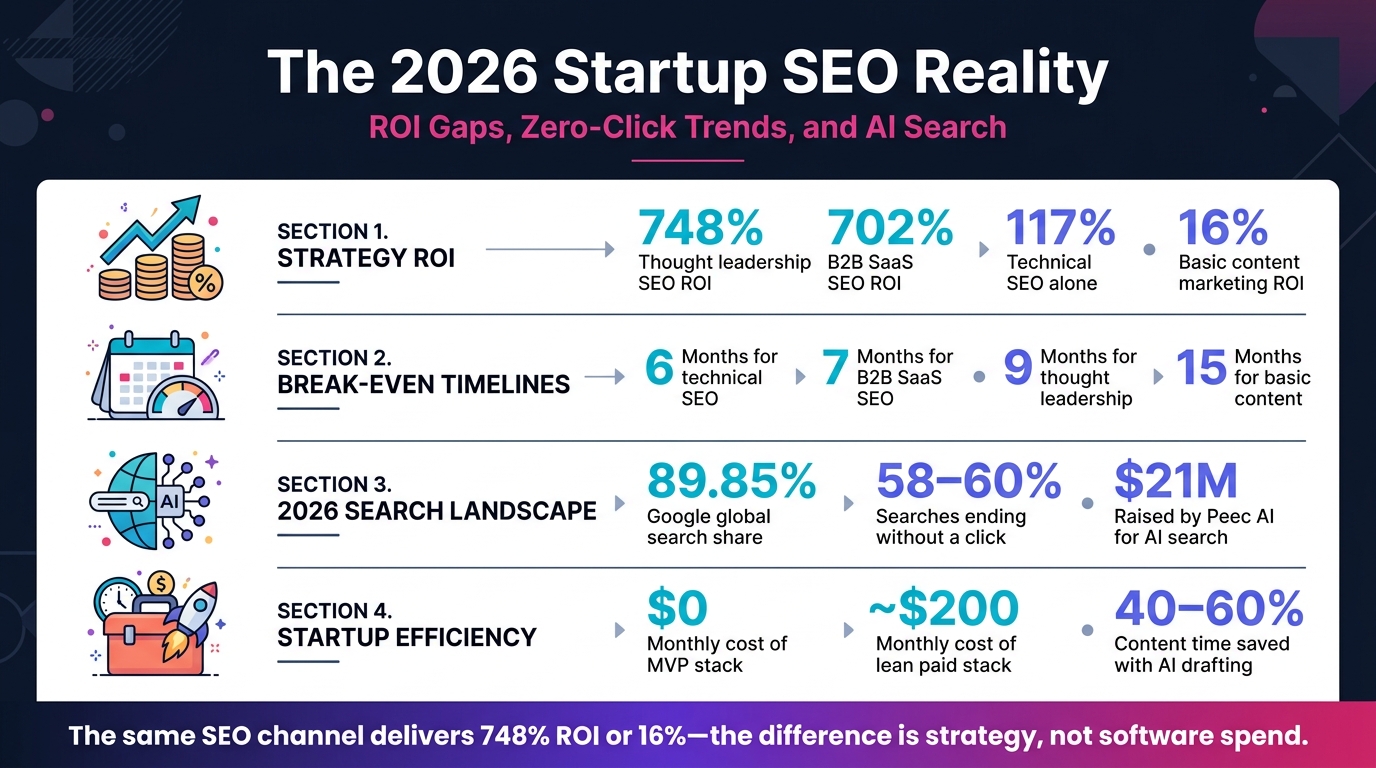
First Page Sage analyzed SEO campaigns across industries and found massive ROI variance depending on what type of SEO you’re doing[5]:
|
SEO Campaign Type |
ROAS |
ROI |
Break-Even |
|---|---|---|---|
|
Thought leadership SEO |
9.10 |
748% |
9 months |
|
B2B SaaS SEO |
8.75 |
702% |
7 months |
|
Technical SEO only |
1.35 |
117% |
6 months |
|
Basic content marketing |
1.05 |
16% |
15 months |
The gap between thought leadership (748% ROI) and basic content marketing (16% ROI) is enormous. Same channel, same time investment—wildly different outcomes. The difference comes down to content quality, intent matching, and authority building.
For a startup burning $30K–$50K monthly, a 15-month break-even on basic content is a non-starter. A 7-month break-even on SaaS-focused SEO? That’s competitive with most paid channels at equivalent spend.
The takeaway: Pick tools that improve content quality and help you match search intent—not tools that just help you publish faster. Free tools like Google Search Console can get you the 6-month technical ROI. But to reach thought-leadership returns, you’ll need keyword research and content optimization tools that tell you what to write and how to structure it.
The 2026 Search Landscape: Google, Zero-Click, and AI Search
Three forces are reshaping where your startup gets discovered:
1. Google still dominates. With 89.85% of global search market share, Google-first tools remain non-negotiable[3]. Ignoring Google in 2026 is like ignoring oxygen.
2. Zero-click searches are the norm. Between 58% and 60% of searches now end without a click[4]. Users get their answer directly from featured snippets, knowledge panels, and People Also Ask boxes. Winning in 2026 often means winning inside the SERP, not just getting the click.
3. AI search is real and growing. Users are shifting queries from Google to ChatGPT, Perplexity, and Gemini. Adweek highlighted a crop of startups building specifically for AI search optimization in 2025[6]. Peec AI raised $21 million specifically to help brands adapt as consumers move from Google to ChatGPT[7]. This isn’t hype—it’s a funded market category.
Backlinko updated its tool recommendations in February 2026 specifically to cover AI search visibility, and Semrush now tracks brand mentions across ChatGPT, Perplexity, Gemini, Claude, and Google AI Overviews[8].
Practical implication: Your 2026 tool stack needs traditional SEO capabilities plus AI-visibility monitoring. The good news: AI visibility builds on SEO fundamentals. The same content quality and authority signals that rank on Google make you more likely to get cited by AI models[8]. Get the basics right, then add AI monitoring.
The Startup SEO Stack Framework: Three Tiers Based on Stage and Budget
Most SEO tool roundups dump 50 tools on you and call it a guide. That’s useless for a founder who needs to make one decision: what do I buy today?
Here’s the framework we’ll use, inspired by the progression practitioners actually follow—starting with free Google tools, adding content optimization, then layering on competitor research and automation[9]:
|
Tier |
Monthly Cost |
Best For |
Core Tools |
|---|---|---|---|
|
Tier 1 — Free MVP Stack |
$0 |
Pre-seed, bootstrapped |
GSC, Keyword Planner, Trends, Screaming Frog free |
|
Tier 2 — Lean Paid Stack |
~$200 |
Seed, early revenue |
Semrush or Ahrefs + Surfer SEO |
|
Tier 3 — Scale-Up Stack |
$500–$800 |
Series A, scaling |
Tier 2 + AI visibility, paid crawler, keyword clustering, outreach |
No startup needs every tool. You add tools only when your current stack becomes a bottleneck. If you’re not yet publishing 4+ articles monthly, you don’t need Surfer SEO. If you’re not yet ranking for 50+ keywords, you don’t need AI visibility tracking. Start small, scale intentionally.
The next three sections walk through each tier in detail.
Tier 1: The Free Minimum Viable SEO Stack (Start Here)
Google Search Console: The One Tool Every Startup Must Use
Google Search Console (GSC) is free, and it’s the closest thing to Google handing you a diagnostic report on your site. Practitioners at the highest level say free Google tools alone can be enough to rank a site when used well[9].
Here’s what GSC gives you that no paid tool can replicate:
-
Exact query data: See which search terms already drive impressions to your site—even if you’re not ranking on page one yet. This is your free keyword research starting point.
-
Index coverage: Know exactly which pages Google has indexed and which have errors. If Google can’t index your pricing page, you have zero chance of ranking for “[your product] pricing.”
-
Core Web Vitals: See whether your pages pass Google’s page experience thresholds. Slow-loading pages hurt rankings and conversions.
-
Manual actions and security issues: If Google penalizes your site or detects malware, GSC tells you first. Catching this early can save months of recovery time.
Practical first step: Connect your domain, submit your sitemap, and wait 48 hours. Then go to Performance → Queries and filter by impressions. You’ll see exactly which keywords Google already associates with your site. Pick the top 5 queries where you have high impressions but low clicks, and optimize those page titles and meta descriptions first.
Skipping GSC is the single most common SEO mistake startups make. It’s free, it’s direct from Google, and it answers the question every founder asks: “Is anyone even searching for what we do?”
Google Keyword Planner and Google Trends: Free Keyword Discovery
Before you write a single blog post, you need to know whether anyone searches for your target terms. Google Keyword Planner (free with a Google Ads account) and Google Trends handle this for $0.
Google Keyword Planner gives you search volume ranges and competition levels for any keyword. The numbers are ranges, not exact figures—”1K–10K monthly searches” rather than “3,400”—but for a pre-revenue startup, directional data is enough. You’re validating demand, not building a media-buying model.
Google Trends shows whether a topic is rising or declining. In 2026, this is especially useful for spotting AI-search-related query trends. If “how to optimize for ChatGPT” is spiking while “SEO meta tags” is flat, that’s a content strategy signal.
Limitation to acknowledge: Keyword Planner volume ranges are broad. Once you need exact search volumes for prioritizing content, you’ll want a paid tool. But for Tier 1, knowing that people search for your topic at all is enough.
Free Technical and On-Page SEO Utilities
Technical SEO breaks even in 6 months at 117% ROI[5]. It’s not flashy, but it’s the fastest ROI you’ll get from SEO. These free tools handle the essentials:
-
Screaming Frog SEO Spider (free version): Crawls up to 500 URLs to find broken links, missing meta tags, duplicate content, and redirect chains. For most early-stage startup sites, 500 URLs is more than enough.
-
Google PageSpeed Insights: Measures Core Web Vitals and gives specific optimization recommendations. A slow site kills both rankings and conversions.
-
Google’s Rich Results Test: Validates structured data markup so your pages are eligible for rich snippets. If you’re targeting featured snippets, this is step one.
-
Keywords Everywhere (freemium browser extension): Shows search volume, CPC, and competition directly in Google search results[9]. It’s the fastest way to get keyword data without switching tabs.
Together, these tools cover technical SEO fundamentals. Fix the errors they surface, and you’ve built the foundation for everything else—content, links, and AI visibility.
Startup SEO ROI and Search Landscape Statistics for Founders
Tier 2: The Lean Paid Stack (For Startups Ready to Invest ~$100–$300/Month)
All-in-One SEO Platforms: Semrush vs. Ahrefs for Startups
When Google’s free tools stop being enough—usually when you’re publishing 4+ articles monthly and need to prioritize keywords by real search volume—it’s time for an all-in-one platform. The two giants are Semrush and Ahrefs.
Here’s a startup-focused comparison:
|
Feature |
Semrush |
Ahrefs |
Startup Verdict |
|---|---|---|---|
|
Keyword research |
Largest database, Keyword Magic Tool |
Smaller but high-quality database, intuitive UX |
Tie — depends on UX preference |
|
Backlink analysis |
Strong, with Link Building Tool |
Industry-leading, larger index |
Ahrefs edges ahead |
|
AI search visibility tracking |
Yes (ChatGPT, Perplexity, Gemini, Claude, AI Overviews)[8] |
Limited |
Semrush wins for 2026 readiness |
|
Content optimization |
SEO Writing Assistant, topic research |
Basic content gap analysis |
Semrush |
|
Learning curve |
Steeper — more features, more complexity |
Gentler — cleaner interface |
Ahrefs for solo founders |
|
Entry price |
~$139/month |
~$129/month |
Near-identical |
How to decide:
If you’re a solo founder doing everything yourself, Ahrefs is easier to learn and its Site Explorer is genuinely intuitive. You’ll spend less time watching tutorial videos.
If you have even one other person helping with SEO or content, Semrush’s broader feature set wins. The AI Visibility Toolkit alone—tracking brand mentions across ChatGPT, Perplexity, and Google AI Overviews[8]—makes it more 2026-ready.
Both start around $129–$139/month. Start with the entry tier and upgrade only when you hit usage limits. Most seed-stage startups won’t exceed the entry plan for 6–12 months.
Content Optimization Tools: Surfer SEO, Clearscope, and Claude
Remember the ROI gap: thought leadership SEO returns 748% while basic content marketing returns 16%[5]. Content optimization tools help you land on the right side of that gap.
Surfer SEO analyzes the top 20–50 ranking pages for your target keyword and gives real-time recommendations: word count ranges, term frequency, heading structure, and semantic phrases to include. It integrates with Google Docs and WordPress, so you can optimize as you write. Best for startups that want a structured content workflow without hiring an SEO editor.
Clearscope is more polished but pricier. It’s stronger on semantic relevance and readability scoring. Preferred by teams where an editor reviews content before publishing. For most startups, the price difference over Surfer isn’t justified until you’re publishing 8+ articles monthly.
Claude (Anthropic) isn’t a traditional SEO tool, but practitioners in 2026 use it alongside Surfer for content drafting and outlining[9]. The workflow: use Surfer to build a keyword-optimized brief, use Claude to draft the article, then edit for originality and voice. This cuts content production time by 40–60% for solo founders.
Startup recommendation: Start with Surfer SEO’s entry plan (~$69/month). Add Claude if you’re producing 4+ articles monthly and need drafting speed. Add Clearscope only if you have a dedicated content editor who needs advanced semantic analysis.
Rank Tracking and Reporting: Simple Tools for Startup Dashboards
Startups need to know if SEO is working, but enterprise-grade rank tracking is overkill. Here’s what actually matters:
Google Looker Studio (free): Connect GSC and Google Analytics to build a dashboard showing organic traffic, top pages, and query performance over time. Not as polished as paid tools, but it works for internal tracking and investor updates.
SE Ranking: A budget-friendly alternative to Semrush/Ahrefs with solid rank tracking, website audit, and backlink monitoring. Plans start around $55/month, making it attractive for bootstrapped startups that need daily rank tracking but can’t justify $129/month for a full platform.
SEOGets: A newer tool that pulls GSC data into clearer dashboards[8]. Useful if you manage multiple domains or want client-style reporting for investors without building Looker Studio dashboards from scratch.
Recommendation: Start with GSC + Looker Studio (free). Add SE Ranking only if you need daily rank tracking for competitive keywords. The free combo covers 80% of what a seed-stage startup needs to report.
Tier 3: The Scale-Up Stack (For Funded Startups Ready to Aggressively Grow)
Technical SEO at Scale: Screaming Frog, Sitebulb, and Crawling Workflows
When your site passes 500 pages—common for SaaS companies with integrations pages, use cases, documentation, and a blog—the free version of Screaming Frog caps out. At scale, crawl issues multiply fast: orphan pages, redirect chains, duplicate meta tags, hreflang errors.
Technical SEO alone delivers 117% ROI and breaks even in 6 months[5]. At scale, that ROI compounds because every crawl error affects more pages.
Screaming Frog (paid, ~$259/year): Unlimited URL crawling, JavaScript rendering, log file analysis, and integration with Google Analytics and GSC. It’s the industry standard for a reason—it surfaces problems that most tools miss.
Sitebulb: More visual and beginner-friendly than Screaming Frog. Generates crawl reports with charts and priority scores, so non-SEO team members can understand what needs fixing. Good for startups where engineering handles technical fixes but doesn’t speak SEO.
Scale-up workflow: Schedule weekly crawls. Fix critical issues (broken internal links, orphan pages, noindex errors) within 48 hours. Review the full crawl report monthly. For e-commerce or marketplace startups with thousands of pages, this is non-negotiable—one misconfigured canonical tag can tank category page rankings.
AI-Search Visibility and Answer Engine Optimization Tools
This is the 2026-specific category most roundups miss. As users shift queries from Google to ChatGPT and Perplexity, startups need to know if their brand appears in AI-generated answers.
Semrush AI Visibility Toolkit ($99/domain): Tracks brand mentions across ChatGPT, Perplexity, Gemini, Claude, and Google AI Overviews[8]. For a startup raising a Series A, showing investors that your brand surfaces in AI answers is a new credibility signal—it means your content is authoritative enough to be cited by models trained on high-quality sources.
ProductRank.ai: Used by practitioners for tracking brand visibility specifically in AI-powered search results[9]. More niche than Semrush but potentially more focused if AI search is your primary growth channel.
Strategic reality check: AI visibility doesn’t replace traditional SEO—it builds on it[8]. The same content quality, structured data, and authority signals that help you rank on Google make you more likely to be cited by AI models. Tools in this category just tell you whether it’s working.
The market is moving fast. Adweek reported in August 2025 that a wave of startups is building specifically for AI search optimization as keywords give way to LLM-driven discovery[6]. Peec AI raised $21 million in November 2025 to help brands adapt as consumers ditch Google for ChatGPT[7]. This is a structural shift, not a fad.
“AI search optimization is not a replacement for traditional SEO; it’s a layer on top. The fundamentals—quality content, clear structure, and authority signals—are what make AI models cite you in the first place.”
— Backlinko, 2026 SEO tools analysis[8]
Link Building and Outreach: Tools for Earning Startup Backlinks at Scale
Backlinks still drive rankings, but startups struggle here because they lack brand recognition. Nobody wakes up thinking “I should link to a startup I’ve never heard of.” Outreach tools help bridge the gap.
Featured: Connects you with journalists and bloggers posting HARO-style queries[8]. You respond to reporter requests with expert commentary, and if they quote you, you get a backlink from a legitimate publication. For startups, this is more accessible than cold outreach—you’re helping a journalist, not asking for a favor.
BuzzStream: For managing proactive outreach campaigns—finding contact info, sending personalized emails, and tracking responses[8]. Useful when you’ve built something link-worthy (original data, a free tool, a definitive guide) and want to tell people about it.
Startup-specific alternative: If you’re pre-launch or early-stage and don’t yet have link-worthy content, building an initial backlink profile through startup directories is a pragmatic first step. StartupRanking’s Booster service provides 30–120+ directory backlinks, which creates a baseline link profile while you develop content worthy of editorial links.
ROI context: Link building supports the thought leadership SEO model that delivers 748% ROI[5]. But it’s a multiplier on content quality. Outreach without great content burns time and reputation—journalists and bloggers will ignore your second pitch if your first was irrelevant.
Keyword Clustering and Content Planning at Scale
When a startup moves from publishing 4 articles monthly to 15+, keyword clustering becomes essential. Without it, you risk writing multiple articles targeting the same keyword, splitting your ranking potential across pages that compete with each other.
Keyword Insights: AI-powered keyword clustering and intent mapping[8]. It groups thousands of keywords into topic clusters and maps them to search intent (informational, commercial, transactional). The output is a content map organized by pillar pages and supporting posts, with clear intent instructions for each.
Why this matters for startups: Google rewards topical authority—covering a subject comprehensively, not just writing isolated posts. Clustering helps you build content hubs where a pillar page covers the broad topic and supporting posts target specific long-tail variations. This structure signals to Google that you’re a legitimate resource on the subject.
Workflow: Export keyword data from Semrush or Ahrefs → run through Keyword Insights → get a content map organized by pillar pages and supporting posts → assign to writers with clear intent instructions. This cuts content planning time from days to hours at scale.
How to Choose the Right Stack for Your Startup Stage
Here’s the decision framework in one table:
|
Startup Stage |
Stack |
Monthly Cost |
Core Tools |
Key Metric to Track |
|---|---|---|---|---|
|
Pre-seed / Bootstrapped |
Tier 1 — Free MVP |
$0 |
GSC, Keyword Planner, Trends, Screaming Frog free |
Indexed pages, click-through rate |
|
Seed / Early Revenue |
Tier 2 — Lean Paid |
~$200 |
Semrush or Ahrefs + Surfer SEO |
Organic traffic growth, keyword rankings |
|
Series A / Scaling |
Tier 3 — Scale-Up |
$500–$800 |
Tier 2 + Screaming Frog paid, AI Visibility, Keyword Insights, outreach |
Revenue attribution, AI brand mentions, backlinks |
Decision heuristic: Only upgrade tiers when your current stack is the bottleneck—not because a tool list told you to.
-
If you’re not yet publishing 2–4 articles monthly, stay in Tier 1. GSC and Keyword Planner are all you need.
-
If you’re publishing regularly but can’t prioritize which keywords to target, move to Tier 2. Semrush or Ahrefs will pay for themselves in content efficiency.
-
If you’re publishing 15+ articles monthly, managing 500+ pages, or raising a Series A, move to Tier 3. AI visibility tracking and keyword clustering become necessary to avoid cannibalization and to prove ROI to investors.
For founders who want to skip the manual directory submission grind entirely, StartupRanking’s Faster Approval and Booster services handle listing and backlink creation while you focus on content and product. It’s one way to accelerate the “build authority” phase without adding headcount.
Conclusion: Start Simple, Scale Intentionally, and Track What Matters
SEO in 2026 isn’t dead—it’s evolving. Google still controls ~90% of search[3], but zero-click results[4] and AI search[6][7] are reshaping how visibility works. Startups need tools that cover both traditional SEO and AI-search presence.
But the biggest mistake founders make isn’t choosing the wrong tool—it’s buying too many tools too early. The data is unequivocal: strategy quality drives ROI. Thought leadership SEO returns 748% while basic content marketing returns 16%[5]. The tools you choose either sharpen your strategy or distract you from it.
Here’s the playbook:
-
Start with Tier 1 (free). Master GSC, publish content that matches intent, and fix technical issues. This alone gets you to a 6-month break-even.
-
Add Tier 2 (~$200/month) when content volume outpaces your keyword research. One all-in-one platform and a content optimizer will get you to the 7–9 month break-even for SaaS SEO.
-
Add Tier 3 ($500–$800/month) only when scale demands it. AI visibility tracking, paid crawling, and keyword clustering prevent the problems that kill growth at scale.
AI search visibility is the new frontier in 2026, but it builds on SEO fundamentals[8]. Get the basics right first, then add monitoring tools to track your brand presence in ChatGPT, Perplexity, and Google AI Overviews.
B2B SaaS startups can break even on SEO in 7 months at 702% ROI[5]. That’s faster than most paid channels at equivalent spend. The right tool stack accelerates that timeline. The wrong stack delays it.
If you’re ready to get your startup discovered, register your startup on StartupRanking to get ranked, build backlinks, and start tracking your visibility alongside the tools in this guide.
FAQs
What is the best free SEO tool for a startup with zero budget?
Google Search Console is the single most important free SEO tool for startups. It shows you exactly which keywords your site already ranks for, identifies indexing errors, monitors Core Web Vitals, and alerts you to manual penalties—all for $0. Pair it with Google Keyword Planner for search volume data and Screaming Frog’s free version (up to 500 URLs) for technical audits, and you have a complete free stack capable of delivering a 6-month break-even on technical SEO[5].
How long does it take for SEO to show results for a startup?
B2B SaaS SEO campaigns typically break even in 7 months and deliver 702% ROI over time[5]. However, results vary dramatically by strategy: thought leadership SEO can return 748% ROI with a 9-month break-even, while basic content marketing takes 15 months for just 16% ROI. Technical SEO alone (fixing crawl errors, improving page speed) breaks even fastest at 6 months. The key variable isn’t time—it’s content quality and intent matching.
Should startups use Semrush or Ahrefs in 2026?
It depends on your team structure. Solo founders will find Ahrefs easier to learn, with a cleaner interface and industry-leading backlink analysis. Startups with even one other team member supporting SEO should lean toward Semrush for its broader feature set, including the AI Visibility Toolkit that tracks brand mentions across ChatGPT, Perplexity, Gemini, and Google AI Overviews[8]. Both start around $129–$139/month, so the decision comes down to ease of use (Ahrefs) versus 2026-readiness (Semrush).
Is SEO still worth it now that AI search tools like ChatGPT are taking over?
Yes, because AI search visibility builds on SEO fundamentals. The same content quality, structured data, and authority signals that help you rank on Google make you more likely to be cited by AI models[8]. Google still holds 89.85% of search market share[3], so traditional SEO remains essential. The shift to AI search means startups should add AI-visibility monitoring tools in Tier 3—not replace their Google-first strategy.
How much should a startup spend on SEO tools each month?
Pre-seed and bootstrapped startups should spend $0 using free tools (GSC, Keyword Planner, Screaming Frog free). Seed-stage startups with early revenue should budget ~$200/month for one all-in-one platform (Semrush or Ahrefs) plus a content optimization tool (Surfer SEO). Series A startups scaling content aggressively should budget $500–$800/month, adding AI visibility tracking, paid crawling, keyword clustering, and outreach tools. Upgrade only when your current stack is the bottleneck—not because a pricing page tempts you.
Leave a Reply